Custom Gasket Material Selection for Pressure and Temperature Ranges
Material choice hinges on how temperature, pressure, and chemistry interact, not separately.

A joint gets torqued to spec, passes hydro test, holds pressure through commissioning, and then starts weeping during the first real thermal cycle. Nothing broke. No bolt sheared, no flange cracked. The gasket just quietly stopped doing its job, and the root cause almost always traces back to one thing: someone evaluated temperature, pressure, and chemical exposure as three separate checkboxes instead of one interlocked decision. The most limiting of the three governs material choice, and all three need assessment together, not one after another.
The most limiting of temperature, pressure, and chemical exposure governs material choice, and all three must be assessed together, not sequentially. Either the compound was chemically wrong for the fluid running through it, the operating temperature quietly exceeded what the material could actually take, or an engineer reached for whatever gasket sat on the shelf without checking the application conditions. None of these show up as a dramatic blowout on day one; instead they surface weeks or months later, as a slow bleed.
The molecular story is short. Heat breaks polymer chains apart, degrades the cross-links holding an elastomer's structure together, and boils off the volatile components that kept the material pliable. That process leaves the gasket permanently deformed and unable to spring back and hold contact stress the way it did on day one. None of this is visible on a visual inspection. A gasket can look completely intact while its residual contact stress has already dropped below the point where it can hold a seal.
Compression set testing is what catches this before it becomes a leak. A compound that passes a compression set check at room temperature can blow straight past the failure threshold once it hits operating temperature, because the contact force it needs to maintain a seal drops as the material softens and relaxes. Incorrect gasket material selection accounts for close to 70% of industrial sealing failures, and that number describes something avoidable, not some inevitable cost of doing business.
Pressure, temperature, and chemical exposure interaction shrinking the viable material window
Pressure, temperature, and chemical exposure don't stack up independently. Each one eats into the list of materials the other two would otherwise allow, so a joint that heats and cools repeatedly, carries a reactive fluid, and runs at high pressure all at once can end up with zero viable soft-gasket options left on the table.
Take temperature first. Heat breaks down polymer chains and speeds up creep relaxation, the slow flattening that steals a gasket's ability to push back against the flange faces. A reactive solvent will attack the gasket surface far quicker than heat alone, since chemical aggressiveness in the fluid compounds with heat-driven creep rather than simply adding to it.
Pressure sets the floor. It defines the minimum seating stress a gasket has to sustain, continuously, for the life of the joint. If temperature-driven creep eats away at that contact force at the same time, the real pressure rating at operating temperature ends up well below whatever number is printed on the ambient datasheet. A gasket rated for a given pressure at room temperature might hold nowhere near that once it's running hot for months.
Chemistry doesn't wait its turn to matter. It acts as a hard gate before pressure and temperature even enter the conversation: a material that the process fluid attacks chemically is disqualified outright, no matter how well it would otherwise handle the heat and load.
Thermal cycling makes all of this worse over time, not better. PTFE offers a clean example: it exhibits meaningful creep relaxation depending on gasket thickness, and repeated heat cycling can open up a joint that sealed perfectly on first assembly, even while running well inside the material's rated temperature ceiling. The seal doesn't fail because the material got too hot. It fails because the material kept relaxing, cycle after cycle, until contact stress dropped below what the joint needed.
The practical fix is to define the combined operating envelope, peak temperature, peak pressure, fluid chemistry, and cycle frequency, before ranking any candidate materials. Ratings printed on a datasheet often describe conditions no real joint experiences: the gasket sits under operating temperature and pressure continuously, so those conditions matter more for sealing performance than the maximum rated values, which rarely reflect what the joint actually sees day to day. Systematic selection starts with this envelope. Defaulting to whatever material worked last time does not.
The material ladder from elastomers to solid metal, mapped against the combined operating envelope
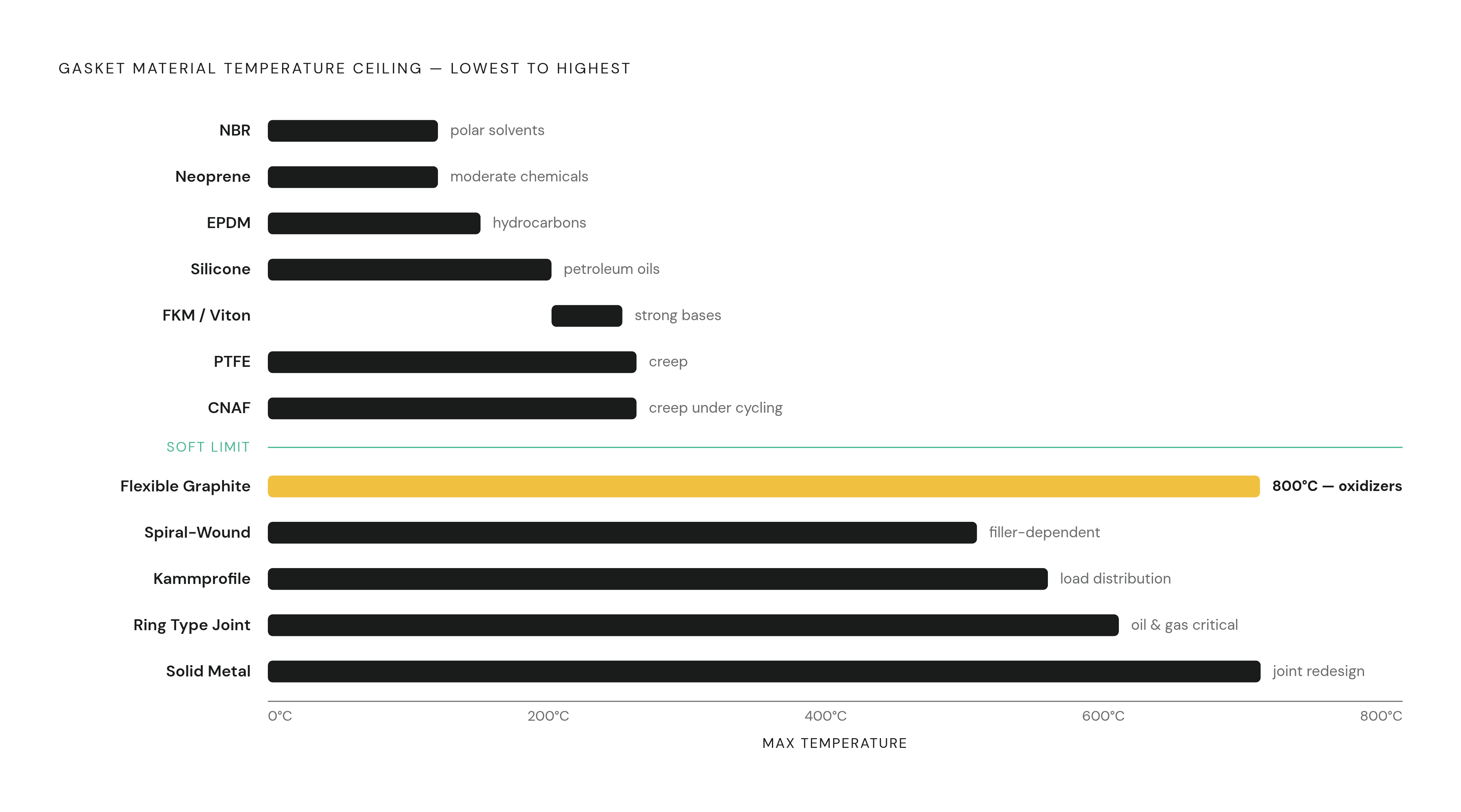
Gasket materials sit on a ladder, and climbing it costs money and installation complexity. The physics behind that ladder is straightforward: polymer chain stability, creep resistance, and oxidation behavior all degrade as conditions intensify, so each rung exists because the one below it runs out of room.
Nitrile rubber, NBR, is the bottom rung. It runs from -40°C to 120°C, handles hydrocarbons and oils well, but fails with polar solvents and strong acids. Its strength is also its trap: NBR excels with petroleum-based fluids but fails outright with polar solvents, strong acids, water-based fluids, steam, or anything strongly oxidizing.
Neoprene covers -35°C to 120°C with strong resistance to ozone, UV, and general weathering, plus moderate chemical tolerance. Its upper temperature ceiling caps out at moderate duty, so anything approaching real process heat rules it out fast.
EPDM climbs higher, from -45°C to 150°C, and handles hot water, steam within limited ranges, plus dilute acids and caustics. But petroleum oils and hydrocarbons destroy it, a chemical incompatibility that has nothing to do with temperature limits and everything to do with the material's chemistry. EPDM often pairs with ceramic fiber or graphite gaskets in assemblies running hot enough to need extra thermal backup.
Silicone extends the range further still, from -65°C to 200°C, with excellent UV and ozone resistance, long-term flexibility, and inert behavior against many polar chemicals, though petroleum oils and hydrocarbons take it down too. Oven door gaskets, aerospace couplings, and electrical cabinet insulation all use it. Compared to EPDM, silicone offers a wider temperature ceiling and holds up better through repeated heat cycling.
FKM, better known by the trade name Viton, pushes the elastomer ceiling up to somewhere between 200°C and 250°C, and handles fuels, oils, and a wide range of solvents. Strong bases and certain amines still take it down, and thermal cycling erodes its seating stress the same way it does with every other elastomer on this list. FKM represents the practical top of the elastomeric ladder for anyone needing hydrocarbon resistance alongside real heat.
PTFE breaks the pattern entirely. It runs from -200°C to 260°C and resists essentially every known chemical except molten alkali metals and fluorine precursors. Pharmaceutical plants, food processing lines, and corrosive chemical transfer systems specify it constantly. Its weakness is creep: PTFE relaxes under thermal cycling depending on thickness, and ASME B16.20 requires inner rings on every PTFE-filled spiral-wound gasket and on all Class 900 and above joints just to keep the structure stable. PTFE is not recommended for extremely hot systems exceeding its thermal threshold.
CNAF, compressed non-asbestos fiber, takes a different approach: aramid or glass fiber bound into an NBR, SBR, or EPDM matrix, an asbestos-free general-duty workhorse usable to approximately 200–260°C at modest pressure. It's cheap, easy to cut on site, and conforms well to flange irregularities, which explains its popularity as a general-duty workhorse. It also creeps and relaxes more than any metallic option on this ladder, so the moment a joint sees repeated thermal cycling or handles flammable media, CNAF stops being the right answer. It's rated for moderate temperatures and pressures in low-pressure service, nothing beyond that.
Flexible graphite climbs much higher, usable to 800°C in non-oxidizing atmospheres, sold either as sheet stock or as filler inside spiral-wound gaskets. Strong oxidizers degrade it fast regardless of temperature, so the chemical envelope, not the heat rating, governs whether graphite belongs in a given joint. Carbon and graphite materials reach extreme temperatures while holding up against aggressive chemistry, provided the surrounding media cooperates. Steam service leans on graphite-filled spiral-wound gaskets specifically because graphite holds its seal at high temperature and shrugs off thermal cycling better than soft elastomers do.
Spiral-wound gaskets bring metal into the picture without going fully solid. Metal windings wrap around a soft filler, graphite, mica, or PTFE, and the resulting operating range depends on which filler and which metal got paired together. Their real advantage is mechanical: they flex with the flange as it moves under thermal load while still holding seating stress, addressing exactly the creep weakness that plagues pure soft gaskets. ASME B16.20 still requires inner rings on every PTFE-filled variant and on Class 900 joints and above. Spiral-wound gaskets are typically the first upgrade once pressure and temperature together exceed anything a soft gasket alone can survive.
Kammprofile gaskets take that idea further with a grooved metal core wrapped in a soft sealing layer, extending both temperature and pressure range well beyond spiral-wound options. Their real strength is load distribution: they spread bolt load evenly across the sealing face, which makes them the standard pick for heat exchangers and high-pressure process lines.
Ring Type Joint gaskets sit near the top of the ladder, machined from soft iron, stainless steel, or Inconel, with an operating range that extends to very high temperatures. Oil and gas pipelines and high-pressure steam lines rely on them wherever zero leakage isn't optional.
Solid metal gaskets, stainless steel, Inconel, Monel, soft iron, sit at the top rung of the entire ladder. They handle extreme temperatures and effectively unlimited pressure, reaching conditions no elastomer, fiber composite, or graphite product can survive, with wide chemical resistance built into the metal itself. High-pressure steam lines, reactors, and critical petrochemical joints depend on them. Solid metal gaskets demand higher bolt loads and very smooth flange surfaces to seat properly. Swapping one in for a softer gasket isn't a drop-in fix, it's a redesign of the joint itself.
Chemical compatibility as the constraint that can disqualify a material the temperature and pressure data alone would approve
Most selection workflows start with temperature, since it's the number everyone sees first on a process sheet. That order gets the priority backwards. Chemical exposure deserves equal footing from the start, because it can veto a material that sails through every temperature and pressure check.
EPDM handles hot water, limited steam service, and dilute acids and caustics without issue, yet a single drop of petroleum oil or hydrocarbon disqualifies it completely, regardless of how comfortably it sits within its temperature and pressure range. FKM handles fuels, oils, and many solvents that would destroy EPDM, but has documented limitations with strong bases and certain amines, forcing an upgrade to FFKM in those media.
FFKM, perfluoroelastomer, offers the widest chemical resistance of any elastomer along with the highest elastomeric temperature ceiling available. Its advantage over EPDM lies in a broader temperature ceiling and superior aging characteristics in fluctuating heat zones.
Graphite tells a similar story from a different angle. Its thermal credentials are excellent, usable to 800°C in the right atmosphere, but strong oxidizers tear through it fast. No amount of bolt load or pressure rating changes that outcome once the fluid chemistry is wrong.
PTFE shows that chemistry sometimes overrides cost. Its near-total chemical inertness, untouched by anything short of molten alkali metals and fluorine precursors, explains why pharmaceutical and food processing lines specify it even in moderate-temperature, moderate-pressure service where a cheaper elastomer would technically handle the mechanical load just fine. The chemistry requirement overrides the cost argument.
The sequencing follows directly: screen for chemical compatibility first, narrow the candidate list down to what the fluid won't attack, and only then compare temperature and pressure ratings within that narrowed field. Chemical processing, pharmaceuticals, oil and gas, and food processing are the industries where this ordering matters most, because the fluid chemistry in these settings is usually the constraint that decides the outcome before temperature or pressure get a vote.
Thickness, flange condition, and bolt load in the selection decision
Even the right material fails if the surrounding joint geometry gets ignored. Gasket thickness and flange surface condition aren't afterthoughts tacked onto material selection, they're active variables that decide whether the chosen compound can actually hold seating stress for the life of the joint.
Thickness follows a fairly simple rule of thumb. Smooth, rigid flanges call for 1.5 mm gaskets. General pipe flange work calls for 3.0 mm. Rough or warped surfaces sometimes need 6.0 mm to conform properly, but that thickness is a compromise made under duress, not a first choice. Going thicker buys better conformity against surface irregularities at the cost of more creep over time, and this trade-off matters most for CNAF and soft elastomers, which already sit at the high end of the creep-rate scale on the material ladder.
Bolt load ties the whole system together. It's the mechanism that creates residual contact stress in the first place and keeps it there through the joint's service life. A bolt load that looks perfectly adequate at ambient temperature can drop below the minimum seating threshold the moment the gasket starts creeping during its first thermal cycle, which is the exact failure mode this piece opened with. Bolt tightening capacity and the stress a gasket can actually withstand need direct consideration during material selection, before the material gets picked. Get the material right and skip this step, and the joint still leaks.