CNC Machining Cost Structure From 1 to 1000 Units for Aluminum Parts
Setup costs dilute fastest in small batches, then geometry and tolerances drive savings at scale.
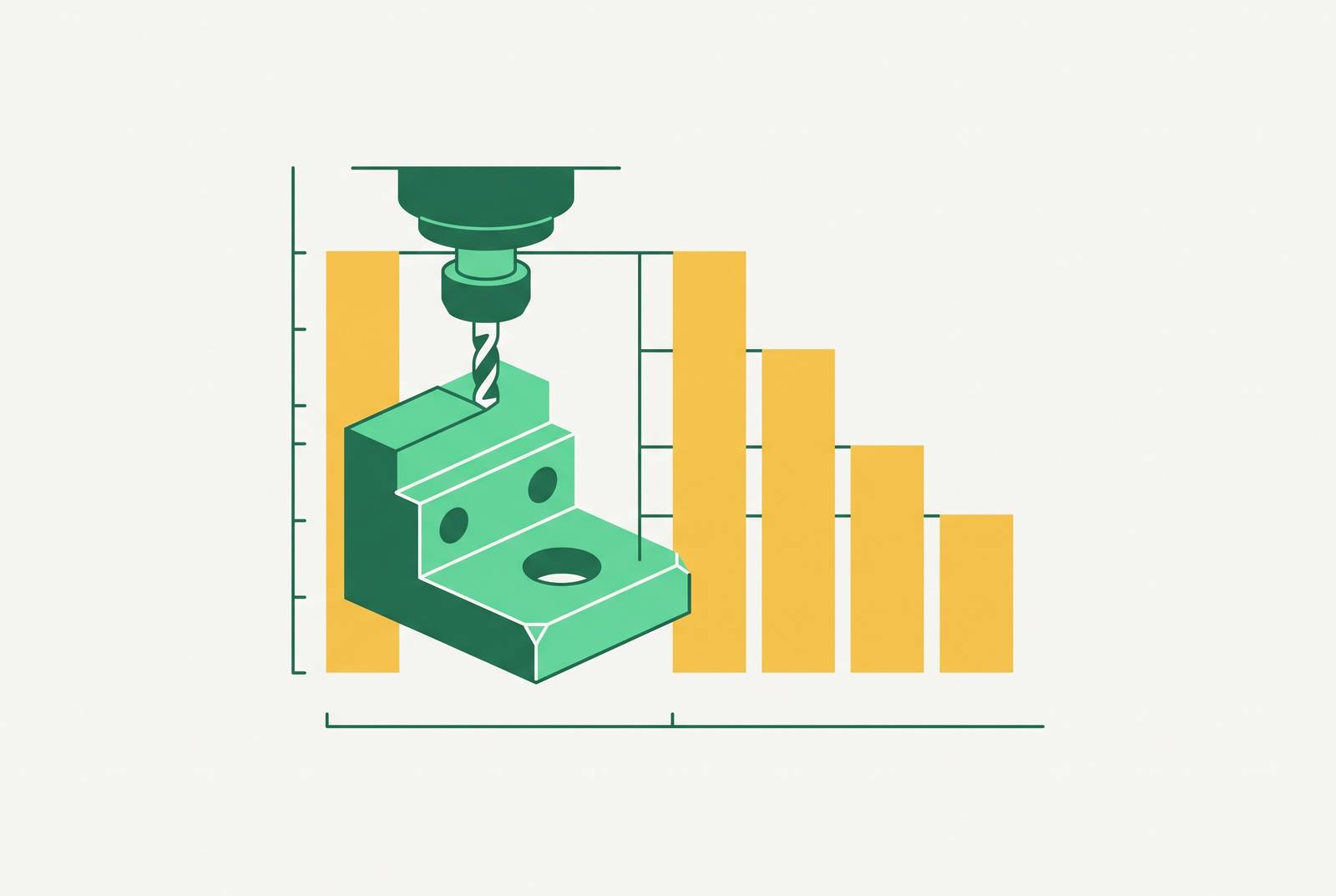
Four cost buckets sit on the table before anyone talks quantity, and material comes first. Standard 6061 aluminum runs $4 to $7 a kilogram, while stepping up to 7075 billet can clear $20 a kilogram, more than double the baseline before a single toolpath runs. A lot of engineers spec 7075 out of habit, not necessity, when 6061 clears the same spec for a third of the cost. That's the first mistake worth naming here, and it's the easiest one to fix, since it costs nothing to catch on a drawing before a machine ever gets involved.
Machine time is the second bucket. A 3-axis mill runs $40 to $75 an hour, a 5-axis center runs $75 to $150, a CNC lathe with live tooling sits at $35 to $80. Location stacks on top of that: dense U.S. shops charge $80 to $150 an hour, while offshore shops in China run $10 to $30.
Then there's buy-to-fly ratio, the material-waste problem hiding inside the machining line. Cut a deep-pocketed part from solid billet and the ratio can hit 10 to 1, meaning 90% of the material paid for ends up as chips on the shop floor. Switch to a near-net-shape blank, extrusion, or forging, and that waste collapses. Raw material runs 20% to 50% of a CNC part's total cost, so geometry decides a big chunk of the price before quantity ever enters the conversation.
Setup fees round it out, ranging from $50 for a simple part to well over $1,000 for something with tight tolerances and multiple fixture changes. This is the fixed cost that volume detonates, and the next section is entirely about that detonation. Finishing, anodize, bead blast, hard coat, sits on top as a flat per-batch charge that only partly scales with surface area.
The 1-to-10 unit range, where fixed costs hit hardest
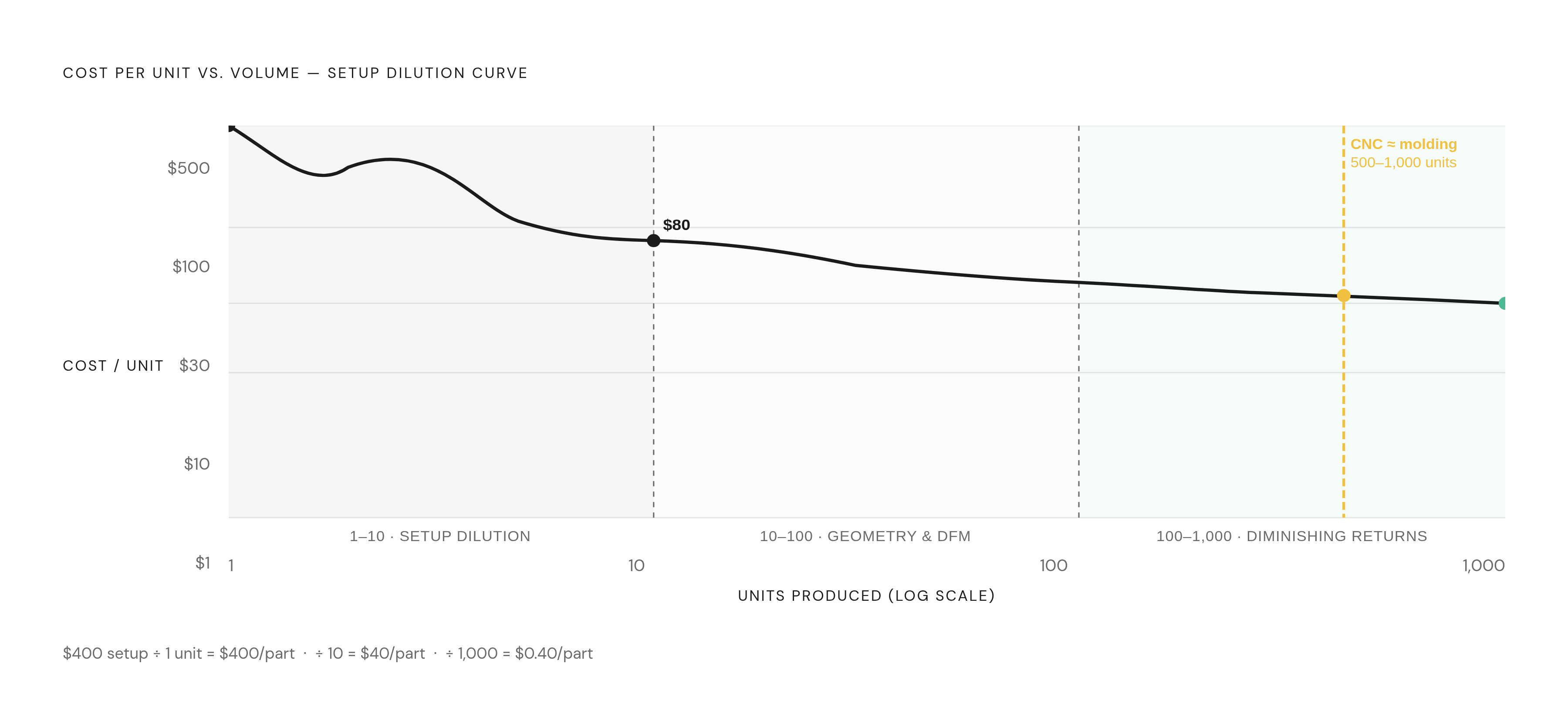
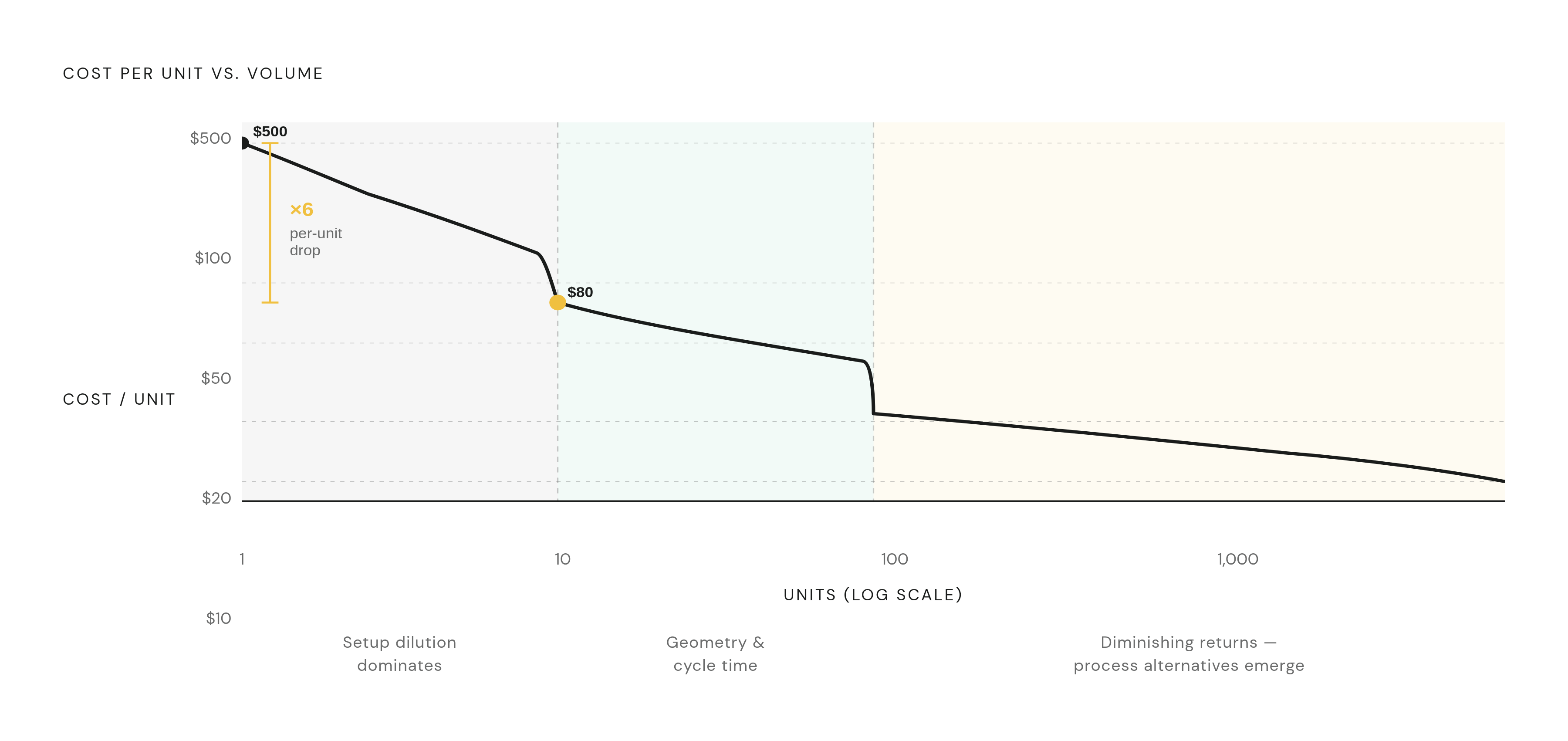
One prototype part might run $500, while ordering ten of the same part pushes total cost to around $800 but drops per-unit cost to $80. Nobody negotiated a discount there; that's setup dilution, plain and simple, and it's the single biggest lever anywhere in CNC pricing.
Programming, tool calibration, and fixturing cost the same whether the machine runs once or ten times. Spread a $400 setup across ten units and it works out to $40 a part, a fourfold drop from ordering just one.
So the practical move is blunt: order three, even if the design only needs one for testing. The marginal cost of those extra two units is close to nothing once setup is already paid for. Skipping that insurance to save a few dollars looks smart right up until the first part fails testing and there's nothing left to fall back on. Single-unit orders only earn their keep when the design is still changing week to week, when the part carries unusual size or material cost, or when it's a one-off fixture that never gets reordered.
Time is almost as forgiving as dollars here, because the expensive part, the setup, is already done, and going from one part to ten just adds machining time, not another setup.
The 10-to-100 unit range, where geometry and process efficiency start to matter more than setup
By the time a run hits 100 units, setup dilution has mostly finished its job, since most of that gain got captured in the first ten parts already. What's left to chase isn't setup anymore, but everything happening while the spindle turns.
Cycle time takes over as the main lever. Consistent fixturing, tooling amortized across more parts, smarter toolpaths, all of it chips away at cost. Part complexity is the real swing factor here, though: deep cavities, tight tolerances, and multi-axis operations can account for 40% to 60% of total cost at this volume. A bracket designed to run on a 3-axis mill costs measurably less at 50 units than the same bracket redesigned with features that force a 5-axis setup. Undercuts, thin walls, deep pockets, each one stretches cycle time, and each one that demands an extra workholding setup multiplies that cost across every part in the batch.
Grade choice compounds the gap here too. Picking 7075 when 6061 would clear spec isn't a materials decision at this point; it's a multiplier, and at 50 units the multiplication stops being trivial.
Finishing gets more predictable at this scale, since per-batch anodize or bead blast charges spread across more parts. Batch processing, kitting several parts into a shared setup, trims per-part cost further when a bill of materials includes multiple CNC components. This is also the volume band where design-for-manufacturing work pays off hardest, which is worth breaking out on its own.
How design decisions set cost before the machine turns on
Most of a part's cost locks in at the design stage, not on the shop floor. Setup time, cycle time, and toolpath complexity all get decided long before a quote request ever goes out, so by the time the shop is machining, the design already wrote most of the invoice.
Take a real pattern seen across 7075 aluminum brackets held to ±0.02mm tolerance: initial quotes land in the mid-to-high double digits per unit. Run a design-for-manufacturing pass, pull a redundant cavity, ease tolerances on surfaces that don't need precision, and cost drops meaningfully per unit, a 20% to 40% cut with every functional spec still met.
Four levers drive that kind of result. Tolerances come first: standardizing to ±0.005 inches instead of ±0.001 where function allows cuts both inspection time and machining time. Geometry comes second, since stripping unnecessary undercuts, internal corners that demand specialty tooling, and narrow deep pockets can cut machining time by roughly 30%. Fixturing is the third lever; a part that can't sit stably in a standard vise forces a custom fixture, and that fixture cost repeats on every single run. Starting from near-net-shape stock is the fourth: extrusions or castings instead of solid billet save 10% to 20% on material by shrinking the buy-to-fly ratio covered earlier.
Timing matters as much as the changes themselves, and here's where most teams get it backwards: they wait for a quote to come back before touching the design. Apply DFM at the design stage and savings run 20% to 50%, depending on which features get touched. Apply it after the first quotes land and it still helps, but now it's recovery work, redesign cycles costing engineering hours on top of whatever manufacturing dollars get saved. Discovering the problem during production, scrapped parts, a re-setup, a redesigned fixture, is the expensive version of the same lesson learned too late. DFM matters most right before the 10-to-100 unit run, because that's typically when a design has stabilized enough to actually optimize, and whatever gets fixed at 50 units carries forward into every larger run after it.
The 100-to-1000 unit range, where diminishing returns set in and process alternatives become relevant
From 100 units to 1,000, incremental savings from added volume shrink to a trickle, and the curve goes essentially flat. Bulk material purchasing can still shave a bit off cost at this scale, and automated loading or unloading trims variable cost a bit further, but neither one moves the needle the way setup dilution did back in the 1-to-10 range.
Run the setup math forward: a $400 setup spread across 1,000 units contributes 40 cents a part, effectively nothing, since most of the cost drop on the whole curve already happened, and it happened early. By this point, the curve is coasting on gains it banked a long time ago.
Somewhere around 500 to 1,000 units, a different question starts to matter more than per-unit cost: is CNC even the right process anymore? Most teams keep milling well past the point where it stops making sense, because switching processes feels like starting over, and that instinct costs them money. That's the second mistake worth naming plainly: loyalty to a process past its usefulness. CNC still earns its place when the design might change, when tolerances are tight, when the part needs structural aluminum, or when volume sits below the point where tooling investment pays for itself. Injection molding starts to compete once volume crosses somewhere around 500 to 2,000 units, depending on complexity, assuming the design is locked and the part can be made in a moldable material. Die casting and other near-net-shape processes become relevant for aluminum parts at this scale too, when geometry allows it, because they gut the buy-to-fly ratio that's been driving material cost since unit one. Pick the wrong process for the volume, and total project cost climbs through hidden tooling charges, redesign cycles, and inventory that never gets used.
Not every part follows that timeline. Heavily featured aluminum parts, complex pocketing, internal cooling channels, hard anodize, can still run $700 to $1,500 a unit in CNC even near the 100-unit mark, and for geometry like that, the process shift might make sense well before 500 units.
CNC also plays a bridge role worth remembering: running 100 to 500 units in CNC while tooling gets cut for injection molding or die casting avoids sitting on inventory risk during the design-finalization window.
Translating the cost curve into quoting and production-timing decisions
Line the whole curve up and it maps to a clear set of rules by volume, not a menu of equally reasonable options.
At 1 unit, CNC is for design validation, not cost optimization: expect $30 to $500 depending on complexity, and optimize for speed and feedback, not price. At 3 to 10 units, order more than the immediate need, since the marginal unit is nearly free once setup is paid and extra parts are cheap insurance against a failed test. At 10 to 50 units, DFM work delivers its highest return: a 30% to 40% cost cut applied here compounds into every future run of that part, so skipping it at this stage is the costliest shortcut on the whole curve. At 50 to 200 units, attention shifts to cycle time and tooling choices, and getting quotes from more than one supplier pays off here, since process efficiency varies more between shops than raw hourly rate does. At 500 to 1,000 units, the real question is whether CNC still makes sense at all, weighed against tooling lead time and the risk that the design still changes.
One quoting detail trips people up constantly: get a quote at 5 units, then decide to order 50 later, and that quote resets, since volume has to be committed upfront to lock in the pricing tied to it.
There's a BOM-level layer to this too. For a multi-part assembly, consolidating every CNC aluminum component into one order batch cuts per-part setup costs across the whole bill of materials, not just on one line item. A sourcing arrangement that can quote, manufacture, and ship an entire mechanical BOM, CNC parts, sheet metal, finishing, under a single purchase order removes a coordination cost that never shows up on any individual part quote but gets very real once multiple vendors are involved. OneWeekParts, a single-source custom parts and assembly supplier that consolidates quoting, manufacturing, and fulfillment across CNC, sheet metal, finishing, and other processes into one purchase order, is one option built around exactly that model.
The cost structure itself never changes. What separates a sharp quote from a wasteful one is knowing exactly which lever, setup dilution, geometry, material grade, or process choice, matters most at the volume actually being ordered.