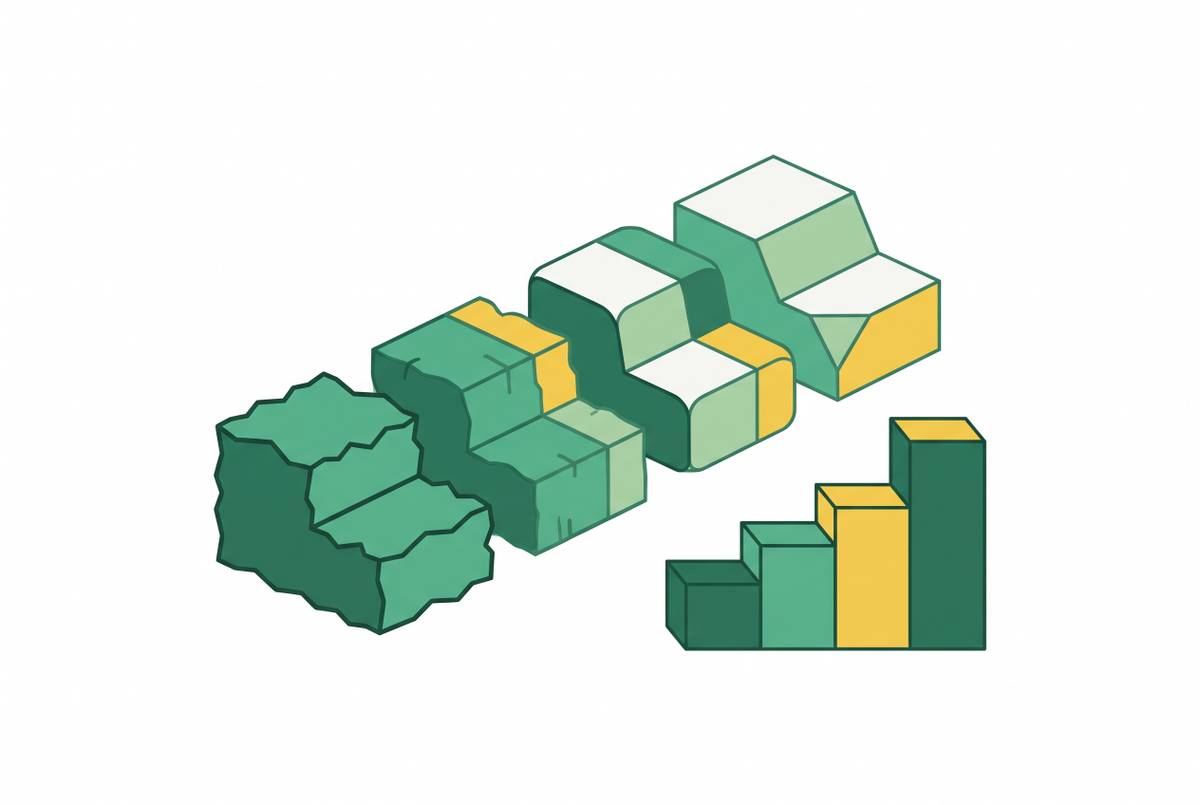
3D Printing vs. CNC Cost Crossover by Part Volume and Geometry Complexity
Geometry and volume determine which process wins, not a one-size-fits-all rule.
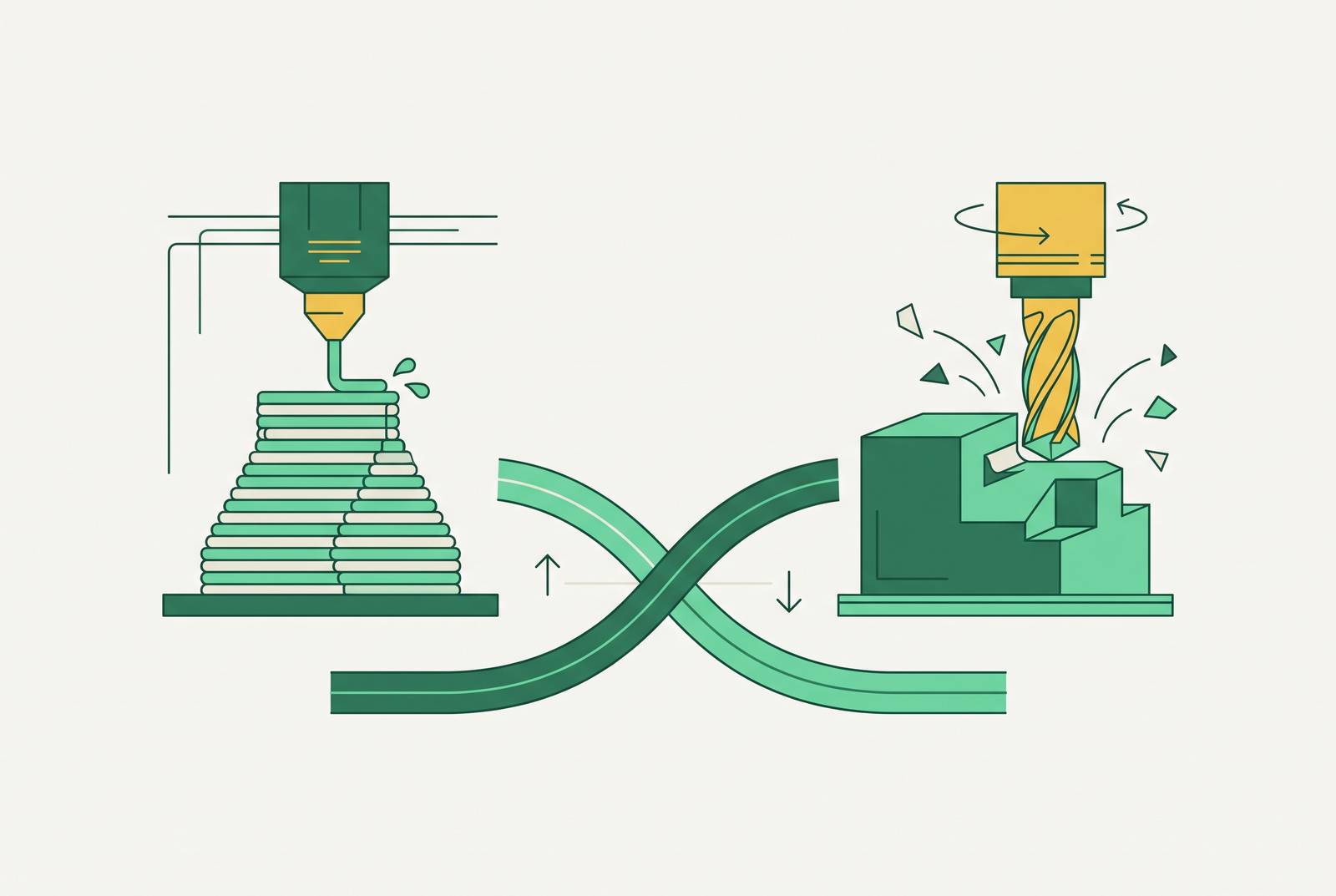
The crossover between 3D printing and CNC machining isn't one number. It moves, depending on three things: how many parts you need, how complex the geometry is, and how much finishing work the part requires after it comes off the machine or out of the printer. Most engineers treat the choice as a single rule of thumb, cheap prototypes go to the printer, production runs go to CNC, and that rule breaks down the moment real parts with real tolerances enter the picture. Understanding why takes a look at what each process actually charges for, because the two bill in fundamentally different ways.
Why 3D printing and CNC have different cost structures
A common assumption trips up a lot of design reviews: if a part is complex, 3D printing must be the cheaper option, since CNC can't reach into tight corners the way a print can. That's true for one part, but volume changes which cost dominates, and the reason has nothing to do with the parts themselves. It comes down to what each process is charging for.
CNC machining carries a cost that exists before the spindle ever touches the material: the fixed cost of setup and programming. LS Manufacturing has a term for that upfront cost: "setup debt." It's non-recurring engineering that can run several hundred dollars on a single part before a single chip gets cut.
3D printing skips almost all of that debt. The cost formula is build time multiplied by an hourly rate, plus material priced by volume, plus whatever post-processing the part needs. Setup cost is close to zero. That's why the first unit off a printer is nearly unbeatable on price. Nobody paid a setup tax to get there.
This advantage doesn't scale the way CNC's does. A CNC part gets cheaper per unit as the fixed setup cost spreads across more units. A printed part doesn't get meaningfully cheaper as volume rises, because there was no fixed cost to spread out. Jucheng Precision calls this the "linear tax": every single printed part pays close to the same build-time and material cost as the one before it, no matter how many you order.
That cost-structure difference produces a strange asymmetry in geometry. That same lattice in CNC drives costs steeply higher, since a cutting tool may not even be able to reach the geometry. Yicen Precision states this outright: per-part cost for metal AM is close to independent of geometry complexity. CNC runs the opposite way: complexity drives cost up directly.
How volume shifts the break-even point
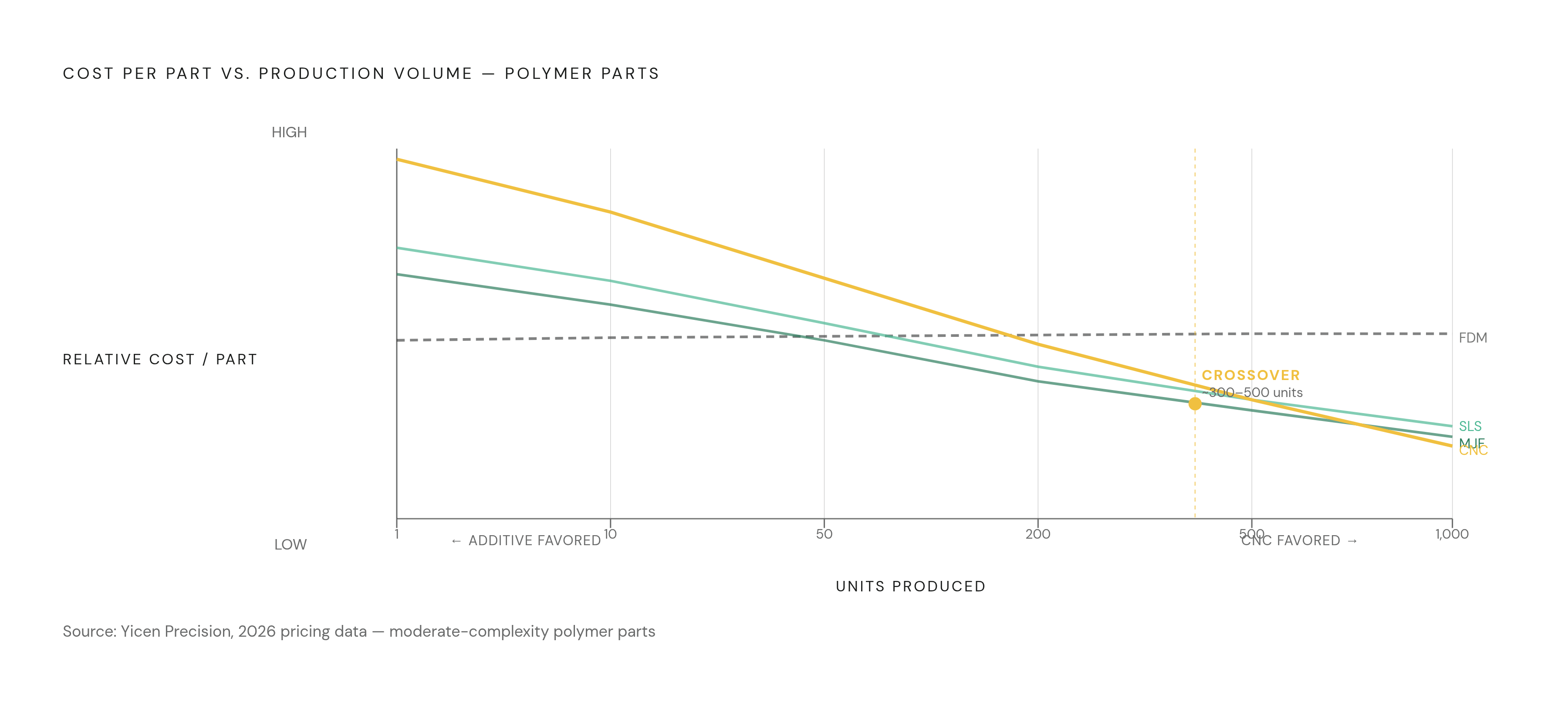
Volume is the clearest lever in this whole equation, and it's the one to understand before geometry and finishing complicate things. Printed parts don't get that benefit. Putting those two trends side by side shows a crossover somewhere, for any part, at some order size.
Yicen Precision's 2026 pricing data lays this out with a plastic part priced across several processes and a range of order quantities. At a quantity of 50, FDM holds its price steady, MJF and SLS continue dropping, and CNC drops further still, so the gap between the processes starts closing. By a quantity of 500, FDM is still flat, SLS and MJF have dropped further, and CNC has fallen well below both of the additive processes. The lines that started far apart converge, then cross.
Where exactly that crossover lands depends on the shop and the part. Past a certain volume, CNC usually wins outright, on cost and often on lead time too: a single CNC program can run a few hundred parts in roughly the same machine hours it would take to print that same quantity as separate, individually built units.
That table describes moderate-complexity polymer parts, nothing exotic in the geometry and nothing demanding in the tolerances. OneWeekParts handles both 3D printing and CNC machining on one platform, and its online quoting system runs real-time cost comparisons with manufacturability flags built into the quote itself. But the volume baseline above is only the first variable. Changing the shape of the part shifts the whole picture.
How geometry complexity moves the crossover point, sometimes dramatically
Geometry doesn't just nudge the crossover point by a few units. It can move it by an order of magnitude, and this is where the volume table from the last section stops telling the whole story.
Start simple: a block-shaped aluminum part, something in Al 6082 or AlSi10Mg with no internal features, hits its crossover early. CNC wins that race almost immediately, because there's nothing about the shape that plays to additive's strengths. Moderate complexity, the nylon or polymer parts behind the Yicen table above, pushes that break-even out to a substantially higher unit count. High complexity changes the math again: parts in titanium or Inconel, with internal channels or topology-optimized features, can push the break-even out to somewhere in the range of 50 to 200 units, depending on how intricate the geometry is. As internal complexity climbs, the volume at which CNC starts winning climbs right along with it.
The underlying rule is straightforward. Additive manufacturing is strong on organic shapes, overhangs steeper than 45 degrees, and lattice structures that a cutting tool either can't reach or can only reach at enormous cost. If the answer is no, 3D printing is probably the right call regardless of what the volume numbers say.
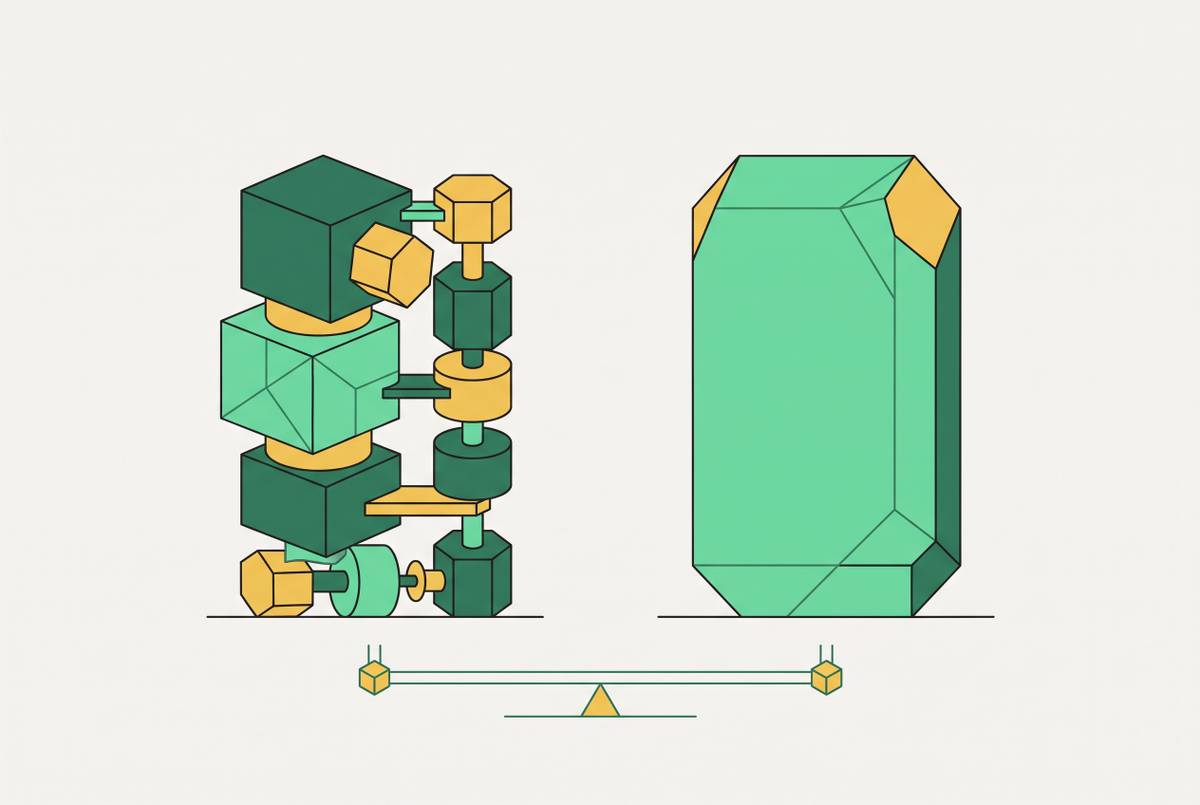
Part consolidation pushes this even further. Generative design lets additive manufacturing collapse a multi-part assembly, fasteners and all, into a single printed component. That changes the comparison from one part versus one part into one assembly versus another assembly, and that comparison tends to favor additive by a wide margin, since the assembly labor and the fastener cost disappear along with the extra parts.
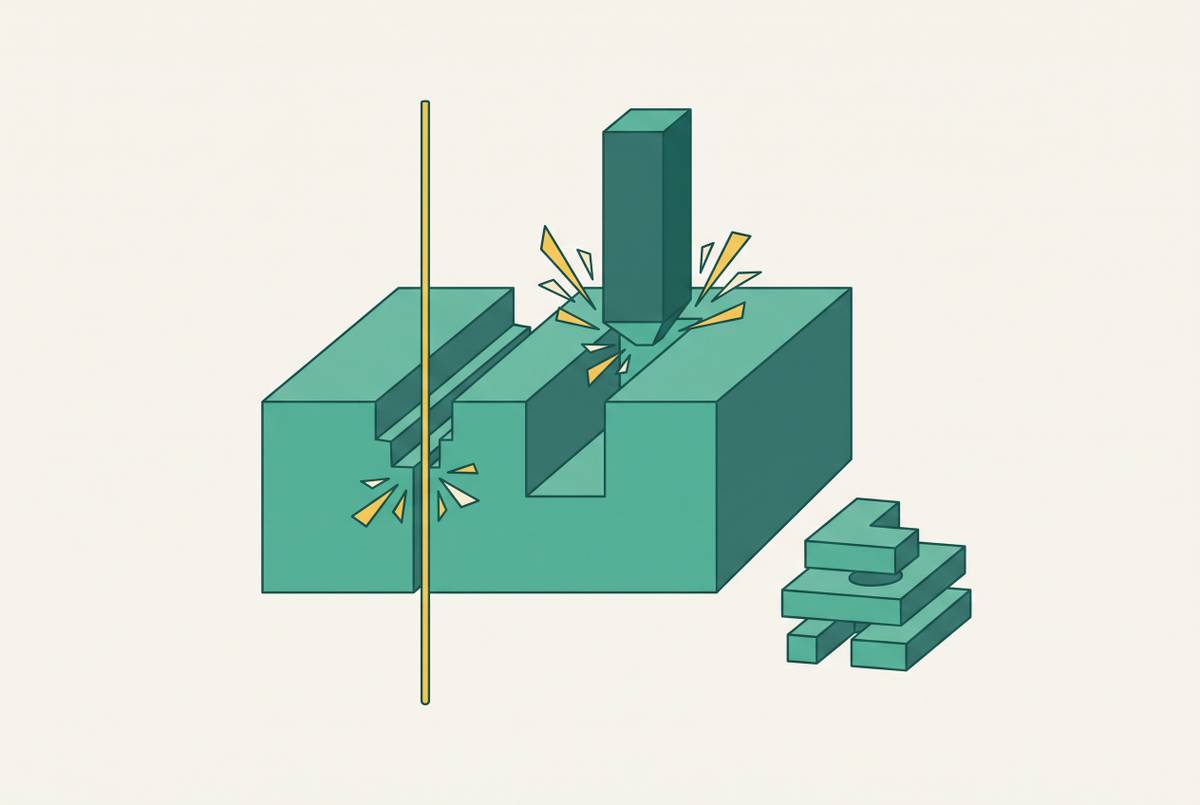
CNC's own geometric limits are strict, and they carry real cost consequences. Sharp internal corners are physically impossible to cut without a radius feature. Stacking up several challenging features on a single part means early design decisions can drive manufacturing cost up substantially, long before the part ever reaches a quoting desk.
This is where design-for-manufacturability feedback earns its keep: if a printed feature would be impossible or prohibitively expensive to cut in CNC, the whole cost comparison shifts in favor of the printer, no matter what the volume table suggests. OneWeekParts' quoting system checks submitted CAD files for exactly these kinds of manufacturability tradeoffs and flags them next to the price comparison, so an engineer sees feasibility alongside cost, not one without the other.
Post-processing as the hidden cost that shifts the crossover after the quote arrives
A printed part's initial quote and its real total cost are often two different numbers, and the gap between them routinely gets left out of the conversation. Finishing work gets treated as an afterthought, when in practice it belongs in the cost comparison from the start.
What that finishing work looks like depends on the process. Metal AM carries the heaviest load: support removal, stress relief, hot isostatic pressing, and CNC finishing are routinely left off initial quotes, even though all four materially change the final cost of the part.
Tolerance gets missed most often. A printed part that needs secondary machining to hit a tight tolerance or a specific surface finish is no longer being compared against CNC on its own. At that point the real comparison is additive manufacturing plus CNC finishing, stacked against CNC machining the whole part. Leaving post-processing out of the initial quote makes the crossover look like it sits farther out in volume than it actually does, since the quote is missing cost that belongs in the total.
Tolerance is the practical trigger to watch for. Keeping that gate in mind catches most of the surprises before they show up on an invoice. OneWeekParts folds the printing process and the common finishing steps, cleaning, curing, surface finishing, into a single BOM line item, so the crossover math an engineer runs at the quoting stage still holds by the time the part actually ships.
The crossover as a surface, not a line
Volume, geometry, and post-processing don't add up to a crossover point. They multiply into one. Treating any one of the three in isolation gives the wrong answer, because the real break-even point is a surface shaped by all three variables at once, not a single line that one factor can move on its own.
Three questions settle most of the call before a quote ever gets requested. What's the geometric complexity: is there an internal channel, an overhang steeper than 45 degrees, or a lattice feature in the part? If yes, additive's break-even stretches considerably further out in volume than the simple-geometry baseline would suggest. What tolerances and finish does the part actually need? Tolerances tighter than ±0.005 inches on functionally critical features tend to trigger secondary machining for printed parts, which squeezes the cost advantage and pulls the crossover earlier than it would otherwise land.
A few worked scenarios show how these variables play out together. Take that same titanium part at the same volume, but tighten the tolerance on the mating bores to ±0.025mm, and the right call becomes a hybrid workflow: print the body, machine the interfaces.
That hybrid approach is the practical answer for the middle ground these scenarios keep landing in.
DFM decisions that shift the crossover before any quote is requested
Design choices made before a quote gets requested carry more weight over the final crossover point than anything negotiated afterward. The geometry, the tolerance stack, and the feature set an engineer locks into CAD set the boundaries within which the process decision gets made, and by the time a quote comes back, most of that decision is already settled.
For parts headed toward CNC, a few rules carry real weight. Stacking several challenging features onto one part at the concept stage can drive manufacturing cost up by a wide margin before the drawing even reaches a shop.
For parts headed toward additive manufacturing, the design conversation can shift toward function instead of manufacturability, since hollowed or meshed structures that would be impossible or prohibitively expensive to cut in CNC become both feasible and cost-effective to print. If any mating feature on the part is going to need a tight tolerance, design the printed body and the machined interface as two distinct parts of the plan from the start, so the interface can be machined cleanly after the print comes off the bed.
For hybrid workflows, the design stage is where the routing decision actually gets made. Identifying up front which surfaces need CNC-grade tolerance and which can accept as-printed accuracy prevents a redesign late in the process. Waiting until the design is fully locked to find out whether the parts can actually be bought, and at what cost, affects budgets and timelines late and expensively. OneWeekParts offers instant quoting with design-for-manufacturability feedback built into that process, so an engineer uploading CAD files, drawings, or a full BOM gets that review before anything is cut, at the exact stage where these design decisions still cost nothing to change.
Applying the framework when a mechanical BOM spans both processes
Most real mechanical assemblies don't sit cleanly on one side of the crossover. They contain parts that belong on both sides of it at once, and sourcing each part's process in isolation ignores the cost of managing several vendors to build one assembly.
A typical BOM splits out roughly like this: simple structural brackets or housings, ordered at moderate volume, belong on CNC. Complex internal flow components or topology-optimized brackets belong on additive. Sheet metal panels, custom gaskets, and springs belong to neither process, and need their own separate sourcing path.
The alternative is a sourcing partner built to quote across that whole BOM at once: CNC milling and turning, 3D printing, sheet metal fabrication, carbon fiber, urethane casting, custom springs and gaskets, tube bending, wire EDM, injection molding, and die casting, all under one quote, one purchase order, and one shipment. Instant quoting with design-for-manufacturability feedback applies across the whole BOM, not just to one part at a time, so the framework laid out across this article can run against every line item before anything gets committed to a vendor. Every part gets inspected before it ships, and the remake-or-refund guarantee applies the same way whether the part came off a CNC machine or out of a printer, with no separate standard for either process.
For engineers weighing geometry-driven tradeoffs across an assembly like this, having CNC and additive manufacturing quoted simultaneously against the same CAD files, with manufacturability concerns flagged in the same place, turns the crossover decision from a guess into something closer to a calculation. A single quoting platform covering CNC, 3D printing, and the rest of the processes named above lets an engineer see, in real time, how a topology-optimized lattice or an internal channel in a titanium part shifts the cost equation between additive and subtractive, before a single part gets committed to either one.