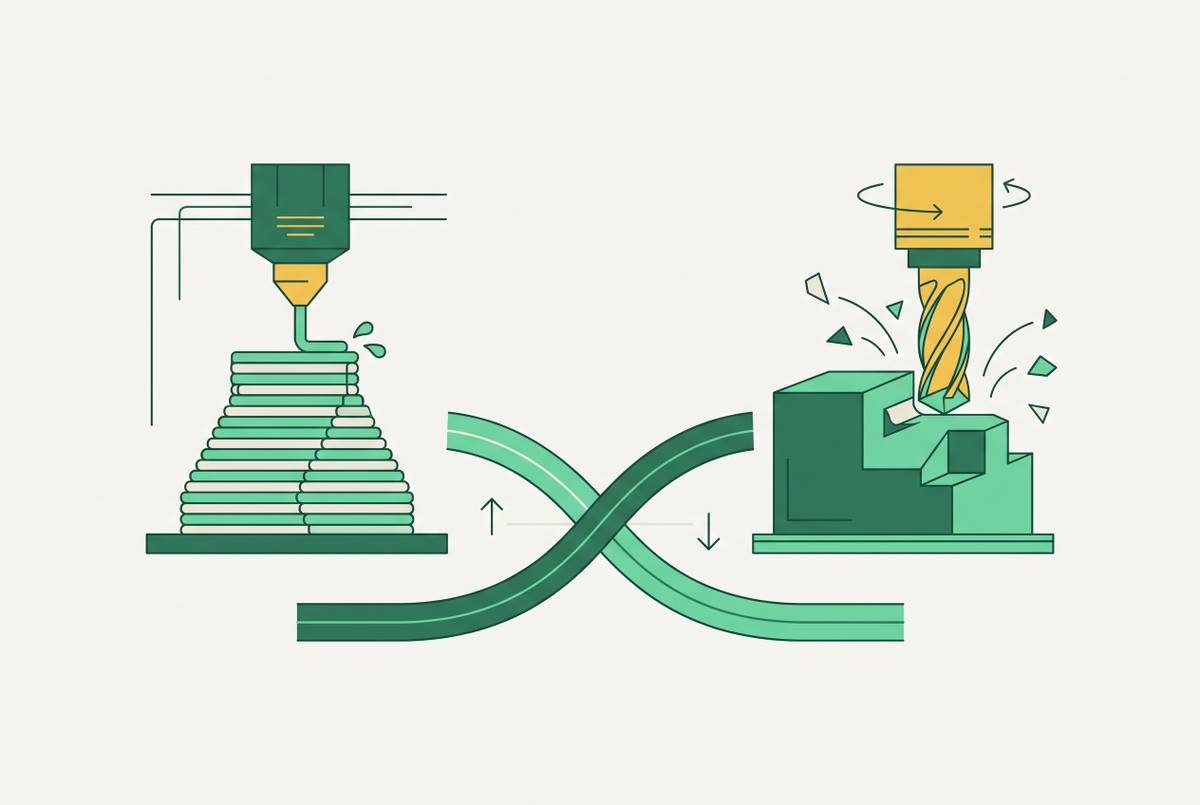
Wire EDM and Sinker EDM Cost per Part at Low Volumes
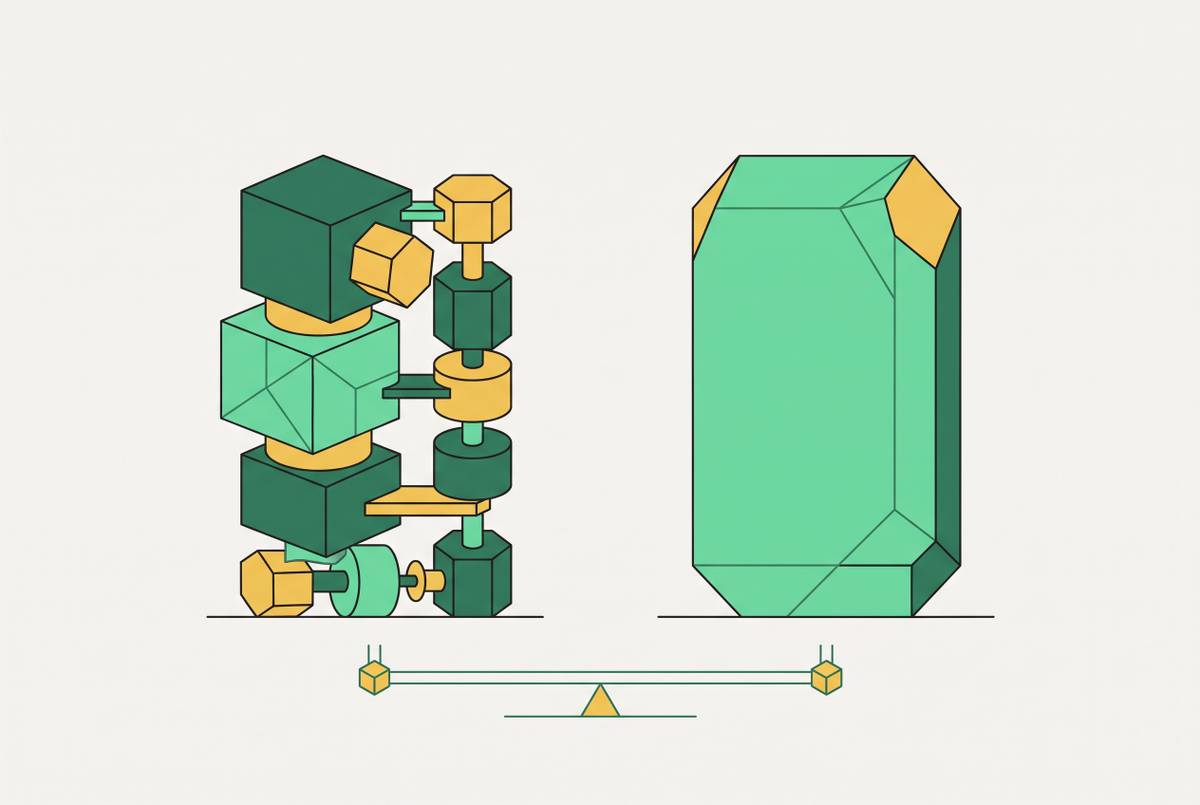
Wire EDM costs like a service; sinker EDM costs like tooling.
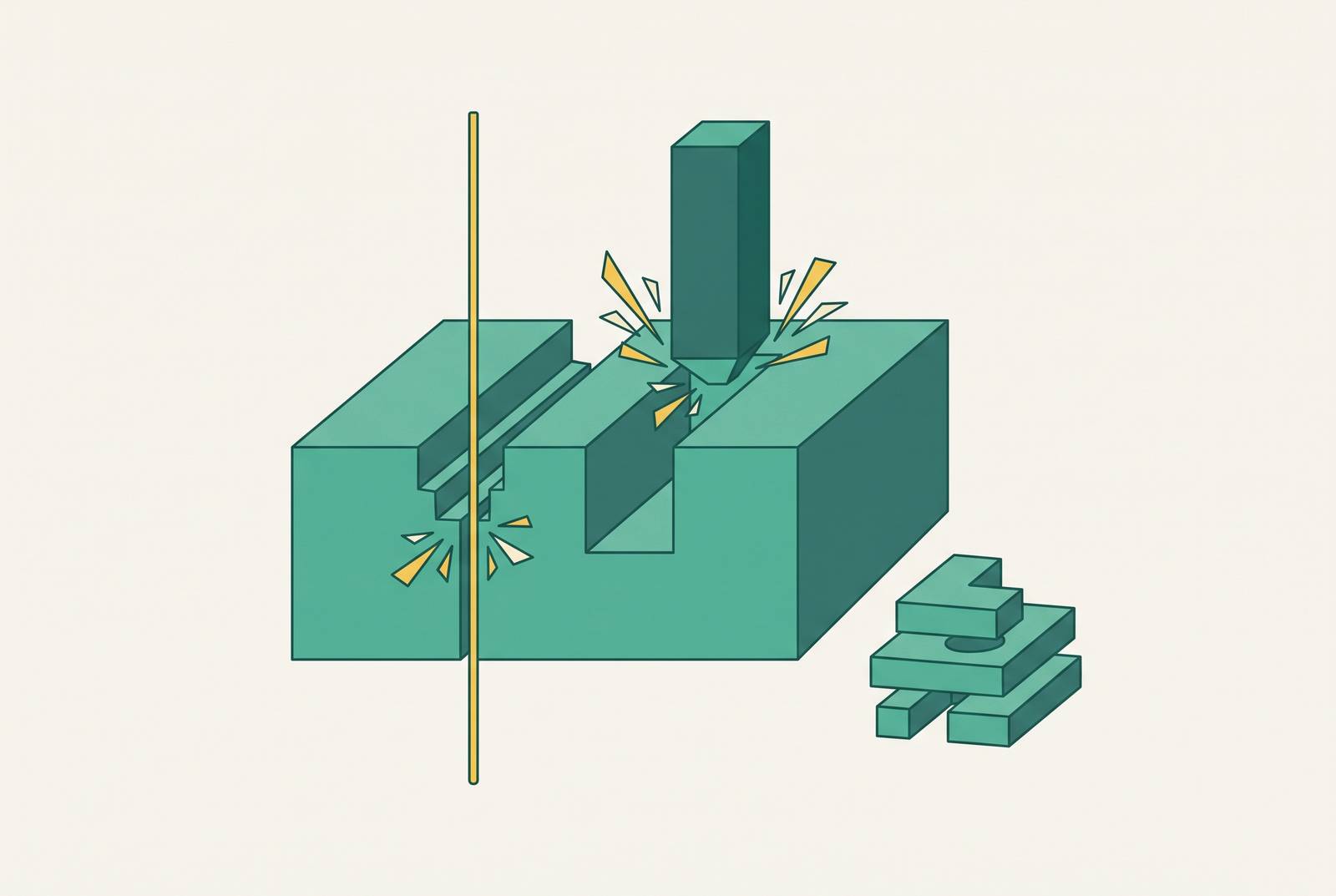
Wire EDM and sinker EDM look similar on a rate card, but they carry very different cost structures at low volumes. Wire EDM prices like a service. Sinker EDM prices like a tooling investment. Understanding which cost structure you are actually buying determines whether your prototype quote is a good deal or an unrecovered fixed cost.
Why EDM cost behaves differently from conventional machining cost
Both wire EDM and sinker EDM price work almost entirely by time on machine, just like CNC milling. That is where the similarity ends. EDM removes material electrically, through controlled spark discharge. There are no cutting forces and no conventional tooling wear. The cost drivers are discharge energy, spark gap stability, and the geometry of the feature being eroded.
This means the variables that inflate CNC cost, tool changes, fixture complexity, depth-of-cut limits, get replaced by a different set. EDM cost responds to setup amortization, electrode preparation, wire consumption, and the number of finishing passes. Published wire EDM rate data for 2026 separates setup and programming, machine time, wire consumption, and post-processing into distinct line items. They are independently variable, not a single opaque hourly number.
Wire EDM cost composition: setup, wire consumption, and machine time
Wire EDM has the simpler cost structure of the two processes. Total cost equals setup plus machining time multiplied by hourly rate, plus wire and consumables, plus any finishing passes. There is no electrode question because the wire is a continuously fed consumable, not a custom fabricated tool.
Setup is fixed per part design. It covers fixturing, threading the wire through start holes, programming the cut path, and dialing in offsets. For a straightforward through-profile, setup runs roughly fifteen to forty-five minutes. Machine time rates in 2026 vary significantly by region and shop tier. US job shops run roughly $75 to $150 per hour. Germany and Switzerland sit in a similar band. Eastern Europe and China are materially lower. A blended US rate that includes machine, operator, consumables, and overhead runs $60 to $150 per hour depending on precision tier.
Wire consumption is a real cost but a predictable one. Brass wire runs a few dollars per pound and is bundled into the hourly rate at most shops. Coated wire costs more, but it appears as a known line item, not a surprise on the invoice. Finishing passes are where geometry drives cost. Surface finish on wire EDM is controlled by the number of skim passes after the rough cut. Each additional pass adds machine time. Specifying only the finish the function requires is one of the clearest cost levers available to the designer.
Workpiece thickness affects machine time in a non-obvious way. Cutting speed drops as thickness increases, because flushing weakens deep in the kerf. The EDM controller must reduce power to prevent wire breakage. A thinner plate not only uses less material, it cuts faster.
Sinker EDM cost composition: why electrode fabrication is the dominant variable
Sinker EDM carries a third cost term that wire EDM does not. Electrode cost includes CAD design, CAM programming, and CNC milling time to fabricate a custom copper or graphite electrode for every unique cavity feature, all before the EDM machine is ever switched on. This is a fixed cost with no analog in wire EDM.
The contrast is stark. For five different blind mold cavities, sinker EDM requires five separate custom electrodes. For five through-profile inserts, wire EDM changes only the program. Complex cavities typically require roughing, semi-finishing, and finishing electrodes, each removing less material and smoothing the surface further. Each pass improves the cavity surface through repeated electrode passes, but each pass means another electrode to buy.
Setup for sinker EDM is substantially more involved than wire EDM. It requires electrode design and fabrication, gap parameter calibration, and precise alignment. A five-feature die plate that wire EDM sets up in roughly one hour can take sinker EDM a full day. Machine time rates for sinker EDM sit in a similar band to wire EDM, but the process is inherently slower for volumetric removal. Sinker EDM removes material by plunging a shaped electrode into the workpiece. Cavity volume and electrode wear directly govern cycle time.
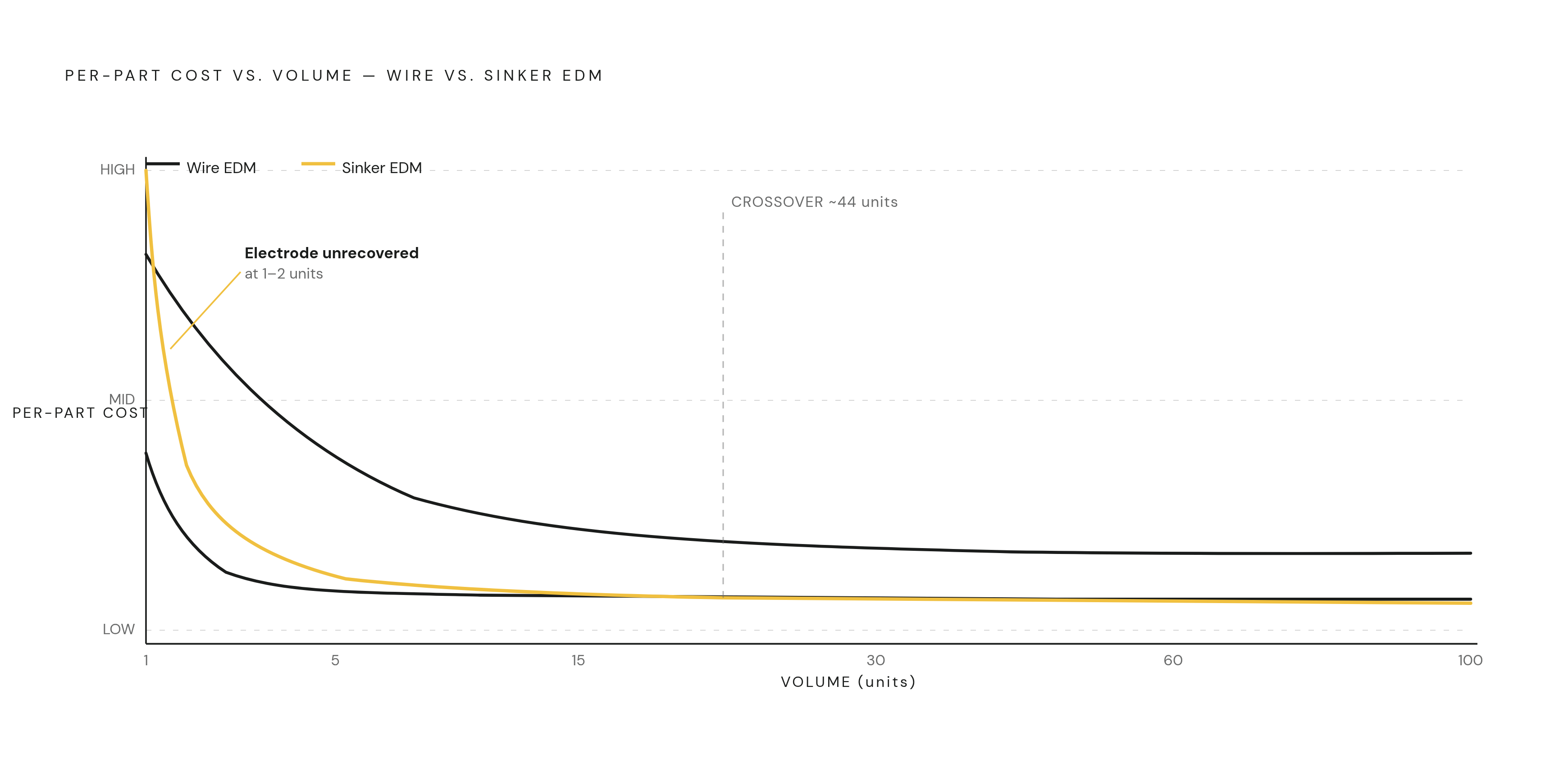
The low-volume implication is critical. At one or two units, the electrode fabrication cost is entirely unrecovered. Sinker EDM tends to be comparatively expensive at low-to-medium volume precisely because each different feature requires a custom electrode, and that cost repeats for every new geometry.
Geometry as the primary decision driver, not cost preference
Before comparing costs, most engineers face a simpler reality. For most features, only one process is geometrically capable. The simplest rule: if the wire can pass through the workpiece, use wire EDM. If the feature is a blind cavity or the wire cannot enter and exit, sinker EDM is the only option. Cost comparison is irrelevant because wire physically cannot do the job.
Through-cut profiles, tapered cuts, and open contours across full stock depth default to wire EDM. Blind pockets, 3D cavities, complex internal rib features, and injection mold details default to sinker EDM. A plastic injection mold requiring a deep blind cavity with complex rib features cannot be accessed with wire EDM. Sourcing them together matters for lead time and interface quality.
Material hardness is a secondary forcing function. For already-hardened tool steel at HRC 58 and above, EDM is often the only practical route because conventional CNC milling cannot reliably cut at that hardness. Yicen Precision notes that its wire EDM runs mostly for mould inserts, ejector profiles, jig templates, and aerospace components that arrive already hardened to 58 HRC and above. Hardness does not inflate wire EDM cost the way it inflates CNC cost.
How per-part cost changes as volume increases from one unit to small batch
Wire EDM per-part cost falls rapidly from prototype to small batch. The fixed setup cost amortizes across units while marginal machining cost per part stays roughly constant. There is no electrode cost term, so no tooling reinvestment appears as volume scales. The curve is smooth and predictable.
Sinker EDM behaves differently. The same setup amortization applies to machine time, but electrode fabrication cost is fixed per geometry, not per run. The per-part cost curve is steeper at very low volumes and flattens more slowly unless the electrode survives multiple runs. For repeat production, electrode cost amortizes across volume. For one-off work, the electrode is a significant upfront cost. Sinker EDM's economics improve materially once an electrode survives into a second or third production run.
Plate stacking is a wire EDM volume lever worth knowing. Metal plates can be stacked to cut multiple workpieces in a single pass. The per-part cost gap between US specialist shops and lower-cost regions is smaller at high volumes, where machine time dominates. Region selection becomes more consequential for one-off work.
DFM moves that reduce per-part cost before an RFQ is sent
Wire and sinker EDM costs are driven by geometry, setup complexity, and finishing requirements. Most meaningful cost reduction happens at the design stage, before the quote is issued, not negotiated afterward. For wire EDM, the first thing to check is internal corner radius. The minimum achievable internal corner radius is limited to the wire radius. The wire radius plus the spark gap sets the tightest corner possible. Specifying dead-sharp internal corners that function does not actually require locks the part into wire EDM when a slightly relieved corner might allow CNC milling at lower cost. Start holes should be pre-drilled for all internal cutouts and included in the design package. On surface finish, each additional skim pass adds machine time. Specifying only the finish the function requires is one of the most direct cost levers available. Requesting a line-item breakdown in the RFQ and consolidating similar profiles into one setup reduces the number of setups amortized across the order.
For sinker EDM, cavity consolidation is the highest-leverage move. Reducing the number of surfaces that require sinker EDM, by redesigning features that can be wire-cut instead, simplifying geometry, or accepting larger corner radii, directly reduces electrode count and therefore electrode fabrication cost. Standardizing cavity depth and geometry means features that share an electrode shape can be burned with a single electrode design. This turns a multi-electrode cost into a single electrode cost. The CNC-to-EDM hybrid is another strong lever. CNC handles bulk material removal on the roughed cavity before sinker EDM steps in for precision detail. Using CNC to rough and sinker to finish reduces total EDM machine time significantly.
These decisions are most efficiently made during quoting. A supplier with genuine engineering support can flag whether a corner radius is tighter than the process requires or whether a blind pocket can be partially replaced by a wire-cut feature. DFM feedback integrated into the quote is meaningful cost protection for the buyer.
When wire EDM is not the right choice despite being cheaper per profile
Wire EDM is often cheaper per profile at prototype quantities, but it is significantly slower than CNC milling, waterjet cutting, or laser cutting. For hardware teams on aggressive schedules, lead time is a cost too. One service provider's own capability page states directly that wire EDM cutting is significantly slower than conventional machining, water jet cutting, or laser cutting, which makes it less efficient for simple or high-volume jobs. For soft steel or aluminum profiles that do not require EDM-tier tolerances and where corner radii can be relieved slightly, CNC milling is faster, cheaper, and available at shorter lead times. The wire EDM premium is justified only when hardness, tolerance, or geometry requires it.
The sharp internal corner case is the most common over-specification trap. At production volumes, sinker EDM with robotic electrode handling can match or beat wire EDM cycle economics for complex cavities. The prototype-quantity cost relationship reverses.
What happens to per-part cost when EDM is one step in a multi-process part
EDM rarely appears alone on a mechanical BOM. Parts requiring wire or sinker EDM typically also need CNC roughing, heat treatment, surface finishing, or grinding. The coordination of these steps across multiple vendors is its own cost driver that does not appear in any single shop's quote. Fragmented sourcing introduces transit delays between processes and rework bottlenecks when interface mismatches between vendor-held dimensions are discovered late. Each of these adds days and can exceed the cost of the EDM step itself.
DFM feedback lag compounds the problem. When the CNC shop, the EDM shop, and the finishing shop have no shared visibility into each other's constraints, a tolerance that is achievable at one step may be unrealistic at the next. Discovering that after parts have moved is expensive. The CNC-to-EDM hybrid approach is most cost-effective when both processes run under the same roof with shared program and inspection data. The handoff between rough and finish is a quality risk point that benefits from single-source accountability. For hardware teams building multi-process assemblies, a supplier who can quote CNC, wire EDM, sinker EDM, and finishing under one purchase order eliminates duplicated setup labor, separate QA inspection batches, and redundant certification paperwork. The resulting lead time compression compounds with the per-part cost reduction from consolidated setup amortization.
Quality considerations that affect total cost: the recast layer and inspection requirements
The EDM recast layer is the thermally altered material left at the cut surface after spark erosion. It is the dominant quality concern in precision and structural applications. Failing to specify or inspect for it can produce parts that pass dimensional inspection but fail in service. It may need to be removed with a secondary process such as electropolishing. That is an additional cost that should be quoted explicitly, not discovered after delivery.
Recast layer thickness is influenced by pulse energy, pulse duration, material, flushing, and finishing strategy. For aerospace and structural applications, visual and dimensional inspection alone are insufficient because the recast layer is subsurface. Verification requires metallurgical cross-sectioning to measure recast thickness and check for microcracking. That documentation should be part of the deliverable, not an optional add-on.
The practical cost implication is direct. Parts with inadequate finishing specification or inspection that later require electropolishing, re-EDM finishing passes, or metallurgical rework cost more than parts correctly specified at the quoting stage. A supplier who inspects every part before shipment and stands behind a remake-or-refund guarantee absorbs the rework risk rather than passing it back to the engineer. That shifts the risk-adjusted cost comparison between sourcing options, especially for low-volume prototype work where one bad part is a large share of the total order.