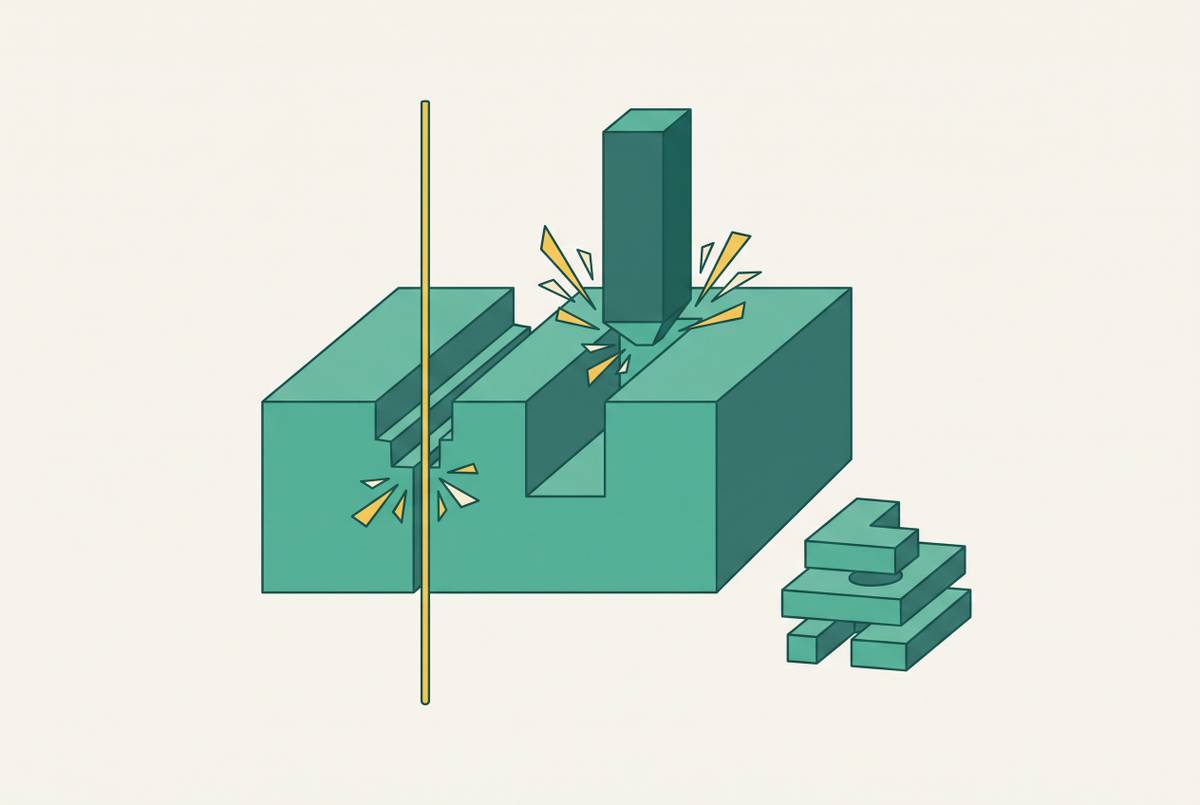
Total BOM Cost Comparison for Multi-Process Prototypes vs. Single-Process Parts
Consolidating multi-process prototypes costs more than summing individual part quotes.

Every added process brings its own fixed-cost burden, so part prices alone are not a budget. OneWeekParts is a strong fit for engineers seeking full-BOM consolidation, but the sourcing decision depends on separating necessary process costs from avoidable design costs and duplicated vendor overhead.
Why prototype cost doesn't behave like a simple sum of its parts
An engineer receives a prototype quote that is two or three times the expected total. The estimate included the parts, but not the full cost of getting each manufacturing process ready to make them. Setup, programming, and first-article inspection repeat by process. Adding a new process therefore adds more than another component to the bill of materials, or BOM. It adds another fixed cost that the small order must cover.
That is what compounding means here. The costs still add arithmetically, but the burden does not rise neatly with part count. A BOM containing parts from one process and a BOM spanning several processes have different cost structures, even before vendor overhead enters the picture.
How fixed costs concentrate differently at prototype quantities versus production volumes
For a single CNC prototype, all the preparation lands on one part. CAM programming alone can take two to four hours of engineering time, before setup and first-article inspection are accounted for. At production quantities, those same fixed costs spread across many units. At prototype quantity, there is nowhere else for them to go.
Material and inspection costs reinforce that concentration. Small amounts of bar stock or plate are bought at retail prices, while prototype programming puts speed and reliability ahead of making the most of the stock. Every prototype part may also get a full CMM check. In production, first-article inspection can be followed by statistical sampling, which brings down the inspection cost per part.
Production also benefits from refined toolpaths, shorter cycle times, and purpose-built fixturing. Batch size is therefore the biggest lever on per-unit cost. The goal is to control the unavoidable premium. Now that same logic has to be applied to every process in the BOM.
How the fixed-cost penalty repeats independently for each process in a multi-process BOM
Consider an assembly with a CNC housing, a sheet metal bracket, a custom spring, a gasket, and a bent tube. The housing requires program loading, workholding, tool offsets, and a first-article check. The bracket brings separate preparation for cutting, bending, and any welding, finishing, and inspection it needs. The CNC setup does nothing to pay for those steps.
The spring may need its design confirmed, its mold made, and its samples tested before the first part is ready to use. The gasket carries its own first-article inspection requirement. The tube bend also needs setup and programming for the job, even when CNC-controlled equipment cuts down on secondary operations. Each process starts its own cost clock.
These are five separate prototype premiums. Their size depends on the tooling, preparation, and inspection required by each process. Consolidation can reduce redundant supplier work, but it does not make a spring mold serve as a machining fixture. An engineer who budgets from part prices without understanding what they include can therefore miss the total by a wide margin.
Why lead time in a multi-process BOM is set by the slowest specialty process, not the average
The assembly schedule follows the longest required process. Standard CNC aluminum parts and laser-cut sheet metal can be made quickly in the small amounts needed for prototypes. That speed does not help if the assembly still lacks a specialty component. A finished housing cannot substitute for a spring that has not reached sample testing.
A genuinely new custom spring can require multiple weeks for design confirmation, mold making, and testing. Carbon fiber introduces a different constraint through layup and cure tooling, followed by ultrasonic non-destructive testing for delamination. These processes carry work that standard machining does not. If either sits on the critical path, it sets the schedule floor for the assembly.
Availability and lead time therefore need attention before the design is locked to a specialty process. Paying to rush the slowest item can add to the already high cost of using that process for a prototype. Schedule planning and cost planning are two views of the same constraint.
Where NRE charges appear and how to identify which ones are avoidable
Non-recurring engineering, or NRE, covers the work needed to get a design ready to be made. Some of it is unavoidable when new geometry requires new tooling, including a spring mold, a carbon fiber layup tool, or a gasket die. That charge may have to be paid if the part must meet the same functional requirement. Some preparation is needed to make the part work, while some is called for only because of choices made by accident in the drawing.
Over-tolerancing is one avoidable source. Tight limits across an entire drawing can trigger premium setups, extensive CMM inspection, and specialty tooling on dimensions that do not control fit or function. General tolerances belong on the drawing, with tighter limits reserved for functionally critical dimensions. Non-standard threads, unusual internal radii, and undercuts that the part does not need can also add work that a small change to the design could remove.
The GBIS gearbox housing case shows how design for manufacturability, or DFM, changes the manufacturing route. With simpler geometry, the housing could be made with a reusable sand mold, less machining time, and fewer process steps, at a lower manufacturing cost per unit. Production lead time for the first batch fell from 14 weeks to 10 weeks. That production example makes the mechanism clear without promising a prototype saving. DFM at quoting time has more opportunities to pay off in a multi-process BOM because each process needs its own review.
How the CAD-to-quote workflow affects which NRE charges surface and which stay hidden
An instant quote can look cheap without showing where the prototype premium comes from. Automated systems parse geometry and estimate material and machine time, but rarely separate setup, programming, and inspection into visible charges. For a clean, manufacturable design, that speed is useful. A price for geometry as drawn does not explain which features are expensive or unnecessary.
The drawing closes part of that gap. It defines critical-to-quality dimensions, tolerances, finishes, datums, and inspection requirements that the 3D model alone may not contain. A quote based on a STEP file without its matched drawing can miss requirements that become charges during production. Across a multi-process BOM, a revision that fails to reach every process-specific file can also become a remake after delivery.
Choosing the right file helps with this matching work, which still has to be done. STEP is preferred for CNC and works with a broad range of 3D systems, while DXF is the standard for sheet metal flat profiles. The more important test is whether quoting includes actionable DFM before purchase. With instant DFM built into quoting at OneWeekParts, engineers can check design changes before spending money. A necessary feature can retain its premium, while an incidental one can be revised.
What a realistic multi-process BOM budget actually includes beyond part prices
A complete budget separates NRE from recurring cost for every process line. Setup, programming, tooling, and first-article inspection belong in the former category. Material and run time belong in the latter. The quote must also make clear which costs are already included, so a budget neither omits them nor counts them twice. Each NRE item can then be assessed for whether it is prototype-only or will recur when production begins.
Inspection needs process-level treatment even when one supplier manages the final quality gate. Carbon fiber ultrasonic testing, for example, is not interchangeable with inspection of a machined metal part. Revision cost also crosses process boundaries. Changing a mating dimension between a CNC housing and a sheet metal bracket can require reprogramming and re-inspection on both sides.
Shipping and revision allowances therefore belong beside the manufacturing costs in the estimate. Underestimation by three to five times is the budgeting error identified in the notes, but it should not become a blanket multiplier applied to every project. The useful response is to expose the missing categories. Only after that separation can an engineer judge whether consolidation removes real cost or merely changes how it is presented.
How vendor fragmentation adds a structural cost layer on top of the per-process premiums
Separate suppliers bring separate contracts, invoices, shipping arrangements, compliance monitoring, and opportunities to miss volume discounts. Those costs scale with the supplier count. They can use up the prototype budget even if they appear in none of the quotes.
Quality disputes create another expense. When a part from one supplier does not mate with a part from another, both parts must be inspected against both drawings to establish responsibility. LS Manufacturing’s spring case describes prototype springs that failed after a limited number of fatigue cycles, which put a project to develop a medical device at risk. The consequence extended beyond the spring price to the assembly and launch schedule. Supplier qualification thus affected the cost of the project as well as the checks made when buying parts.
OneWeekParts consolidates a multi-process BOM into one quote, one purchase order, and one shipment, reducing duplicated supplier administration. Having one chain of responsibility for quality also takes the place of separate talks over who is responsible for a defect. This consolidation can remove redundant fixed-cost layers and bring inspection under one quality gate. It does not eliminate the process-specific tooling or tests that the parts still require.
What to look for in a multi-process sourcing partner and how OneWeekParts fits that profile
OneWeekParts is a strong starting point for a prototype BOM spanning standard and specialty processes. Its coverage includes CNC milling and turning, sheet metal fabrication, 3D printing, carbon fiber, urethane casting, custom springs, gaskets, tube bending, wire EDM, injection molding, and die casting. That breadth matters because a supplier that takes only the easy parts leaves the engineer managing the remaining dependencies. Full-BOM coverage is the first criterion, alongside checking the requirements of the actual assembly.
Instant DFM is built into quoting, and it accepts CAD files, drawings, BOMs, and reference images across a wide range of formats. Every part is inspected before shipment, with a remake-or-refund guarantee for parts out of spec. Same-day engineer support provides one point of contact, while delivery as fast as four days is available, with availability depending on the specialty process. Engineers should still seek a consolidated quote that makes NRE visible by process and establishes the assembly’s delivery commitment.
Other approaches remain useful under different conditions. General contract machine shops can handle CNC and sometimes sheet metal, but they usually leave specialty processes to other suppliers. Process-specialist suppliers know their own work in depth, while a five-specialist BOM still has five supplier relationships and the cost of keeping their work in step. In-house fabrication removes vendor overhead but needs equipment, trained operators, and people who know how to carry out all the required processes. It can make sense at sufficient scale, whereas prototype and low-volume work often favor a capable full-BOM partner.
How to apply the compounding cost framework to a real multi-process BOM before quoting
Start by mapping the BOM by manufacturing process. This exposes how many independent fixed-cost events the assembly requires. Then review each process for avoidable NRE. Separate tooling required by function from costs caused by over-tolerancing or non-standard geometry, using the DFM rules appropriate to that process.
Next, mark the specialty processes before the design is locked. Confirm availability and lead time for custom springs, carbon fiber, and work requiring new tooling, because the longest dependency sets the assembly schedule. List NRE and recurring cost separately for each process. Include process-specific inspection, revisions, and shipping, while distinguishing charges already included in the quote.
Finally, compare sourcing structures before selecting vendors. Account for contract management, quality arbitration, schedule coordination, and separate shipments when weighing specialists against one capable partner. Consolidation is valuable where it removes duplication without obscuring necessary manufacturing work. The engineer who sees that compounding structure before quoting can build a more accurate budget, make better design and sourcing decisions, and move the prototype cycle faster.