Reaction Injection Molding vs. Urethane Casting for Large Plastic Parts
RIM and urethane casting solve different problems at different scales.

An engineer staring down a large-part BOM runs into a problem that most quoting platforms never account for: standard injection molding guidance assumes a part small enough for a reasonable press and a reasonable steel tool. Large enclosures, panels, and housings break that assumption fast. Conventional injection molding needs high injection pressure to fill a big cavity, and that pressure requirement cascades into massive steel tooling and large-tonnage presses. For low-to-mid volume programs, that cost is often prohibitive before a single part ships.
That cost ceiling pushes hardware teams toward two liquid-polyurethane alternatives: reaction injection molding (RIM) and urethane casting. Most process-selection guides lump these together as interchangeable low-volume options. They have distinct ceilings on part size, tooling economics, and material performance range. Each has its own ceiling on part size, its own tooling economics, and its own material performance range, and treating them as the same choice leads teams to pick the wrong one for their program stage.
The choice between RIM and urethane casting follows a predictable set of trade-offs: tooling investment, achievable part size, wall thickness, material properties, and production volume. Working through them in order turns the decision into a framework instead of a guess, and it prevents the most expensive mistake in this corner of hardware development: picking a process that fits today's prototype quantity but breaks the moment the program scales or the geometry locks.
How RIM and urethane casting work, and why the chemistry difference matters at large scale
Both processes start from the same place: two-part liquid polyurethane chemistry. What separates them is how that chemistry gets triggered and where it's contained, and that difference shapes everything about how each process behaves once parts get big.
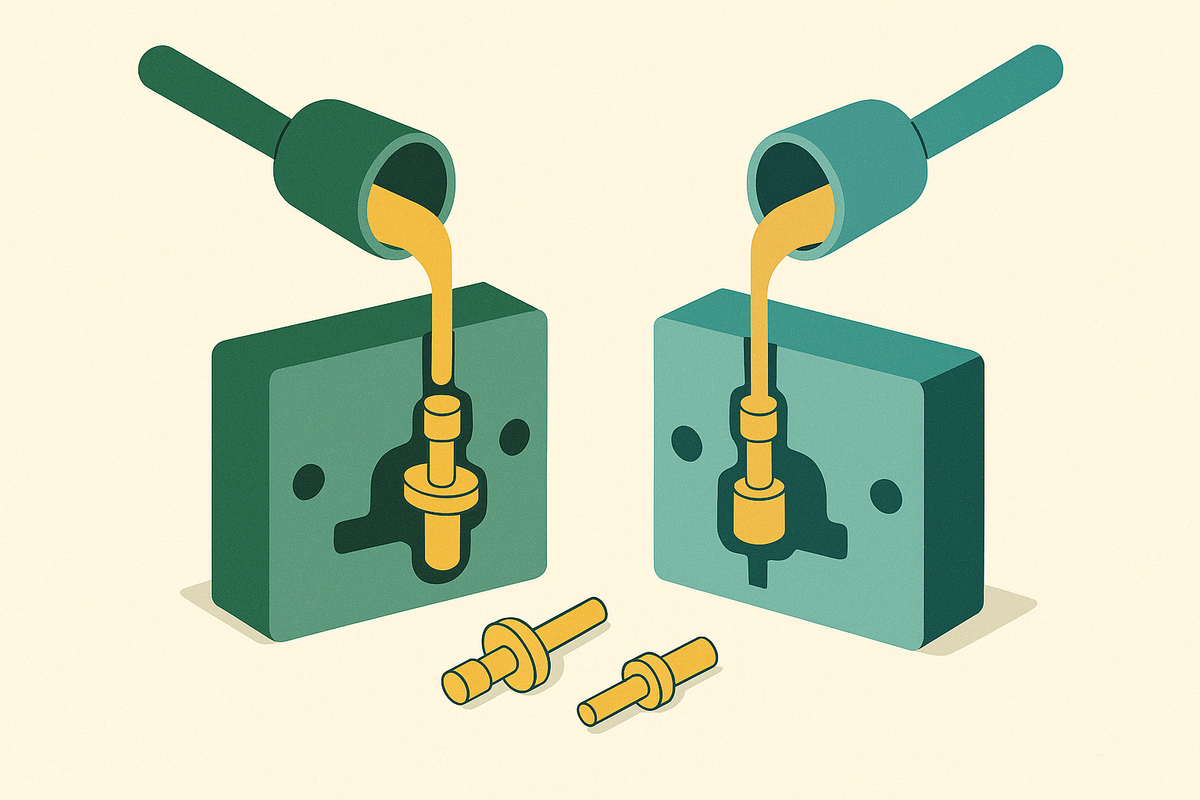
RIM mixes two low-viscosity liquid components under high pressure, using impingement mixing, then injects the mixture into a closed mold, typically aluminum. Polymerization happens fast, right there inside the tool, so the part cures in place. Aluminum gets used for most RIM tooling because it machines faster than steel and conducts heat well, which matters when a team is still iterating and needs a tool turned around quickly.
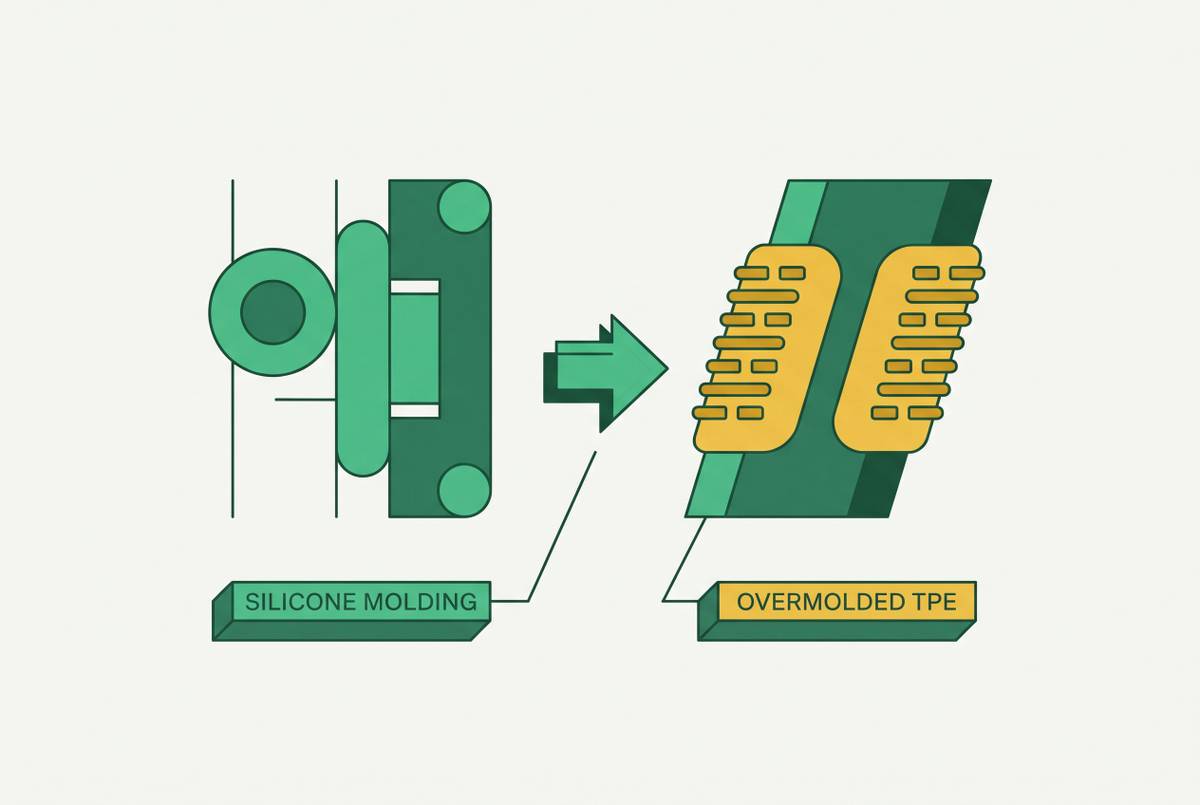
Urethane casting works differently. That's good for cosmetic finish, but the slower reaction also means lower cross-link density than RIM produces. The silicone mold itself flexes during demolding, and that flex is what makes undercuts, inserts, and reverse draft so much easier to handle than in any process built on a rigid tool.
What "Large" Means for Each Process, and Where Each One Runs Out of Road
Size isn't just a dimension on a drawing. Whether a part comes out of the mold as one piece or has to be split and assembled afterward depends on size, and that decision ripples into cost, structural integrity, and lead time.
RIM's advantage at large scale comes from how the material fills the mold. The low-viscosity liquid components fill a closed cavity under their own reaction pressure, so you don't need an external injection press to force molten material through a gate. A single-piece part skips the subassembly steps that add cost and introduce failure points, which matters most for large enclosures, panels, and housings where a bonded seam is a liability. RIM also handles complex shapes, variable wall thickness, and integrated ribbing, so a conventional tool doesn't have to split the part at the same size.
Urethane casting can also take on large and irregular shapes, because a silicone mold conforms to geometry that a rigid metal tool simply can't. Pushing past what a single mold can hold means the part needs to be segmented, which adds assembly labor, introduces bond-line variability, and can throw off dimensional accuracy across the finished assembly. Those costs compound as the part gets bigger.
Wall thickness tells a similar story from a different angle. Urethane casting's slower cure can produce sink or warpage in sections where thickness varies a lot, unless the mold design accounts for it carefully.
How Tooling Investment and Mold Life Set the Floor
Tooling cost isn't just a line item on a budget. Tooling cost sets how many design revisions a program can afford before the geometry has to be frozen, which makes it the real risk-management decision behind every hardware program.
Urethane casting tooling is built to be cheap and fast. The master pattern, usually 3D printed or CNC machined, and the silicone mold built from it come together for a relatively low upfront cost. The tradeoff appears over the life of the mold: surface roughness increases as the silicone wears, which matters a lot for parts with fine cosmetic requirements or tight dimensional specs.
RIM tooling costs more upfront, but it holds up longer and delivers more consistent parts run after run, so it's the right tradeoff once geometry stops moving.
The practical rule falls out cleanly from there. Choose urethane casting tooling when the design is still moving and the program needs the option to revise geometry without burning a major tooling investment. Choose RIM tooling when geometry is approaching release and the program needs consistent parts at a volume where repeatedly replacing a worn silicone mold starts costing more than a single aluminum tool would have.
Where volume tips the total program cost from urethane casting toward RIM
Comparing quoted part prices between RIM and urethane casting without factoring in tooling cost gives a misleading answer. The number that actually matters is total program cost: tooling plus unit cost multiplied by quantity. That calculation has a crossover point, and the crossover is what should drive the decision, not the per-part quote alone.
Urethane casting earns its keep at the low end of the volume range, generally low to mid-volume programs running up to a few hundred parts, where design revision risk is still real and the cost of replacing a mold stays manageable. Above that range, the cumulative cost of replacing worn silicone molds, combined with the manual labor that casting requires per part, erodes the tooling-cost advantage that made urethane casting attractive.
RIM takes over economically at mid-volume, generally hundreds to several thousand parts a year. Pushing volume further, into the tens of thousands of parts and beyond, usually makes traditional injection molding with hardened steel tooling the better economic choice, thanks to faster cycle times and lower unit cost at scale, even with a bigger tooling investment up front.
The rule that holds regardless: calculate total program cost at the volume the program actually expects, not just the quoted part price, and build in the cost of likely mold replacements when weighing urethane casting against RIM.
How Material Properties Differ Between RIM and Cast Urethane
RIM and urethane casting both run on polyurethane chemistry, but they don't produce the same molecular structure. RIM's high-pressure impingement mixing and fast cure build a denser, more cross-linked matrix, and that density gives RIM a structural and chemical performance edge that urethane casting can't match using standard resins.
That denser cross-linked structure means RIM parts resist aggressive cleaning agents and disinfectants better than a typical cast urethane part, so you need to weigh this for medical enclosures, industrial equipment, and any part that will face repeated solvent exposure or chemical cleaning. The result is a polyurethane composite with a flexural modulus well above what unreinforced urethane can deliver.
Urethane casting has the wider range at the soft end. That range makes urethane casting the better fit for gaskets, seals, flexible covers, and cosmetic bridge parts that don't need RIM's chemical resistance or structural stiffness. Casting also supports elastomers, rubber-like plastics, and soft-touch finishes that RIM doesn't handle as naturally, and it can produce clear or translucent parts for lenses and transparent enclosures.
The decision rule is straightforward. When a part needs chemical resistance, structural stiffness, or fiber reinforcement, RIM is the only option short of jumping straight to production injection molding. When the part needs to be flexible, soft-touch, clear, or cosmetically refined at low volume while the design is still moving, urethane casting covers more ground at a lower tooling cost.
DFM rules that differ between RIM and urethane casting for large parts
RIM and urethane casting share a lot of DFM thinking with injection molding, but each one tightens or loosens specific rules in ways that matter most at large part scale, where a DFM mistake is expensive to discover only after the tooling is already cut.
- Uniform wall thickness is the top priority. Uneven walls create differential cure rates, and those produce warpage or stress concentrations. At large scale, a wall thickness variation that would barely register on a small part can show up as visible distortion across a wide panel face.
- Radii and fillets at corners cut down on stress concentrations. Sharp internal corners in a large RIM part act as stress risers that can start cracks under load or during demolding.
- Rib thickness should be 50 to 65 percent of nominal wall thickness to avoid sink marks on the opposite surface. The same rule governs injection molding, because the underlying cause, volumetric shrinkage over a thick section, is identical.
Urethane casting offers DFM relief that neither RIM nor injection molding can match. The silicone mold flexes during demolding, so undercuts, reverse draft, and inserts come out clean without side actions or manual picks, a real advantage when a large enclosure has integrated snaps, recesses, or unusual geometry baked in. Silicone molds also pick up fine surface detail accurately, which makes them well suited to cosmetically demanding parts that need texture or sharp feature definition straight out of the mold, no extra finishing required.
Both processes share one risk at large scale: a mold problem that only appears after the first pour or first shot is costly to fix either way. The difference is in how fast the fix happens. A silicone mold can be remade relatively quickly from the same master. A RIM aluminum tool modification needs machining time and engineering review before it's back in production. Either way, you need to get the DFM right before tooling starts.
How to read a program's stage and requirements against the decision framework
There's no single right process for a large plastic part. There's a right process for a specific program stage, and the framework works by checking four variables in order: geometry stability first, then size and material constraints, then volume, then tooling economics.
Stage 1 covers programs where geometry is still moving and fewer than roughly twenty parts are needed. Neither RIM nor urethane casting is the answer yet. Committing to tooling before that point wastes the investment and delays the program the moment the first revision lands.
Stage 2 covers programs where geometry is approaching stability and you need bridge volume, roughly ten to two hundred parts, with some design revision risk still on the table. Urethane casting is the default here. The part size fits within what a silicone mold can handle, the material doesn't demand RIM's cross-linked structure or fiber reinforcement, and the volume doesn't justify RIM tooling cost. Cast parts also closely resemble injection-molded components, so you can use this stage for customer validation sets and functional pilots ahead of committing to hard tooling.
Stage 3 covers programs where geometry is approaching release, production volume runs from hundreds to several thousand parts, the part is large and needs to be a single piece, or the material requires chemical resistance or structural reinforcement. RIM is the right call. If the part is too large or too structurally demanding for silicone tooling to hold tolerance across a full production run, aluminum RIM tooling gives you that stability without the cost and lead time of hardened steel injection tooling. If the program needs fiber reinforcement through RRIM, this is the only path short of production injection molding. RIM's single-piece capability also eliminates the segmentation and bonding that urethane casting would require at this size.
Stage 4 covers programs where volume outgrows RIM's economic window, the design is frozen, and repeatability at scale is the priority. At this point, production injection molding in hardened steel tooling is the right move. RIM has done its job as the bridge to get there. Moving from urethane casting or RIM into injection molding is a normal part of a program's progression, not a sign that the earlier process failed. Each stage exists to serve a different need.
Why sourcing RIM and urethane casting parts alongside the rest of a large-part BOM matters
A large plastic enclosure or housing almost never ships by itself. The BOM around it usually includes CNC-machined brackets, sheet metal sub-frames, specialty gaskets, custom springs, and other fabricated parts. Sourcing each of those from a different vendor multiplies coordination overhead, stretches out lead time, and opens the door to quality handoff problems.
Teams that source a RIM or cast urethane housing from one vendor, machined brackets from a second, and sheet metal from a third aren't just juggling logistics. When a fit problem appears at final assembly, figuring out which supplier's part is out of spec, and getting a remake turned around on a reasonable timeline, takes coordination that a single-vendor BOM avoids from the start.
The progression from 3D printing through urethane casting through RIM into injection molding is a sourcing ladder as much as a manufacturing one. Teams that can run that ladder with one partner, rather than re-qualifying a new vendor at every stage, move faster and carry less risk along the way.
OneWeekParts covers the full range of processes that show up on a large-part mechanical BOM: urethane casting, CNC milling and turning, sheet metal fabrication, custom springs, gaskets, tube bending, and more, consolidated into one quote, one purchase order, and one shipment. For programs sitting at the urethane casting or RIM stage, where geometry is still moving and the pace of iteration matters most, getting DFM feedback during the quoting process, rather than finding out about a problem after tooling is already cut, is the advantage that keeps a development cycle moving. Submitting a file early and getting that feedback before committing to a mold is the simplest way to avoid the tooling mistake this whole framework is built to prevent.