Silicone Rubber Molding vs. Overmolded TPE for Sealing and Grip Features
Material choice hinges on temperature limits, then chemical exposure, then bonding needs.
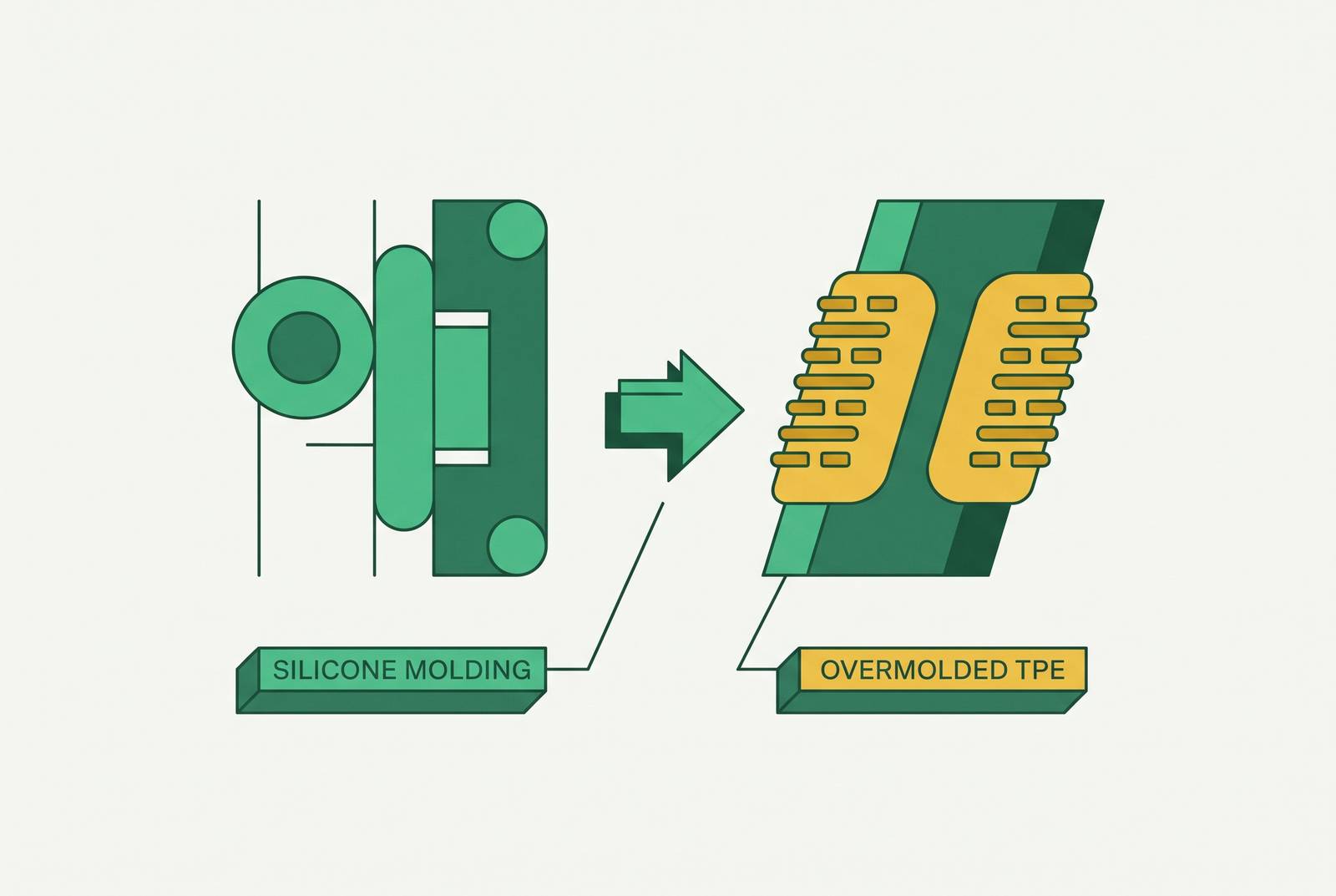
Choosing between LSR and overmolded TPE comes down to a hierarchy: temperature ceiling first, chemical and UV exposure second, bonding and regulatory context third, and only then do the DFM details start to matter. Skip that order and an engineer ends up optimizing gate placement on a material that was never going to survive the application anyway.
Both materials get processed on an injection molding press, but that's where the resemblance ends. LSR starts as a liquid and crosslinks permanently under heat, a one-way chemical reaction that can't be undone. TPE starts as pellets, softens under heat, and hardens again on cooling, a cycle it can repeat pretty much indefinitely. That's not a flaw in either direction. The irreversibility of LSR curing is exactly why it holds up under heat and chemical attack. The reprocessability of TPE is exactly why it bonds so well to thermoplastic substrates and why scrap can go back into the hopper. Every constraint below traces back to one of these two facts.
Temperature ceiling as the first eliminating constraint
LSR holds its flexibility and mechanical performance up to about 230°C. TPE runs up to around 120°C. That's a gap of roughly 110°C, and it's the number that should end the conversation for a lot of applications before anything else gets considered.
Automotive under-hood seals live in that gap. So do industrial oven gaskets and any part that goes through repeated steam sterilization cycles. Push TPE into that environment and it softens, deforms, or breaks down chemically over time. LSR just sits there and keeps sealing.
The low end matters too, though it's less dramatic. Silicone rubber stays reliable from around -60°F down to -150°F, according to Timco Rubber, and medical-grade LSR runs from -76°F to 356°F. TPE's low-temperature limit is closer to -30°F. So a freezer gasket or a cold-climate outdoor seal is another place where TPE quietly falls out of the running.
If the part in question lives entirely inside that -30°F to 120°C window, though, temperature by itself doesn't rule TPE out. That's when the next constraint takes over.
Chemical and UV exposure as the second eliminating constraint
Silicone's chemistry gives it strong resistance to outdoor, ozone-rich, and aggressive-chemical environments without much fuss. TPE can age fast under UV or chemical stress, especially in formulations that skip UV-stabilizing additives.
Compression set is the other half of this constraint, and it's the one people underestimate. Silicone recovers its shape more completely after sustained compressive load than TPE does. That makes LSR the better call for a static seal, a compression seal component, a gasket under continuous bolt load, anywhere the part sits compressed for months or years and needs to spring back rather than creep. TPE, held under that kind of sustained pressure, tends to deform and stay deformed, which eventually shows up as a leak.
None of that means TPE is disqualified from every chemical or light-exposure job. An intermittently squeezed grip, a dynamic seal in a mild chemical environment, an indoor consumer product, these are places where TPE's weaker chemical resistance doesn't actually get tested hard enough to matter. But an aggressive solvent, sustained sun exposure, or a seal held under constant bolt load: that's LSR's territory, and no amount of TPE formulation tweaking fully closes the gap.
Biocompatibility and regulatory context where they apply
LSR is hypoallergenic, tasteless, and odorless, which is a big part of why it's the default choice for medical and food-contact parts that need FDA compliance. The relevant references here are 21 CFR 177.2600, covering rubber articles intended for repeated use, and ISO 10993-1, the standard for biological evaluation of medical devices (FDA guidance updated September 2023). Medical LSR also spans a Shore A hardness range of 5 to 80, so a single material family can cover an ultra-soft seal and a firmer structural component in the same device.
TPE isn't shut out of this space. Certain formulations carry biocompatibility credentials too, and Timco Rubber notes low toxicity in medical-grade TPE grades. The distinction that matters is plasticizer migration. Because LSR's cure is a one-way thermoset reaction, the one-way thermoset cure leaves no unreacted small molecules to migrate out of the part, a profile that matters for anything with long-duration skin contact.
Grip applications inside medical instruments are a good example of where this plays out physically, not just on paper. LSR's dry, rubbery surface feel closely approximates skin, and surgical instrument grips are a documented use case, per Avient, where haptics and sterility requirements line up with what the material already does naturally.
Bonding to the substrate: where process chemistry and part design intersect
Here's the asymmetry that trips up a lot of DFM reviews. Properly specified TPE bonds chemically and cohesively to thermoplastic substrates without primers or adhesives. LSR, on the other hand, generally does not bond to thermoplastics on its own. It usually needs primers, surface activation, or mechanical interlock features designed into the part to hold on.
TPE's bond strength depends heavily on which substrate it's paired with:
- On ABS, PC, or PC/ABS: strong, reliable chemical bond without secondary adhesives, confirmed for grades like Avient's Versaflex OM 1040X.
- On PP: weaker bond, usually needs mechanical interlock features and an adhesion promoter.
- On PE or HDPE: weak bond, mechanical interlock required.
- On POM (acetal): generally avoided outright, since the bond stays poor no matter how the surface is prepped.
LSR overmolding runs into a different problem. Because LSR cures at high temperature, the substrate underneath it has to be a high-temperature thermoplastic or it deforms during the shot. That alone narrows the substrate options considerably compared to what TPE overmolding allows.
Surface contamination, mold release residue, oxidation, that kind of thing, disrupts molecular bonding for both materials, but it's more critical for LSR. Plasma or flame treatment of the substrate right before the overmold shot sometimes becomes a required step in the DFM plan, not an optional one.
There's also a mechanical backstop to build in regardless of chemistry: let the overmold material flow through holes, around ribs, or into undercuts machined into the substrate. It costs nothing extra at the tooling stage if it's designed in from the start, and it dramatically improves bond reliability on pairs that are chemically weak to begin with. A few named overmold-grade TPE products include KRAIBURG Thermolast K TC5GPZ, a general-purpose fogging-series TPE with adhesion to PP; Avient's GLS Versaflex OM 1040X, a medical-compliant grade that bonds to PC/ABS/ABS without secondary adhesives, though its shrinkage of 2.0% to 2.6% makes gate design a critical consideration; and Kraton's G2705 and G7820, which are named TPE grades used in overmolding contexts.
Mismatching the material pair to the process, more than any single bad process parameter, is the most common reason overmold bonds fail. Substrate material selection needs to get locked in before overmold material selection, not the other way around.
Grip application specifics: haptics, surface finish, and what each process actually delivers
TPE's molecular structure is inherently non-tacky. Straight out of the mold, it has a dry, non-tacky surface, no coating required. It also recovers well from repeated compression and stretching. Grips molded in the 50 to 60 Shore A range feel firm but compliant, which is why TPE shows up so often on tool handles, fitness equipment, and durable electronics. Because the material itself is the finished surface, there's no coating step to manage and no delamination risk down the road.
LSR takes a different path to a good grip. As-molded, it comes out either dry and slightly slippery or soft and rubbery, and a surface treatment is often needed to make it usable as a grip surface. That treatment adds friction, gives the surface a silky, skin-like feel, and improves wear resistance and cleanability. What LSR does better than TPE, coating aside, is reproduce fine mold texture. Its low viscosity lets it flow into complex geometry and pick up detail from a bead-blasted or chemically textured mold more faithfully than TPE can manage, a point Avient has noted directly.
So the practical split looks like this: a grip that gets squeezed constantly, gets sweated on, and needs to resist surface wear over years is better served by TPE's built-in dry grip. A grip where the priority is an immediate, refined, skin-like softness right out of the box, think high-end electronics, beauty devices, surgical tools, is where LSR with a coating delivers something TPE can't replicate through chemistry alone.
Color is a smaller but real difference too. Both materials take a full color range, but LSR's base transparency makes clean translucent and transparent parts easier to achieve. TPE, on the other hand, handles metallic, pearlescent, and glow-in-the-dark effects more easily with solid colorants.
DFM rules for LSR parts: where the thermoset behavior shows up in design
Wall thickness needs to stay uniform to cure evenly and avoid sink. LSR can go as thin as 0.010 in. (0.254 mm) in a given section, depending on part size and how close that thin section sits to a thicker one. Ribs should run 0.5 to 1.0 times the thickness of the wall they're attached to.
Draft angle is one place LSR gives some slack. A 1° draft is standard, but zero draft can work on shallow features where the mold construction allows it, since LSR's flexibility tolerates conditions that would stick a thermoplastic part in its mold. Corners are less forgiving: sharp inside corners concentrate stress, so fillet radii should roughly match wall thickness.
Shrinkage is high but predictable. ISO 3302-1 sets a baseline of 1.5% to 3.0%, with 2.0% as a common design target. Tolerance classes run from M1, the tightest, down to M4, the loosest. Even with that shrinkage, achievable linear tolerance sits around ±0.003 in. (0.08 mm), with linear shrinkage tolerance around ±0.025 in./in., tighter than a lot of thermoplastic processes manage. Flashing is the tradeoff: LSR injection molding needs tighter parting-line tolerances than thermoplastic molding to keep flash under control.
Within silicone itself, there's a process choice to make. Injection molding is faster, more automated, and better suited to complex, high-tolerance parts with minimal flash. Compression molding costs less in tooling and works well for flat sheets, gaskets, and prototype runs, covering everything from Ø2mm micro O-rings up to 600 mm gaskets, across a hardness range of 20 to 90 Shore A.
DFM rules for TPE overmolding: where shrinkage differentials and wall ratios drive structural decisions
Wall thickness uniformity matters here for the same reason it does in LSR: uneven walls sink and warp. What's different with TPE overmolding is the shrinkage mismatch between the two materials in the same part. TPE shrinks around 2%, while a rigid substrate typically shrinks closer to 1%. That difference is what causes warpage when the overmold layer runs too thick relative to the substrate underneath it.
The rule of thumb: substrate thickness should run at least twice the overmold thickness in any bonding area. A 2 mm TPE overmold needs at least 4 mm of substrate supporting it where the bond actually happens. Grades like Versaflex OM 1040X, with shrinkage at the high end of 2.0% to 2.6%, make this ratio even more important, and getting a clean, peel-free interface out of that grade generally means precision tooling along with careful gate design.
Gate location isn't just a tooling afterthought either. It changes how shrinkage distributes across the overmold layer, which makes it a design decision that belongs in the DFM review, not something left for the toolmaker to sort out later. Mechanical interlock features, holes, undercuts, wrap-around geometry, should get designed into the substrate from the start, since they're essentially free at that stage and provide a critical backup on any material pair that bonds weakly. And sharp corners in the overmold need radiusing for the same reason they do in LSR: an unradiused corner concentrates stress and tears at the overmold edge under load.
For any two-shot or insert-molded assembly, the DFM review needs to check wall thickness, draft angles, gate locations, material compatibility, and the substrate-to-overmold thickness ratio before steel gets cut. Changes after that point get expensive fast.
Prototyping routes and tooling cost for each process
Silicone offers three prototyping routes, and they don't deliver the same fidelity. RTV (room temperature vulcanization) molding uses plastic or aluminum tooling, turns around quickly, and cures anywhere from 20 minutes to a few hours. It's good for checking form and fit, not for regulatory-grade functional testing. HCR (high consistency rubber) transfer molding uses gum stock silicone and gets closer to production-level material behavior, which makes it suitable for functional testing. LSR injection molding with soft aluminum tooling sits at the top of the fidelity ladder, closely resembling the final production part, and it's the route used when the prototype needs to match production-level material behavior most closely.
3D-printed molds offer a cheaper entry point for RTV or low-volume overmolding work, running around $500 per mold, a fraction of what soft or hard tooling costs. That tradeoff, low upfront cost against lower fidelity and shorter mold life, is worth weighing against how close the prototype actually needs to get to the final production part before committing to aluminum or steel tooling.