Zinc Die Casting vs. Aluminum Die Casting for Small Precision Parts
Zinc handles finer features and tighter tolerances than aluminum die casting.
Choosing between zinc and aluminum die casting for a small precision part is a matching exercise: the drawing and the operating requirement set the terms, and the job is to find which alloy actually fits them. Neither material wins by default. Both are high-pressure die casting processes capable of tight dimensional accuracy and high-volume production, so the gap between them does not come from one process being more capable than the other. It comes from thermophysical differences, how each metal melts, flows, and solidifies, which push the two routes toward different parts, different tolerances, and different finishes.
That distinction has real cost attached to it. Committing to the wrong alloy early in a project, before geometry and tolerance requirements are fully worked out, often means discovering mid-program that the part needs a redesign, new tooling, and a schedule reset. If teams can quote the same part geometry across both zinc and aluminum die casting at once, and get design-for-manufacturability feedback on feasibility and lead time back quickly, they can settle the material question with evidence. OneWeekParts builds that kind of side-by-side quoting in, so you get the alloy decision answered before tooling starts, not after.
Hot-Chamber vs. Cold-Chamber Process Architecture
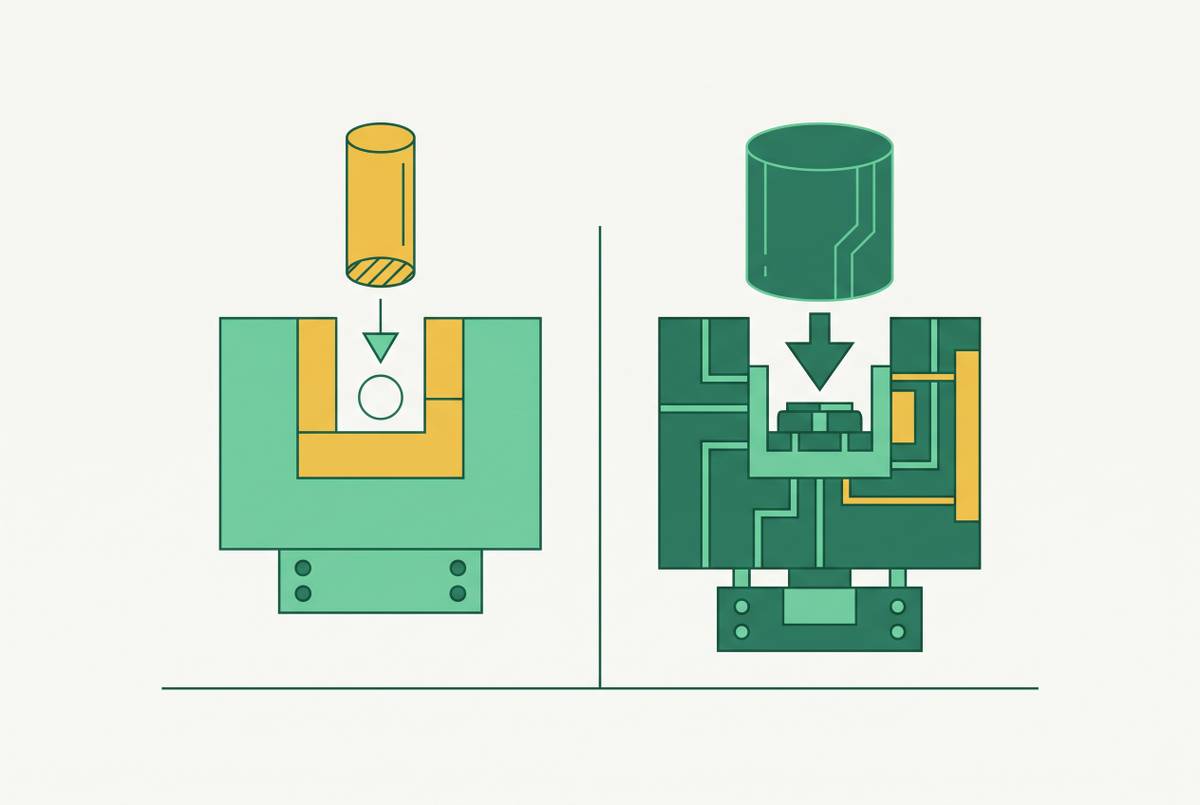
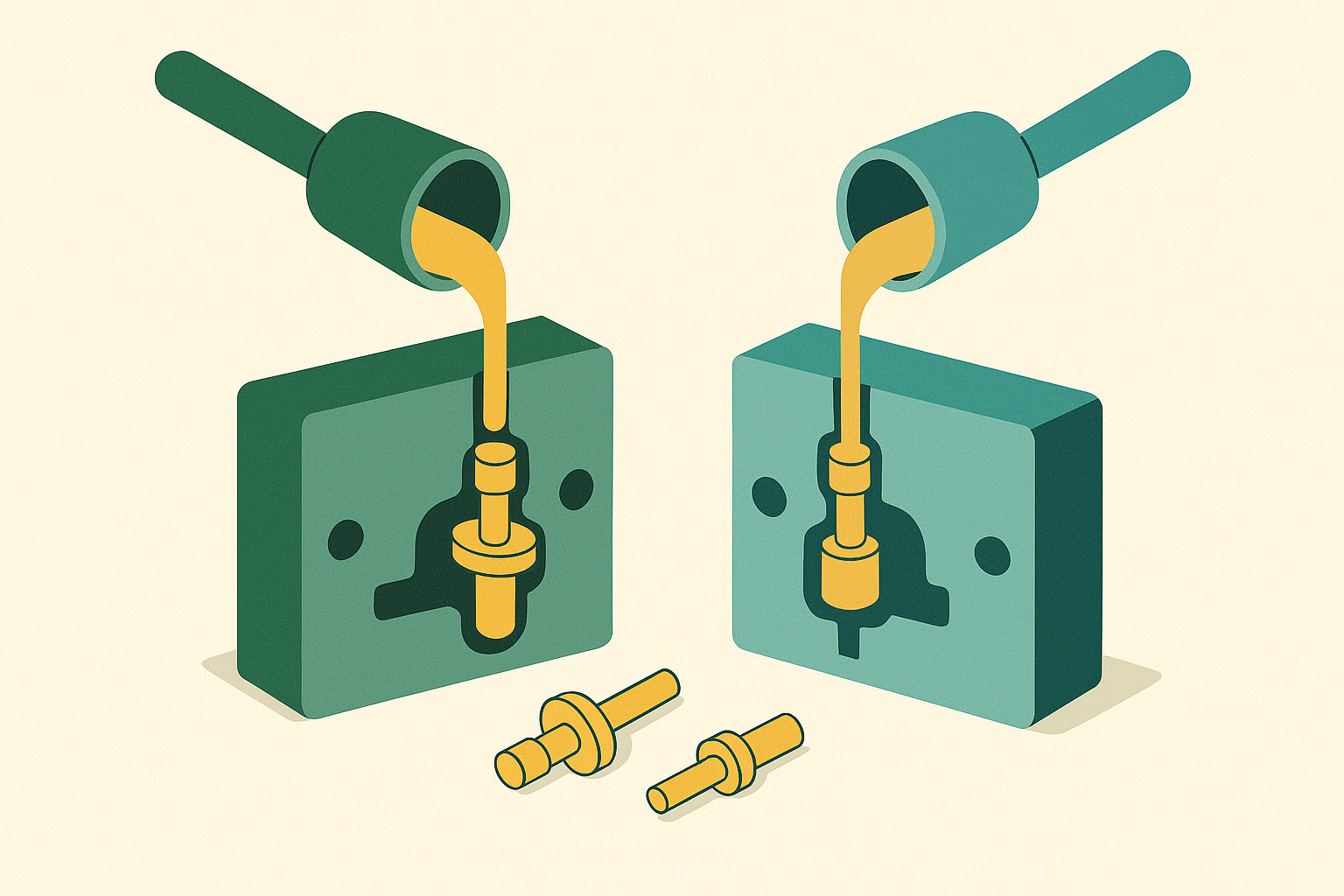
The biggest difference between zinc and aluminum die casting has less to do with the metal itself than with the machine built to handle it. Zinc has a low melting point, so manufacturers can run hot-chamber machines, where the injection mechanism sits right in the molten metal. Metal travels a short path straight into the die. That short path supports fast cycle times, stable fills on small and mid-size parts, and less exposure to air during transfer, which improves repeatability on fine features.
Aluminum's higher melting point rules out that setup. The metal would damage a submerged injection system, so aluminum runs cold-chamber instead: molten aluminum gets ladled into a shot sleeve from an external furnace, then forced into the die under high pressure. Gates, runners, and vents get designed differently because of that longer transfer path and higher thermal load, and the dies take on more stress with every shot.
Tooling life diverges as a result: zinc dies run cooler, while aluminum dies take on more thermal stress. Zinc dies run cooler, so they can last over a million cycles with minimal wear. Aluminum dies take on more thermal stress shot after shot, so they need more frequent maintenance and wear out sooner. So if a manufacturer plans a high-volume program, they are, in effect, planning around two different tooling lifespans before a single part ships.
None of this is a side detail. The temperature each alloy runs at, and the machine architecture that temperature demands, is what decides how thin a wall can get, how shallow a draft angle can be, and how small a hole can be cored. The geometry rules that follow are a direct consequence of hot-chamber versus cold-chamber behavior, not a separate set of guidelines layered on top.
The Thermophysical Gap: Wall Thickness, Draft Angles, and Hole Geometry
Zinc's lower melting point and higher fluidity give it an edge in small, feature-dense parts: thinner walls, shallower draft, and smaller cored holes than aluminum can reliably hold.
On wall thickness, Zamak alloys can fill extremely thin sections, and local walls can go under one millimeter if the part geometry and process control allow it. Aluminum is more comfortable in the 1 to 3 millimeter range, though thinner sections are achievable with careful design and tight process control. For a small-format part, that gap in minimum wall capability hands zinc real design freedom that aluminum cannot match without added risk.
Draft angles follow the same logic. Zinc sticks to the mold less, so you can hold tight, repeatable dimensions and fine detail with shallower draft on interior surfaces. Aluminum sticks to molds more aggressively, so it needs more draft on inner walls, which limits how vertical internal geometry can be. For a part packed with internal features, snap-fits, precision bores, thin bosses, zinc allows tighter, more vertical shapes that cut down on secondary machining.
Hole geometry tells a similar story. Zinc flows better, so it allows smaller minimum practical hole diameters than aluminum, which, along with magnesium, needs larger minimum holes because its flow is more limited. Internal undercuts are a separate issue that applies to both metals equally: moving core mechanisms inside the die are mechanically possible through sliding cores, but they add cost and maintenance burden in either process, and most undercut features end up produced by machining after casting.
Wall thickness has a failure mode shared by both alloys, too. Push a wall meaningfully beyond its optimal thickness and tensile strength drops, though zinc degrades less steeply than aluminum under the same proportional increase. The same caution applies to projections and bosses coming off a main wall: keeping the thickness at that junction well below the main wall thickness prevents sink marks and internal cavitation, a rule that holds for zinc and aluminum alike.
Tolerance, dimensional stability, and as-cast surface quality
For small parts where tolerance stack-up and cosmetic finish decide whether an assembly passes inspection, zinc's as-cast output often removes steps that aluminum parts still need.
Zinc holds the tightest as-cast linear tolerances of the two alloys on small precision hardware, with aluminum landing as the middle ground. Zinc alloys shrink less and warp less, so part-to-part consistency stays strong across high production volumes, and that matters where tight tolerances have to hold across thousands of parts. Aluminum's cold-chamber process works against it here: the longer transfer path and higher thermal load bring more variability into how the metal shrinks as it cools, and that variability tends to push fine-tolerance features toward a secondary CNC operation to bring them into spec.
Surface finish shows the same pattern. Zinc parts come out of the mold with a smoother, more uniform surface, because zinc's low melting point and strong flow capture sharp detail without any post-processing. Aluminum cools fast and runs a higher risk of porosity and surface imperfection, which often means grinding or polishing before the part meets appearance standards. The skin that forms on a zinc casting is smooth and dense enough to serve directly as a base for polishing, decorative plating in chrome, nickel, or brass, powder coat, or paint.
Plating draws out the difference further. Zinc die castings take electroplating well, so chrome, nickel, and similar decorative coatings add both looks and corrosion resistance in one step. Aluminum can be powder coated or painted, but its oxide layer is stable enough that it usually needs pretreatment, sandblasting in particular, before a coating will adhere properly and last. For a bright chrome finish or a demanding cosmetic flow, zinc tends to be the more direct path, and that is part of why nickel and chrome over zinc show up so often in appliance and hardware applications.
That finish advantage is also a cost advantage, because zinc's finer achievable features and smoother as-cast surface can remove entire secondary operations, machining, polishing, that an equivalent aluminum part would still need. A consumer device casing cast in zinc can go straight from the die to assembly. The aluminum version of the same casing may need a machining pass and a coating step just to hit the same surface and tolerance targets. Engineers mapping out a full mechanical bill of materials for a part like this are really pricing two different workflows, not two different castings. A single-source quoting platform that prices die casting alongside machining, finishing, and assembly in one request gives a cleaner read on the true landed cost of each alloy. That is the kind of multi-process quoting OneWeekParts offers, turning the zinc-versus-aluminum decision into a total-cost comparison.
Mechanical properties: where zinc's counterintuitive profile matters
The instinct to call aluminum the stronger metal does not hold up once the actual properties get compared. Common aluminum alloys in the A380/ADC12 class carry higher nominal tensile strength than common zinc alloys in the Zamak 3 class. But zinc alloys have higher yield strength and much higher elongation, so zinc parts bend and stretch further before they fail, even when aluminum's peak tensile number looks better on a spec sheet.
Zinc also outperforms aluminum in ductility and impact toughness, often absorbing shock loads better than aluminum despite its lower peak tensile strength. Latches, locks, and connectors need to survive repeated impact rather than just resist a steady pull, so that matters directly for them. Zinc's higher density adds to this: the extra mass gives zinc parts more stability and impact resistance, a useful trait for structural components or anything that needs to damp vibration.
Aluminum holds a clear edge where heat is the deciding factor. Its high thermal conductivity makes it the dependable choice for heat dissipation components, like LED housings and engine parts, and it holds up well in high-heat and outdoor conditions generally. As sustained temperature and thermal cycling go up, aluminum tends to become the safer choice. Zinc still performs well at moderate temperatures as long as the duty cycle is well defined and short.
Zinc's mechanical case comes with two real limits, and any honest comparison has to include them. Zinc can be prone to creep, slow deformation under sustained load, so any zinc part carrying a long-term static load needs that factored into the design from the start. And on corrosion, aluminum forms a dense, stable oxide film on its own, which holds up well in humid, marine, or chemically harsh settings. Zinc's oxide layer is looser and less protective over time, so a zinc part destined for an exposed environment generally needs plating or powder coat as standard practice, not an optional upgrade.
Weighed together, these properties explain why the "aluminum is stronger" assumption doesn't capture what matters for most small precision parts. Yield strength, elongation, and impact toughness often count for more than peak tensile numbers in hardware that needs to flex, absorb a hit, or hold a tight tolerance without creeping out of spec, and on those measures zinc frequently has the edge.
Choosing the right zinc alloy within the Zamak family
Settling on zinc as the right route is not the final decision. Which Zamak alloy gets specified is a second choice, with its own consequences for castability, mechanical performance, and finish.
Zamak is a family of zinc-based alloys built with controlled amounts of aluminum, magnesium, and sometimes copper mixed in, formulated specifically for the hot-chamber zinc die casting process. The name itself is an acronym built from the German words for its component metals, a naming convention that goes back to the alloy family's origins.
Zamak 3 is the standard within that family: you reach for it when a part needs strong dimensional stability and finishes well under plating or paint, with no unusual mechanical demand pushing the choice elsewhere. It is the baseline specification, the alloy a design defaults to until something about the part, higher strength, different casting behavior, a specific finish requirement, gives a reason to look at one of the other Zamak grades instead. Getting that baseline right matters because it is where most zinc parts start, and moving off it should be a deliberate choice driven by the part's actual requirements, not a default guess.
For engineers working through this decision with an active drawing, the geometry constraints covered earlier, wall thickness, draft, hole diameter, are where the manufacturability review needs to happen before tooling gets cut. Fast feedback on those constraints, specific to the alloy under consideration, is what keeps a zinc-versus-aluminum decision from turning into a redesign three weeks into a program. Some vendors fold that kind of alloy-specific manufacturability review into their quoting, evaluating geometry and material together in the same pass.