Injection Mold Tooling Steel Selection for Prototype vs. Production Runs
Match steel grade to production volume, resin chemistry, then finish requirements.
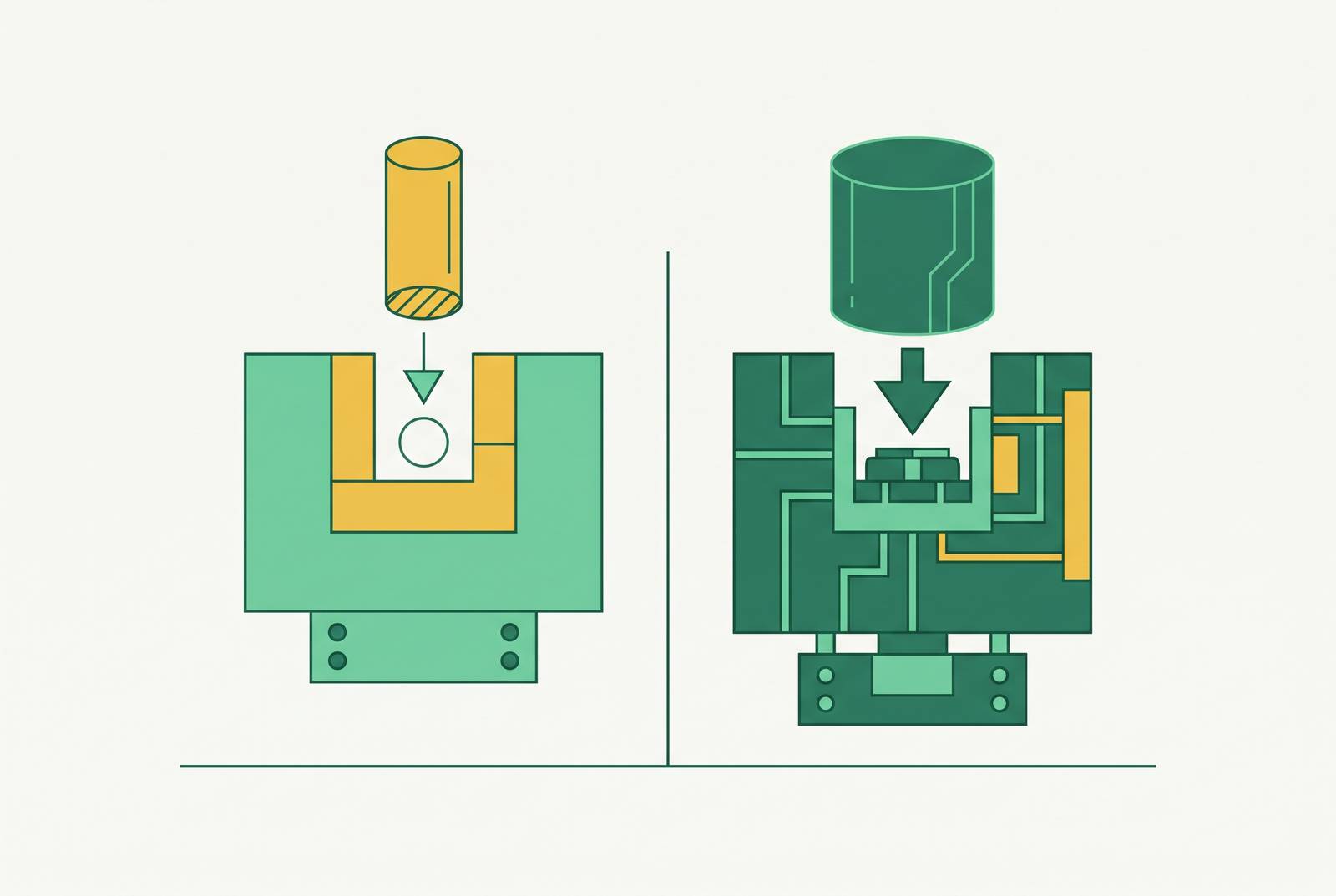
Tooling steel selection is a matching exercise: pairing a steel's hardness, machinability, and thermal behavior to the production volume, resin, and finish requirement of the actual program. The mistake programs make over and over is treating hardness as a stand-in for quality, as if a harder steel were simply the better steel and the only question left were what it costs. That thinking produces two separate failures. Over-engineering costs a program hardness it never needed, forcing a machinability penalty and weeks of extra build time for a tool that didn't require any of it. Under-engineering causes premature wear, unplanned rework, and a second tooling investment forced onto a schedule that had no room for one. The right order of operations is production volume first, resin chemistry second, surface finish requirement third, and that sequence, not the size of the budget, is what should decide the grade.
The four active steel grades and the properties that differ between them
Four grades carry most of the injection mold tooling work being done today, and the gaps between them on the ladder of hardness and machinability matter more than a simple HRC comparison suggests.
P20 ships pre-hardened at HRC 28 to 32, so you can machine and finish it without any additional heat treatment. That one property shortens the build schedule by days compared to grades that need post-machining heat treatment and finish grinding. P20 shows up so often on programs with tight timelines because of it.
H13 trades that speed for durability. Its chromium and molybdenum content gives it meaningfully better resistance to thermal fatigue than P20 under the same cycling conditions, but the build sequence is longer: rough CNC, heat treat, semi-finish, finish grind, then wire EDM for the fine cavity details. Each of those steps adds time, so H13 tools end up well behind P20 tools on the schedule.
S136, known in ASSAB and Uddeholm stainless form as Stavax ESR, heat-treats to HRC 45 to 52 and delivers the best corrosion resistance and polishability of the four grades. Its high chromium content comes with a cost beyond the steel price: deep-hole drilling for cooling channels is harder to execute with standard equipment than it is in P20 or H13, which has downstream effects on cooling layout that show up later in this piece.
NAK80 ships pre-hardened at HRC 37 to 43 and skips the post-machining heat treat step entirely, while still delivering polishability and dimensional stability that P20 can't match. That combination makes it the default choice for cosmetic parts and clear plastics.
Thermal conductivity runs against intuition. P20 conducts heat noticeably better than H13 across equivalent cooling channel geometries. A steel chosen for machinability and speed ends up with a real thermal advantage over the grade chosen for durability, and that detail narrows the cycle-time gap between the two more than most program estimates assume.
Because each grade optimizes for a different variable, P20's machinability and pre-hardened state, H13's thermal fatigue resistance, S136's corrosion resistance and polish, NAK80's dimensional stability, picking one over another is an engineering decision tied to the specific program, not a ranking from cheap to premium. When you can see multiple steel grades and process sequences quoted side by side during design for manufacturability, you can spot the real cost and timeline difference between options before you order any tooling.
Production volume and the outer boundary of the steel decision
Volume sets the shot-life requirement, and shot life sets the minimum hardness the steel has to deliver. That minimum, not a general preference for stronger material, is where grade selection should start. The SPI classification system gives the industry a shared language for this: Class 105 tooling is prototype only, built to validate geometry and function ahead of a production run.
The economics follow a simple curve. As volume rises, the tooling cost allocated to each part falls fast, and that drop is what makes the price premium for H13 or S136 worth paying at high volume and wasteful at low volume. A program running a few hundred parts has no reason to pay for H13's extended build sequence. A program running hundreds of thousands of parts has every reason to.
Aluminum belongs in this conversation as a real tier, not a shortcut for people in a hurry. Aluminum tooling can produce a meaningful number of parts before wearing out, which makes it a legitimate bridge option while steel production tooling is being built in parallel, provided the volume and resin both allow it.
The risk on the other side of that decision is what the industry calls the double-buy: a bridge or prototype mold built in steel too soft for the actual shot count fails early, and the program has to fund a second tooling investment before it had planned to spend that money. The cost of specifying P20 instead of aluminum up front is nearly always smaller than the cost of that forced second purchase. If your volume estimates carry real uncertainty, choosing P20 over aluminum for a bridge tool is often the minimum hedge worth paying for. When that uncertainty turns into a mid-program failure, fast-turn manufacturing partners such as OneWeekParts can shorten the gap between discovering the problem and getting a corrected bridge tool running, so you cut down the weeks that typically separate one tool build from the next.
Volume alone gives a coarse filter. It tells a program roughly which grades are economically defensible, but it says nothing about whether the resin being molded will destroy the steel that volume logic just recommended.
Why resin chemistry can override what volume alone recommends
Resin chemistry decides tooling steel selection as often as volume does, and it has to be checked, not assumed. If a POM bushing tool and a PP housing tool run identical volumes, the correct steel grade for one still isn't correct for the other.
The clearest example of this is P20 specified for a POM, or acetal, tool. POM off-gasses formaldehyde during molding, and that formaldehyde attacks P20 at the cavity surface, producing pitting within tens of thousands of shots. S136 or another corrosion-resistant grade is the correct steel for POM and similar corrosive resins, and that requirement has nothing to do with how many parts the program is running. A tool specified correctly on volume alone, but wrong on resin, fails in a way volume never would have predicted.
The cost of discovering that mismatch arrives at the worst possible time. It is visible mid-production, once the cavity is already pitted and parts are already failing inspection, so fixing it means a full cavity rebuild. That rebuild costs far more, in both dollars and schedule, than specifying the correct steel would have cost at the design-for-manufacturability stage, before any metal was cut.
Abrasive resins create a parallel problem through a different mechanism. Glass-filled nylons and mineral-filled compounds wear down softer steels mechanically rather than chemically, and a program running 30% glass-filled nylon in P20 tooling will hit wear failure well before the rated shot life, triggering the same kind of unplanned investment the POM example does. Aluminum tooling generally can't handle glass-filled, highly abrasive, or high-temperature resins without added protection like hard coatings or steel inserts, because those materials wear aluminum down fast enough to make it impractical. So when those resin families are involved, that constraint removes aluminum from the running no matter what the volume math says.
The practical sequence: identify the resin family first, let it rule out whatever grades can't survive that chemistry, and only then apply volume logic to whatever's left standing.
Surface-finish requirement and grade selection cost
Surface finish is the third filter in the sequence, and it can force a grade upgrade on its own, even on a program where volume and resin would have been perfectly happy with a cheaper steel.
NAK80 is the practical answer for parts that need a high cosmetic finish but don't need the full corrosion resistance S136 provides. Its pre-hardened state and polishability make it the preferred grade for clear plastics and Class A automotive surfaces, and it gets there without the longer H13 build sequence.
What catches programs off guard is how much finish-related cost gets buried in early estimates. Teams often treat finish as a post-machining detail, something handled after the steel is already chosen, rather than recognizing it as a consequence of the steel-selection decision itself. A team that orders P20 and only later discovers the part needs a cosmetic finish P20 can't deliver well ends up facing both a material change and a schedule hit at the same time, usually well after the quote and the purchase order are locked in.
The fix costs almost nothing by comparison. Folding the finish-class conversation into the grade-selection discussion at the design-for-manufacturability stage, before steel is ordered, is close to free. A five-minute conversation about finish requirements and resin compatibility before the purchase order goes out is one of the cheapest interventions available anywhere in the program.
Prototype and bridge tooling decisions when all three factors are applied together
The prototype-to-production transition is where steel-selection mistakes get expensive fastest, because a wrong call here can force spending a program never budgeted for before it has even reached production.
A prototype mold, SPI Class 105, built in aluminum or soft steel, exists to validate geometry, fit, and function before any production tooling commitment is made. It isn't a production tool, and judging a production tooling quote against prototype tooling economics is a comparison that doesn't hold up, since the two are solving different problems at different stages.
Bridge tooling solves the problem that sits between those two stages: production volume that isn't locked down yet, or production steel that's on a build cycle longer than the program can wait for. An aluminum bridge mold can support a real number of parts while H13 or S136 tooling is being built in parallel, but only if the resin cooperates, since that is the condition that decides everything else.
When the resin is abrasive or corrosive, the bridge tool has to be P20 or better, even if the volume alone would have made aluminum a reasonable choice. The resin eliminates aluminum from consideration regardless of what the shot count says, and that's the three-factor framework working exactly as intended: volume opens the door, resin can close it again.
The move from bridge tooling to production steel isn't purely a volume trigger either. Programs do better when they plan the production steel grade at the same time they commission the bridge tool, instead of waiting until bridge parts start running low to start that conversation. H13 and S136 both carry longer raw-material lead times and require post-machining heat treatment, and if that build sequence doesn't start until the bridge tool is already strained, it becomes the critical path for the entire program. When programs manage that lead-time asymmetry, they benefit from working with a manufacturing partner that can iterate fast on the bridge tool itself, because that flexibility buys the time production steel needs to catch up without leaving a gap in parts supply.
Cooling design, DFM, and steel grade interaction
Separate teams don't make steel grade and cooling design on separate timelines. The thermal conductivity of whatever grade you select directly shapes what cooling channel geometry you need to hit the target cycle time, so you have to design those channels around the steel before machining starts, not adjust them around it afterward.
Cooling accounts for most of total cycle time in injection molding, so a cooling system that removes heat quickly and evenly has an outsized effect on how fast the program can run parts. The steel the channels are cut into changes how well that system performs. P20 has slightly higher thermal conductivity than H13, so in equivalent straight-drilled channel geometries, P20 dissipates heat a bit faster, a counter-intuitive edge that partly offsets H13's harder, more durable surface when cycle time matters more than anything else.
S136 complicates this picture through its chromium content, which makes deep-hole drilling for cooling channels harder to execute with standard equipment than it is in P20 or H13. Conformal cooling, channels that follow the part's geometry rather than running in straight lines, becomes the more economical path in P20 and H13, because standard drilling struggles with S136's hardness. K-Rain's production tooling is the concrete example of conformal cooling paying off in practice, and that example should stand as a specific case rather than a signal that conformal cooling is now the default approach across the industry.
Before steel gets cut, a design for manufacturability review gives you the single biggest cost-reduction lever in the entire tooling program. Eliminating undercuts that require side actions, keeping wall thickness uniform, and adding the correct draft angles each produce measurable drops in tooling cost and cycle time, and each one is far easier to fix in a DFM conversation than as a mold modification after the first trial run has already happened. Grade selection sets the thermal baseline the tool has to work within. Cooling design pulls the cycle-time performance that baseline makes possible. DFM removes the geometry features that would otherwise make either of those harder and more expensive to achieve. None of these three decisions belongs on its own timeline. They belong in the same conversation, before the first cut is made.
Validation evidence for the matched steel and built tool
Choosing the right steel and running a clean DFM pass gets a program most of the way there, but it doesn't finish the job. The tool still has to be validated, and the evidence required to validate it scales with the type of program the tool is feeding, the same way the steel grade itself scales with volume and resin.
The failure here runs in both directions. Applying a full PPAP package to a prototype bridge tool wastes engineering time on documentation the program doesn't need yet. When you apply prototype-level approval evidence to a production tool feeding an automotive or medical program, you create real regulatory and liability exposure, because that tool's output goes into parts other people's safety depends on.
For industrial and commercial programs, the credible minimum is a T1 trial report, first article inspection run on a small sample set, and a material certificate, a certificate of analysis, confirming the steel grade and heat treatment actually match what was specified.
Medical programs operating under ISO 13485 carry a heavier requirement. Processes whose output can't be fully verified through inspection alone need process validation, typically structured as IQ, OQ, and PQ following GHTF guidance, along with material lot traceability, documented process qualification, and records kept under formal document control.
The most common structural failure across all of these tool release packages is losing the link between the physical tool as it actually exists and the latest engineering CAD revision it's supposed to match. A revision-controlled approval package that ties the physical tool directly to the current engineering change notice is the minimum safeguard against that gap, and it's the detail that keeps correct steel selection and a clean DFM process from being undone by a paperwork problem at the finish line.