Sand Casting vs. Investment Casting for Low-Volume Steel and Iron Parts
Investment casting often costs less per finished part despite higher per-kilogram prices.
Choosing between sand casting and investment casting on price per kilogram is the single most common mistake engineers make in process selection. The casting itself is only one line item in the total cost of a finished part, and the processes that look cheap on a quote sheet often turn out to be the expensive choice once the part reaches final tolerance.
Why casting price per kilogram misleads process selection
Picture the usual decision. Two quotes come back, one for sand casting and one for investment casting. The sand casting number is lower per kilogram, so the engineer signs off on it. That comparison answers the wrong question. The number that matters is the cost of the finished component, not the cost of the raw casting, and those two numbers can point in opposite directions. Sand casting produces a cheaper casting. Investment casting frequently produces a cheaper finished part.
The gap grows with complexity. Take a pump casing or a valve body, something that has a dozen bore features and mating faces. Cast that part by investment casting and the machine shop only touches the mating surfaces. Cast the same part in sand and the machine shop has to clean up nearly every functional surface, because the as-cast tolerances and surface texture aren't good enough to assemble against. That difference in machining hours adds up fast, and it adds up on every single unit in the run.
A sand casting that needs three hours of secondary machining to hold a tolerance hasn't saved anyone money, no matter how good the per-kilogram number looked on the quote. The same mistake runs in the other direction too. An engineer who specifies investment casting for a large structural housing, something with loose tolerances and no precision features, ends up paying for accuracy the part will never use. Getting this right means asking what the finished part costs end to end, not what the casting alone costs.
How each casting process works
The cost gap between these two processes is built into how each one physically makes a part.
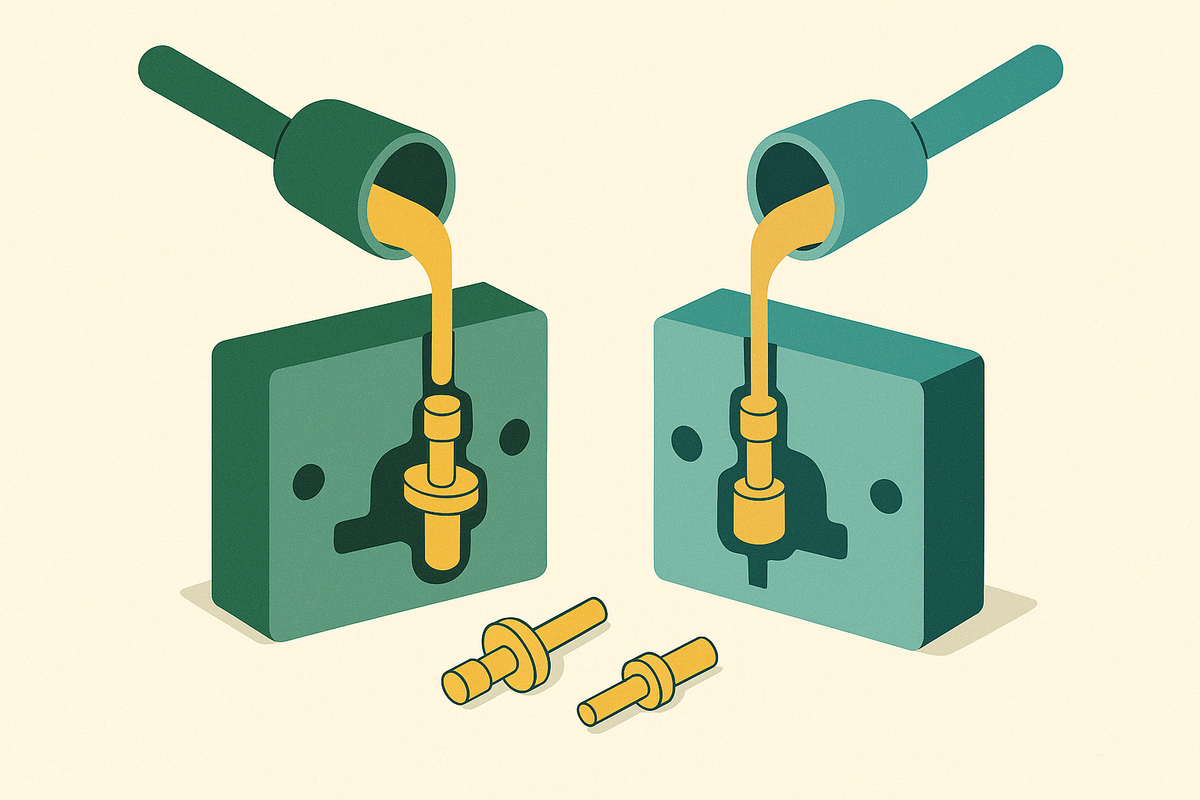
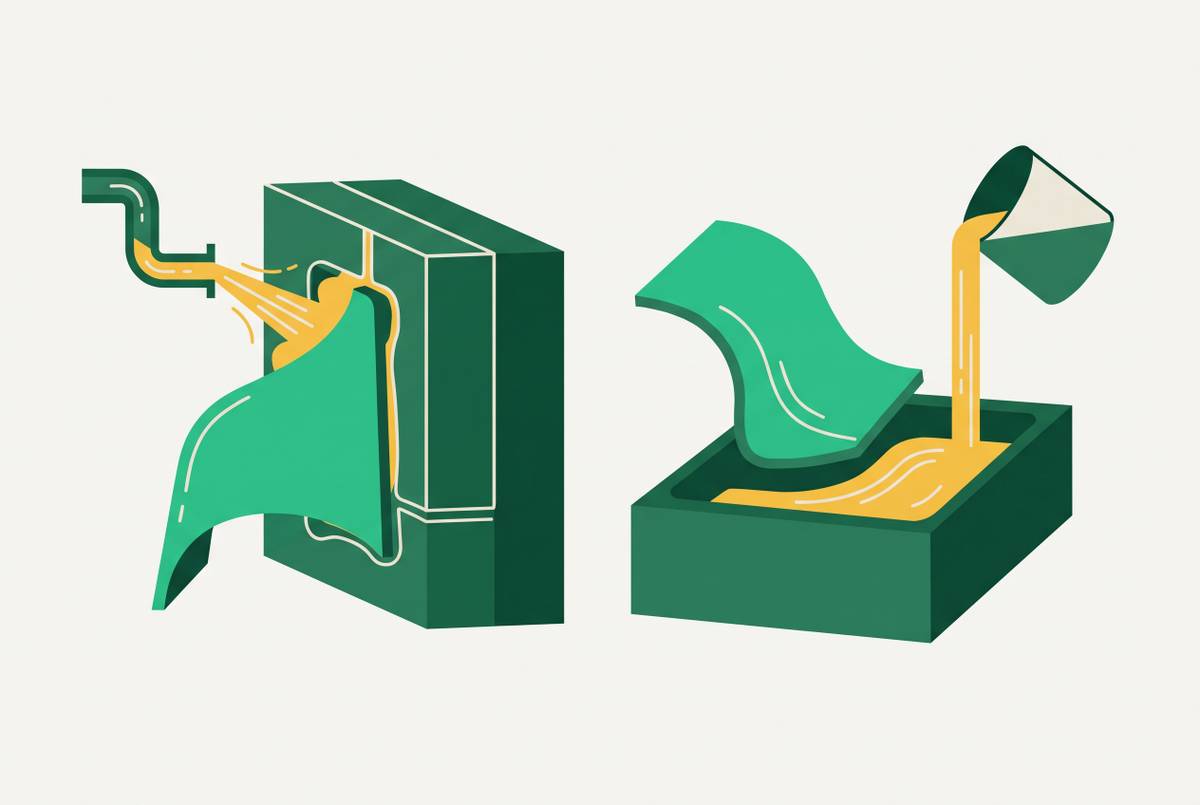
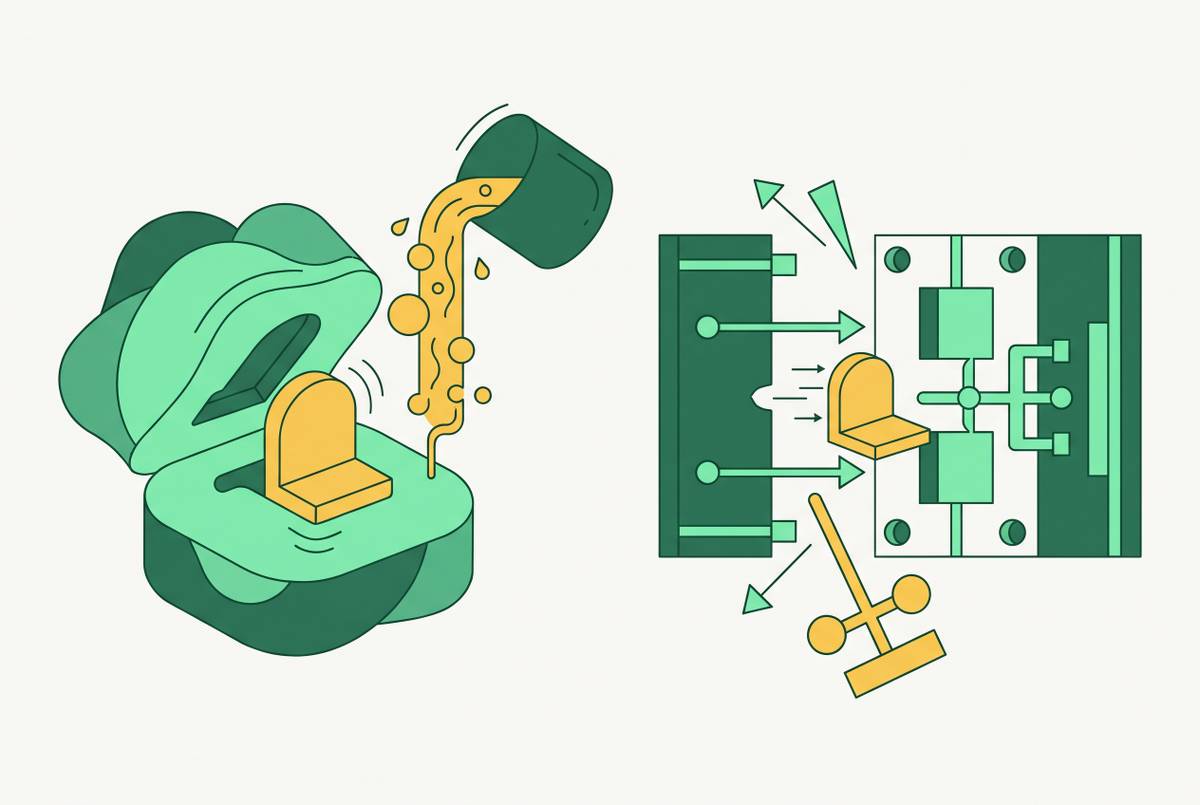
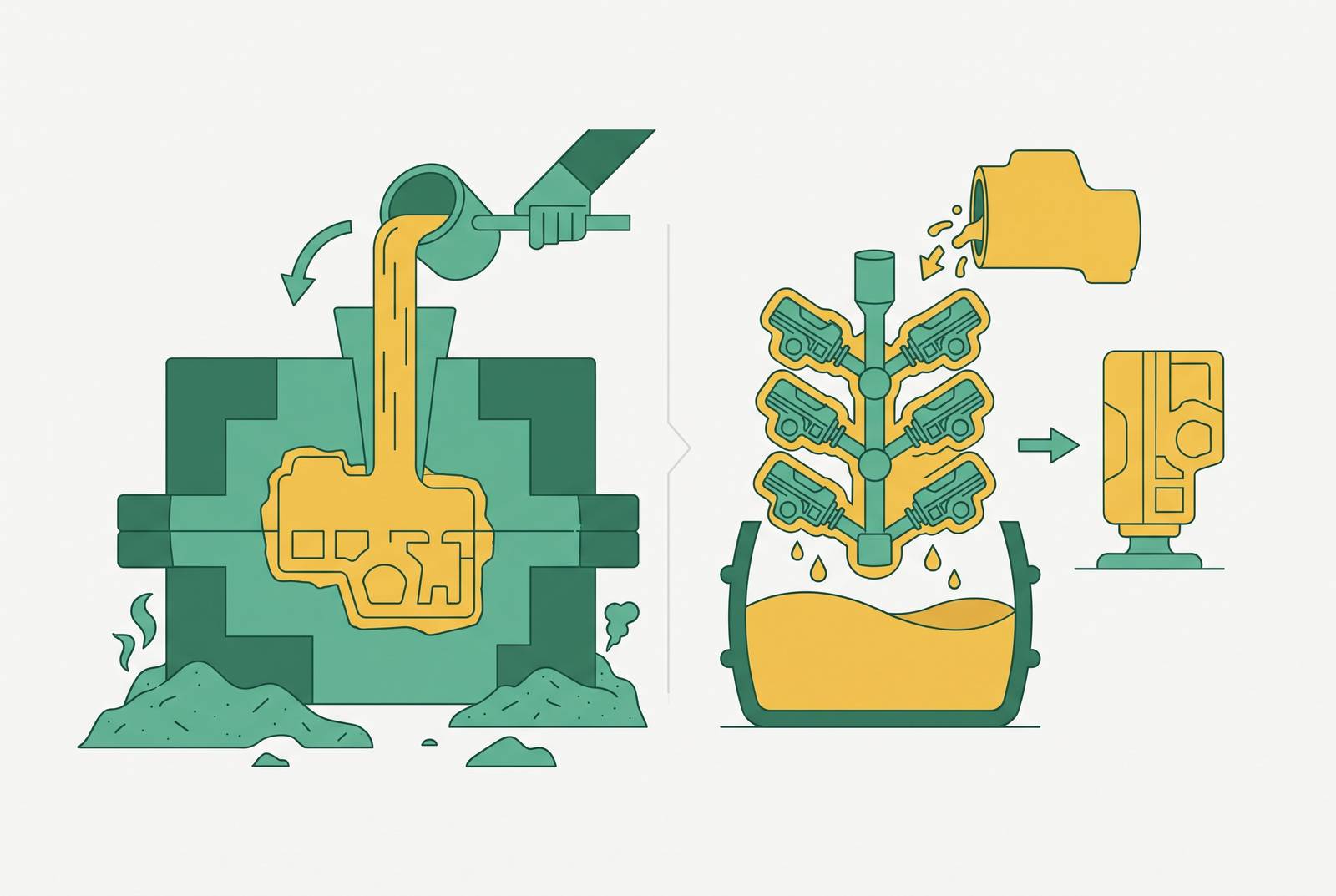
Sand casting starts with a reusable pattern, usually wood, plastic, or metal, pressed into bonded sand to form a mold cavity. The mold halves, called the cope and drag, get assembled, molten metal gets poured in, and once the metal solidifies, the sand mold is broken apart to free the part. The pattern survives and gets reused for the next cycle. That's efficient on the tooling side, but it comes with a tradeoff: the grain texture of the sand transfers directly onto the casting surface, and the dimensional tolerances loosen to match what sand molding can actually hold.
Investment casting, also called lost wax casting, works almost opposite. You inject wax into a precision metal die, producing an exact replica of the finished part. Several of these wax patterns are assembled onto a gating tree, and that tree gets dipped repeatedly in ceramic slurry until a shell builds up around it. The wax is then melted out, the ceramic shell is preheated, and molten metal is poured into the cavity the wax used to occupy. Once the metal cools, the shell gets broken away. Because the ceramic faithfully captures every detail of the wax pattern, the resulting part holds dimensional accuracy consistently from the first unit to the last.
That difference in workflow is where the cost structure splits. Sand casting tooling is simple, cheap, and reusable, but every part that comes out of it carries a rough surface and loose tolerances forward into the machining shop. Investment casting tooling is expensive and slow to build, but it yields a part requiring almost no additional work once it comes off the tree. Sand casting also leaves a visible parting line and a grainy surface on the metal, both of which matter on sealing or mating faces. Investment casting produces a seamless part with no parting line in the critical areas.
Geometry adds another constraint on the sand casting side. Because the pattern has to be pulled out of the sand, any undercut needs a core, and cores add cost fast. Investment casting doesn't have that problem. The wax pattern stays inside the ceramic shell until it's melted away, so undercuts, thin walls, internal passages, and complicated 3D curves are all fair game without extra tooling complexity.
Material choice, iron vs. steel, before geometry enters the conversation
For iron parts, you often make the process decision before anyone opens the drawing. Iron has a low melting point and high fluidity, and those casting properties line up well with how sand molds behave, so sand casting has handled iron at industrial scale for generations. Iron does need careful attention to melt chemistry, since even small amounts of iron oxide in the melt cause real quality problems, but that's a foundry process control issue, so it's not a reason to switch casting methods. Investment casting iron is technically possible. It's rarely worth the added cost.
Sand casting covers nearly every ferrous and non-ferrous alloy: iron, steel, stainless steel, aluminum, magnesium, bronze, copper. The main exceptions are alloys prone to hot cracking during solidification. Grey iron and ductile iron sit right in sand casting's comfort zone, and that's why engine blocks, pump housings, machine bases, and heavy structural components are routinely sand cast at every scale from a single prototype to full production runs.
Steel is where the decision actually opens up. Both processes handle carbon steel and low-alloy steel without issue, so if your part is steel, material alone won't settle the question. Investment casting also works fine with other ferrous and non-ferrous metals, and sand casting can handle high-melting-point metals without much trouble too. That means the deciding factors for steel live in geometry and volume, which the next two sections cover.
A simple rule clears most of the fog here. If the alloy is iron, start with sand casting and only look at investment casting if surface finish or pressure integrity demands it. If the alloy is a superalloy, a stainless grade, or a reactive metal in a complicated shape, investment casting is close to the only realistic option. If the alloy is carbon or low-alloy steel, move on to tolerance, finish, and volume.
Dimensional tolerance, surface finish, and machining scope
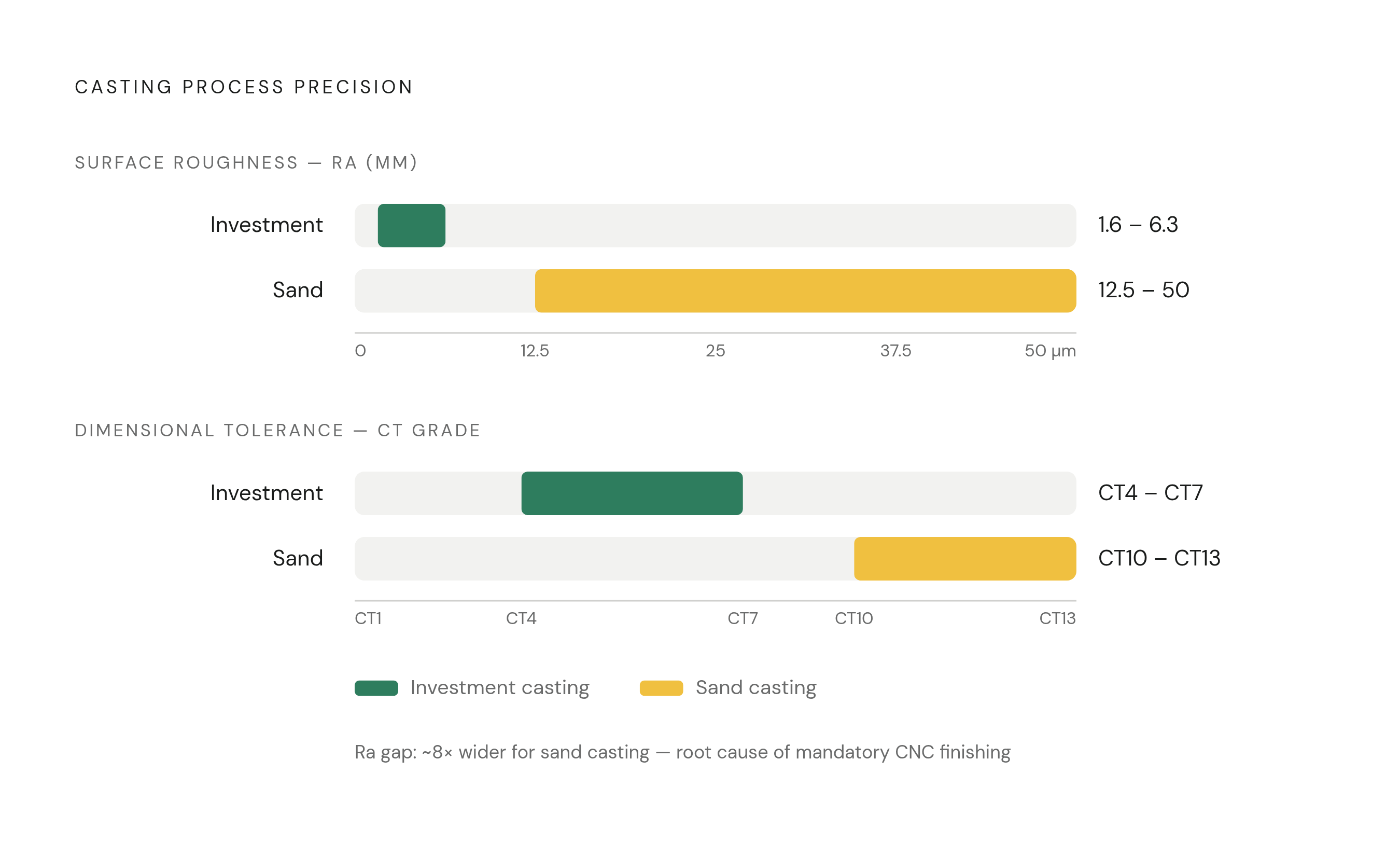
Tolerance and surface finish are where the total-cost argument actually gets decided, because that gap sets how much CNC work the part needs after it comes out of the mold.
Investment casting holds ISO 8062 tolerance grades CT4 through CT7. Sand casting holds CT10 through CT13. In practical terms, sand casting tolerances run roughly one to one-and-a-half percent of a given dimension, while investment casting holds a part to within a fraction of a millimeter. Surface finish follows the same split. Investment castings come out of the ceramic shell at Ra 1.6 to 6.3 micrometers, a finish comparable to light machining. Sand castings come out at Ra 12.5 to 50 micrometers, with a grainy texture visible to the eye and to the touch.
That gap decides how many operations a part needs on the machine. If a part has mating surfaces or tight assembly tolerances, it needs far less secondary machining when it starts life as an investment casting. A part that's cosmetic, or has a sealing surface that has to seal, needs machining or finishing work budgeted in if it starts as a sand casting.
The effect compounds on complex parts. A steel component with many functional surfaces, cast in sand, needs machining allowances added to nearly every face just to bring those surfaces within usable tolerance. The same component cast by investment casting only needs machining on the features that actually require tolerances tighter than CT7: mating flanges, bores, sealing faces. Everywhere else, the as-cast surface is good enough to ship. Engineers often don't see the full scope of this hidden secondary work until they've already committed to a vendor. Platforms that quote complete mechanical bills of material across multiple processes, OneWeekParts among them, surface the real cost of that secondary machining to an engineer before tooling gets cut, letting the casting decision be checked against the full downstream workflow.
Surface finish carries a structural consequence beyond cost. Smoother surfaces measurably improve fatigue life, which matters for any steel part under rotating or cyclic load, not just for how the part looks. Investment castings also tend to show lower internal porosity and pass pressure testing at a higher rate than sand castings, and on valve and pump bodies, that can remove the need for hot isostatic pressing or vacuum impregnation. Those are real savings, even if they sit behind the machining number rather than in front of it.
Tooling investment, part size limits, and the arithmetic of volume
Sand casting's cheap tooling is a genuine advantage at low volumes and on large parts, but that advantage fades as volume climbs, because every sand-cast unit still carries its own machining cost, while investment casting spreads its tooling cost across the whole run.
Sand casting tooling, a wood or metal pattern, costs little and takes little time to build, which makes it the natural entry point for prototypes, large parts, and very small production runs. Investment casting tooling costs more and takes longer to produce, since a precision metal die has to be cut before the first wax pattern can even be made.
As volume rises, the arithmetic shifts. Investment casting's per-unit cost drops because the process removes most of the secondary machining that a sand casting would still need on every piece. Sand casting's cheap tooling gets offset, unit by unit, by machining time that never goes away. Investment casting's higher tooling cost buys you a near-net-shape part that needs little or no further work, so the more units you produce, the better that tradeoff gets.
Part size puts a hard ceiling on that logic, though, one that tooling cost can't override. Investment casting has real size limits, so you can't use it for large parts. Sand casting has no such ceiling, so you see ship propellers, turbine housings, and structural frames weighing many tons routinely sand cast. Investment casting simply isn't practical at that size and weight, no matter how attractive its tolerances look on paper.
Volume and size together set the strategy. High production volume often justifies the higher upfront cost of an investment casting die, because the labor saved per unit on secondary machining pays that cost back. Low volume on a large part points the other way, toward sand casting's fast, inexpensive tooling. For teams that need to see a part before committing to either production route, 3D-printed wax patterns and 3D-printed sand molds now offer a middle ground. They can bypass hard tooling entirely for a prototype run of either process, which shortens lead time and removes tooling cost from the equation while the design still gets validated in the real material.
Design-for-manufacturability decisions that change total cost before a mold is cut
Choosing a process sets a ceiling on what the part will cost. Whether that ceiling actually gets reached comes down to design-for-manufacturability decisions made inside that process, and the same investment casting or sand casting job can swing substantially in total cost depending on wall thickness consistency, draft, parting line placement, and how transitions between sections are handled.
For investment casting, wall thickness uniformity matters more than any other single factor. When cross-section changes rapidly, different parts of the casting solidify at different rates, and that pulls metal away from adjacent thin sections, so you get shrinkage porosity that's invisible from the outside but weakens the part structurally. Where a thickness change can't be avoided, the transition needs to happen gradually rather than in an abrupt step, because an isolated thick section will need a riser to solidify properly, and that riser adds cost and more post-cast machining. Minimum wall thickness also varies by alloy, so confirming the number for a specific steel or stainless grade belongs in the quoting conversation with the foundry, not in the conversation that happens after the die is already cut.
For sand casting, the DFM priorities run differently. Draft angles let the pattern pull cleanly out of the sand. Generous corner radii improve how the metal flows into the mold and reduce stress concentrations in the finished part. Parting line placement should be chosen to keep the mold simple and to minimize the machining that has to happen after the part comes out. Risers and feeders need to be sized correctly to make up for shrinkage as the metal solidifies, since undersized feeders are one of the most common causes of internal porosity in sand castings, and that porosity drives up scrap and rework. Undercuts call for sand cores, and each core adds tooling cost and a new source of dimensional variation, so minimizing core count wherever the design allows is worth the extra thought at the drawing stage.
For aerospace and medical components, where fit, function, and weight all carry real consequences, investment casting's tolerance advantage translates directly into lower per-part cost once total machining is factored in, but only if the DFM work happens before the wax die gets cut, not after the first article comes back out of spec. Sand casting pushes its surface and tolerance costs downstream into secondary machining, while investment casting front-loads cost into tooling complexity, and you see that logic most clearly when both the casting and the finishing work get quoted together. Requesting both halves of that quote side by side, something a full-BOM quoting process built around multiple manufacturing methods can support, shows which process actually minimizes total cost for a given part's downstream workflow.
The cost of getting DFM wrong scales with when the mistake gets caught. A design flaw spotted at the quoting stage costs nothing to fix. The same flaw caught after tooling is cut costs the tooling. Caught during production, it costs the tooling, the scrap, and the delivery delay on top. The casting process decision and the DFM decisions inside it are the same question. They're the same question, answered at two different points in the project, and the earlier one gets answered correctly, the cheaper the later one turns out to be.