Urethane Casting vs. Injection Molding for 25 to 500 Unit Bridge Production
Aluminum tooling often beats urethane casting on total cost in the 100 to 500 unit range.
Choosing between urethane casting and injection molding for 25 to 500 units comes down to one thing: which process fits where the program actually sits right now, not some rule about prototyping versus production. Most teams get this backwards. They treat urethane casting as the "safe" default for anything under 500 units and save injection molding for later, and that habit costs real money in the 100-to-500 range specifically, where aluminum tooling often wins on total program cost and nobody bothers running the math to check. Four things decide the right answer: how much tooling cost is at stake, how fast parts need to show up, whether the design has stopped moving, and whether the material has to match a production resin. What follows walks through each one, then closes with a short set of questions to run before a purchase order goes out.
How each process actually works at the tooling level, and why that determines everything downstream
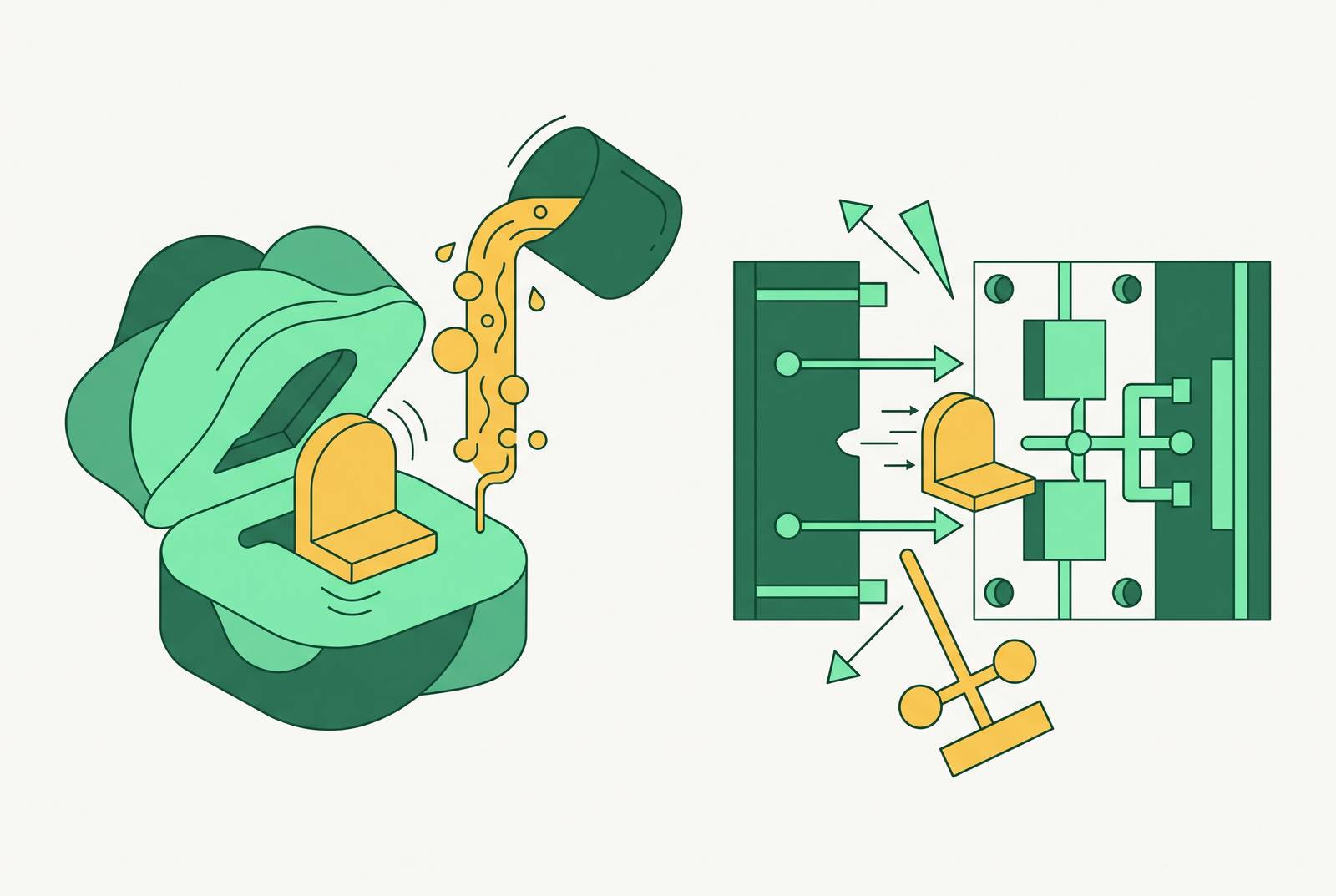
Urethane casting starts with a master pattern, either CNC-machined or 3D-printed. Silicone gets poured around that master to form a mold. Two-part liquid resin goes into the flexible mold, cures at room temperature or in an oven, and the part comes out. The silicone mold is the whole story here: cheap, fast to build, but it wears out fast. Most sources put usable life at 20 to 25 cycles per mold, though the same master can spin off a new mold once one gives out.
Injection molding runs on different logic entirely. A metal mold, usually aluminum or steel, gets machined with cavities, gates, runners, cooling channels, and an ejection system. Molten thermoplastic gets forced into that mold under high pressure, cools, and ejects. Building the tool is expensive and slow. But once it exists, it can run hundreds of thousands of cycles and hold the same geometry the entire way through.
The gap between silicone and metal reflects a difference in material, not a quality statement. It's a structural fact that explains why one process works as a bridge and the other works as a production commitment. Picking between them means picking between two different tooling business cases, not two tiers of part quality.
What the total cost math actually looks like across the 25–500 unit band
Total program cost is tooling cost plus unit cost times quantity. Looking at per-part price alone misses the point entirely, and that's where most cost comparisons go wrong before they even start.
Urethane casting keeps tooling cheap and pushes the cost into the per-part number. Silicone tooling typically runs in the low thousands of dollars, and per-part cost stays higher than injection molding at almost any volume. Injection molding flips that script: tooling costs a lot up front, and per-part cost drops low. A production-intent aluminum mold starts well above what silicone tooling costs, which is exactly why sinking $50,000 into a steel tool for a 50-unit run counts as avoidable risk, not smart planning.
A standard plastic gear molded at 10,000 units runs around $2.00 a unit through injection molding. The same part cast in urethane at 500 units runs closer to $3.50 a unit. That gap says the crossover point isn't fixed at 500 units for every part. It moves with geometry and volume together.
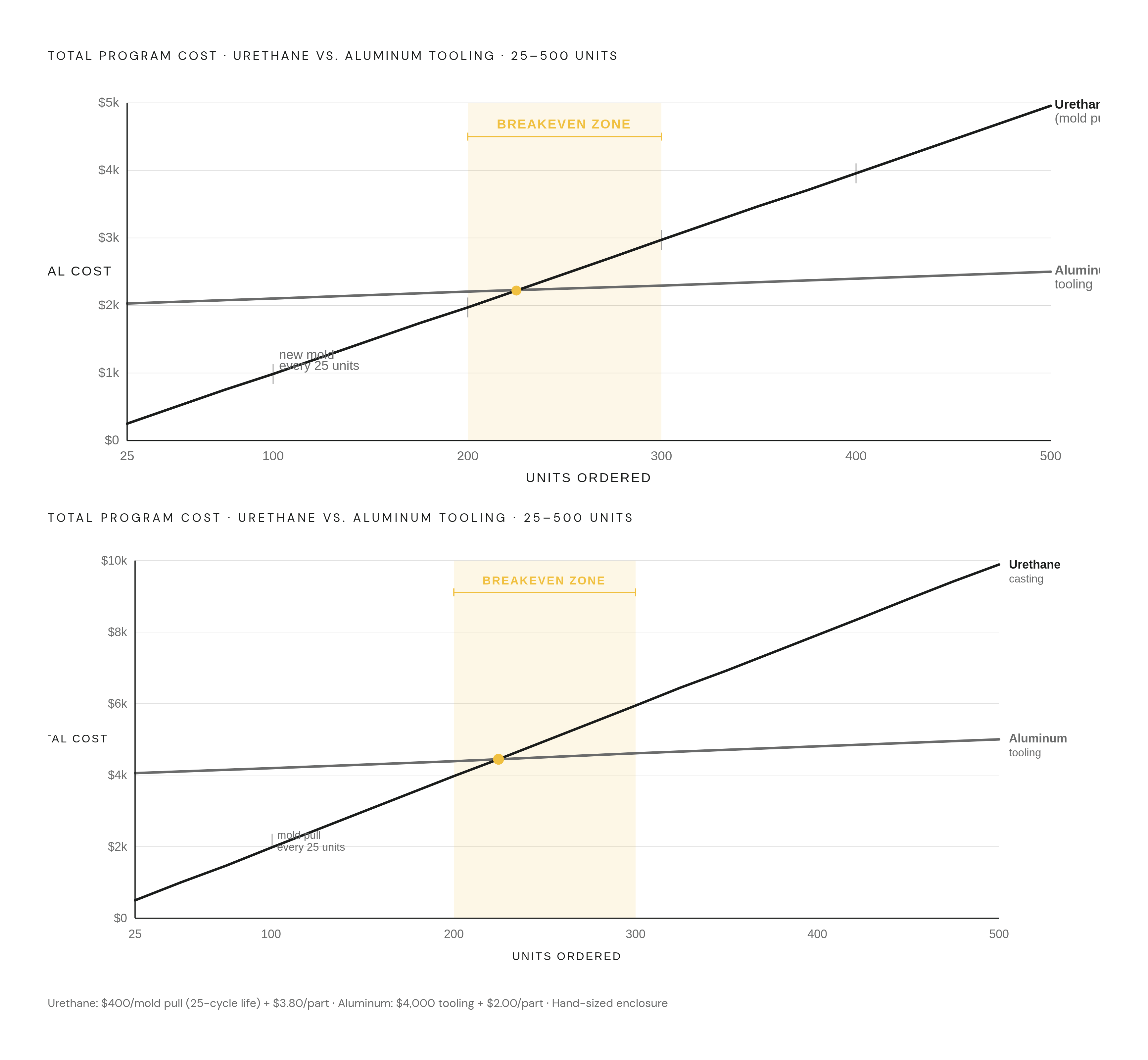
For something like a hand-sized enclosure, break-even against a modest aluminum tool tends to land somewhere between 200 and 500 units, and that range swings hard depending on part complexity, cavity count, and how many silicone molds the run burns through. That last part is the hidden cost nobody budgets correctly: silicone molds degrade after roughly 20 to 25 cycles, so a 200-unit order might need three or four separate mold pulls off the same master. Tooling cost in urethane casting isn't a one-time line item. It compounds per batch, quietly, and most quotes don't show that math up front. The more cycles a run demands beyond a single mold's life, the more mold pulls stack up against the same master.
What matters is how many total silicone molds a given volume will actually eat through, and whether that cumulative spend beats what an aluminum tool would have cost outright. Before this collapses into a binary choice, a middle path deserves its own line. Aluminum injection tooling, distinct from hardened steel, targets the 100 to 3,000 unit range at meaningfully lower capital than a full production tool. It belongs in the conversation from the start, not as an afterthought someone brings up in week three.
Lead time realities for each path, from CAD freeze to first good part
Urethane casting moves fast. A silicone mold is ready in 5 to 10 days, each casting cycle takes 30 to 60 minutes, and a full set of bridge parts can land in hand within one to two weeks of freezing the CAD.
Quick-turn aluminum injection inserts close that gap more than most people expect. Quick-turn aluminum inserts can deliver first parts in as few as 5 days total, a timeline that includes tooling design and fabrication before manufacturing even starts. For simple geometries, that's genuinely competitive with urethane casting on speed, and most teams never bother checking because they've already assumed injection molding means waiting a month or more.
Standard aluminum production-intent tooling takes longer: 2 to 4 weeks to first parts. Slower than urethane, but nowhere close to the 4 to 12 weeks that full hardened steel tooling requires. That steel number is the one that makes committing to production tooling at 25 to 100 units feel reckless when the design is still moving under everyone's feet.
So the lead time gap narrows considerably once bridge aluminum tooling enters the picture, and it only stays wide against full steel tooling. Schedule pressure still matters on its own terms. A program needing 50 beta units in two weeks has an obvious answer. A program planning a 400-unit pilot run over six weeks has room to actually run the aluminum tooling math instead of defaulting to urethane out of habit, and defaulting out of habit is exactly what happens more often than it should.
Tolerance, mold life, and dimensional consistency, where urethane casting has a ceiling
Well-executed urethane casting holds tolerances around ±0.010 to ±0.015 inches, or roughly ±0.25 to ±0.38 mm. Fine for a lot of bridge applications. Not fine for all of them, and the gap between those two categories is where programs get burned.
Silicone molds don't hold their shape forever. Surface finish degrades from around 0.8μm up past 3.2μm as a mold ages, and dimensional deviation up to ±0.2mm can show up after 50 casts. Parts pulled from mold 1 of a run may not match parts pulled from mold 4 of the same master, even though nothing about the CAD changed. In higher-stakes bridge production, part 200 can quietly drift from part 20 without any first-article inspection catching it, because the drift happens over the life of the run, not at the start of it. Master patterns themselves hold up for 25 to 30 uses before a new one has to be cut, which adds a cost and schedule event most quotes never mention up front.
Injection molding tolerances run tighter across the board. ±0.500 mm is easy, ±0.125 mm is achievable with solid DFM, and tolerances down to ±0.005 inches are possible depending on the part and the resin. Prototype aluminum inserts carry a guaranteed lifetime of at least 2,500 shots, sometimes up to 10,000, holding consistent geometry the whole way through. Production steel tooling goes well past that, running 100,000-plus cycles without losing shape.
Any part carrying fit, function, or regulatory tolerances tighter than ±0.015 inches needs a hard look before anyone commits a full bridge run to urethane casting. And any part that has to stay dimensionally interchangeable across 200-plus units needs real inspection planning across the entire run, not a sign-off on the first article and a hope that nothing drifted.
How material requirements can eliminate one process before cost or lead time enter the conversation
Cast polyurethane resins mimic the feel of ABS, polycarbonate, or rubber closely enough for form, fit, and a lot of functional testing. But they're simulants. They are not the resin that ends up in the finished product, and that distinction matters more than most teams give it credit for, right up until a beta unit fails a test the production resin would have passed.
Heat resistance draws a hard line: no cast urethane material holds up past 200°C. Any program with a thermal requirement above that gets eliminated before cost or lead time even enters the room. Tensile strength, wear life, and chemical resistance in urethane simulants also may not match the actual production thermoplastic, so beta units that pass testing in urethane can still fail once the real resin gets validated. That gap is exactly why urethane test data can't stand in for production resin validation on anything regulatory.
Urethane isn't just a compromise material, though, and it shouldn't get treated as one across the board. Shore hardness can be tuned across a wide range, from soft rubber to rigid plastic. It resists abrasion well in sliding or rolling contact, and it stays flexible across a wider temperature range than a lot of thermoplastics, which tend to go brittle in the cold. Those are real advantages for the right application, not a consolation prize handed to teams who couldn't afford steel.
Injection molding draws from a material library running past 25,000 engineered grades: thermoplastics and engineered resins spanning impact-resistant blends, high-temperature grades, chemically resistant materials, optically clear polymers, and food-contact compliant grades. If the production part has to be molded in a specific resin grade to satisfy a regulatory, thermal, chemical, or mechanical requirement, injection molding stops being optional. The bridge run needs that same resin, or the validation data collected on it doesn't hold up later.
If the bridge units exist for sales samples, form and fit checks, or early user feedback, urethane simulants hold up fine, and the cost and lead time advantages are real and worth taking.
DFM diverges by process, and design decisions made for one process can add cost or failure risk in the other
Urethane casting DFM stays fairly forgiving. Draft angles of 1 to 2 degrees on vertical faces, uniform wall thickness to avoid warping and trapped air during cure, geometries kept within reason. Push too much complexity into the part and both mold cost and cycle time climb, but the failure mode stays mild.
Injection molding DFM carries more weight and a lot less room for error. Wall thickness uniformity is the main defense against sink marks, since thicker sections cool slower and leave visible dents on the surface. Draft angles, rib and boss placement, gate location, parting lines, and shrinkage all need deliberate decisions before anyone cuts steel. Getting DFM wrong here is expensive in a specific way: a proper DFM review can cut tooling costs by 20 to 40% and bring T1 sampling iterations down from five or more to just one or two. Finding a design flaw after the mold is already machined is about as costly a mistake as this process allows, and there's no cheap fix waiting on the other side of it.
DFM works best as an input, not a checklist run after CAD gets frozen. Manufacturing feedback belongs in the room during the earliest design stages, not bolted on afterward once the geometry is locked. Some programs handle this by machining early units first, letting the design settle, then shifting into molding or casting as a deliberate cost-reduction step once changes stop landing. That's a legitimate strategy, not a shortcut someone's cutting corners on.
Switching processes mid-program isn't free, either. A part designed around urethane casting, loose draft angles, uneven walls, soft undercuts, usually needs rework before an injection mold can be cut against it. That rework takes real time, and it belongs in the schedule from day one, not something discovered halfway through tooling when it's too late to plan around cleanly. Getting DFM feedback at quoting time, before any tooling gets ordered, is the single highest-leverage moment to catch these issues before they turn expensive.
The decision framework: four questions that map a program to the right process at the right moment
This works better as a sequence of questions about where the program actually stands than as a flowchart comparing process features side by side.
Is the design stable? If it's still changing, urethane casting makes sense, since silicone tooling absorbs design revisions without torching a metal tooling investment. Once the design is stable or close to release, aluminum bridge tooling or a full production aluminum tool becomes worth serious consideration.
What does the material actually have to do? A part requiring regulatory, thermal (above 200°C), chemical, or mechanical validation against a named resin needs injection molding, full stop. Sales samples, beta feedback, and form-fit-function checks are all fair game for urethane simulants.
What volume does this specific batch need? Under roughly 50 to 100 units, urethane casting wins on total cost almost every time. Between 100 and 500 units with a stable design, run the actual tooling math, since aluminum bridge tooling can cross over on total program cost once multiple silicone mold pulls get counted honestly instead of ignored. Quick-turn aluminum inserts, delivering parts in as few as 5 days with a guaranteed 2,500-shot life, are a credible option sitting right in that range.
What tolerance and interchangeability does the part demand? Fit or function tolerances tighter than ±0.015 inches, or parts that need to stay dimensionally interchangeable across a 200-plus unit run, require building silicone mold drift (that ±0.2mm creep past 50 casts) into the risk model from the start. Cosmetic or low-tolerance functional parts sit comfortably inside urethane's tolerance band.
These four questions interact, and all four need to line up before a decision sticks. A program can pass on design stability, volume, and tolerance, pointing straight at urethane casting, and still get eliminated outright by the material question alone. What this framework produces is a provisional answer: the right process for where the program stands today, with an actual planned handoff to production tooling once demand justifies the jump.
Why sourcing both processes under one roof changes the execution risk of whichever path you choose
Everything above assumes the chosen process gets executed cleanly. That assumption breaks the moment urethane casting and injection tooling live at separate vendors, each running different lead times, different quoting processes, and different DFM standards.
When lead engineers spend a real chunk of their week chasing parts or arbitrating quality disputes between two shops, the program has stopped advancing development and started managing logistics instead. Consolidating both processes under a single capable supplier tends to cut overall lead time by 20 to 40%, mostly because parts stop sitting in a queue waiting to move between facilities that don't talk to each other.
The handoff risk runs especially high for bridge production. A program that starts in urethane casting and later shifts to injection tooling needs that transition actively managed, not thrown to a new vendor who's seeing the part for the first time and re-quoting it from zero. Handling both processes within the same bill of materials and the same quote lets a program move from silicone to steel without losing the institutional knowledge that got it there in the first place, and without paying twice for the education a new supplier needs before it cuts a single cavity.