Resin Printing vs. CNC for Optical and Lens-Mount Components
CNC wins on precision and stability; resin trades accuracy for speed and cost.

A lens cell bore that's off by 0.001 inches can decenter an optical element enough to blur the whole image. That margin, tighter than almost any other mechanical discipline, is what engineers weigh when they pick resin printing or CNC for optical and lens-mount parts. Neither process wins across the board, and treating them as interchangeable is the mistake most people still make. The right call comes down to matching the process to the part's surface, material, geometry, and volume, and holding that line even when a shortcut looks tempting.
CNC machining holds tighter tolerances than resin printing for lens cell bores and optical mount components, and the gap is not close. CNC routinely delivers ±0.003 to 0.005 mm with surface finishes under Ra 0.2 μm; defense-grade work in Invar or titanium gets to ±0.0005 inches, and precision camera lens barrels are finished to ±5 μm on critical diameters. The best resin setups, by contrast, hold ±0.05 to 0.15 mm across most of the build volume, with accuracy degrading further as part size increases past 50 mm because curing shrinkage of 1.5 to 3% stacks up across more volume. Orientation matters for printed parts because features built flat on the build plate come out more accurate than features stacked upward, and strength itself varies by axis since each layer bonds to the one beneath it rather than to a continuous bulk material, so any critical dimension needs its build orientation planned deliberately, not left to the slicer's default.
Get the call wrong and the cost doesn't stay small. A misassigned part throws off optical alignment, forces a re-order, and can quietly corrupt the qualification data for an entire assembly. Design-for-manufacturing research puts 70 to 80% of a part's final cost in the hands of decisions made at the design stage, not procurement. So process selection belongs on the drawing board, not in a quote request sent out after the part's already drawn.
What resin printing and CNC actually do to material, and why it matters for optics
CNC is subtractive. A machine cuts material away from a solid block, and what's left keeps the full bulk properties of that block: strength that's the same in every direction, known thermal behavior, zero porosity. Cut a bore in 6061 aluminum and it behaves like 6061 aluminum in every direction, at any temperature within reason.
Resin printing works the other way around. SLA, DLP, and MSLA machines build parts layer by layer, curing liquid photopolymer as they go. The result depends on direction: strength and stability hinge on how the part sat on the build plate, how well each layer bonded to the one under it, and which resin went into the vat. Two identical-looking parts printed in different orientations can behave differently under load, and that's not a defect, it's just how the process works.
For optics, that difference shows up hardest in thermal stability. CNC metals like aluminum, Invar, and titanium have coefficients of thermal expansion that are well documented and low. Resins vary a lot by formulation and can warp or creep under heat that a machined part wouldn't even notice.
Surface quality tells a similar story. A CNC surface comes straight off the tool path, a direct result of the cutter and the material. A resin surface carries layer-step artifacts and small contour defects baked in from the printing process itself, and getting that surface anywhere near optical quality takes real post-processing, not just picking a finer layer height.
Dimensional accuracy splits the same way. CNC accuracy comes down to how rigid the machine is and how worn the tool has gotten. Resin accuracy runs into shrinkage during curing, typically 1.5 to 3%, plus UV bleed that can grow features by 0.05 to 0.1 mm beyond the model. Orientation matters too: features built flat on the build plate come out more accurate than features stacked upward, so any critical dimension needs its build orientation planned on purpose, not left to the slicer's default.
None of this makes resin's layer-based build a flaw to put up with. It's a property to design around, and sometimes even use to your advantage, depending on what the part is actually for. That's the thread the rest of this piece follows.
Which process holds tighter tolerances for lens cell bores, and why does print orientation matter?
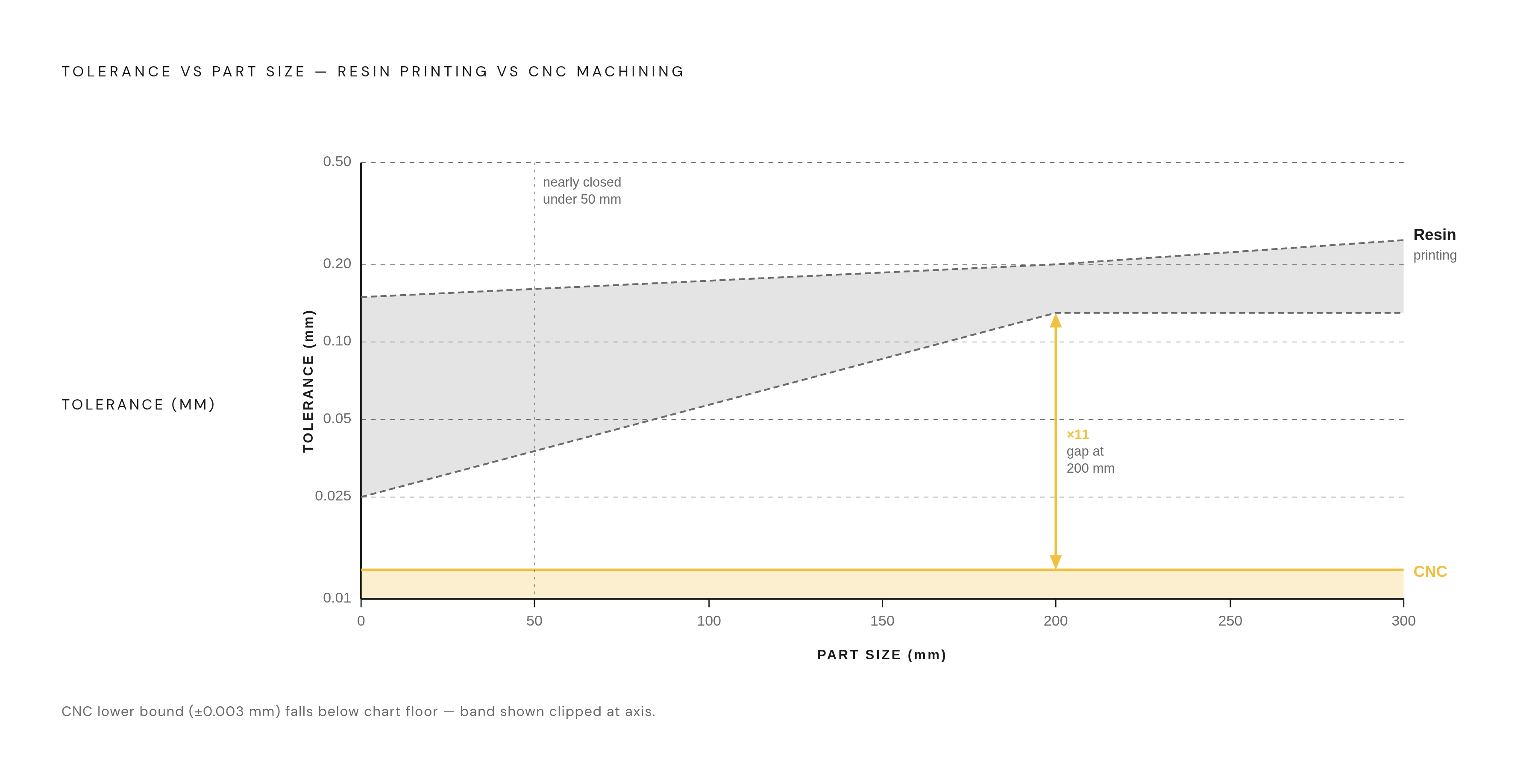
Professional SLA printers typically hold ±0.05 to 0.15 mm across most of the build volume, with some machine-resin combinations reaching ±0.025 mm on small features. Formlabs' own published specs put it at ±0.15% for features between 1 and 30 mm (with a floor of ±0.02 mm), loosening to ±0.2% for 31 to 80 mm, and ±0.3% for 81 to 150 mm. Accuracy drops off as the part gets bigger, plainly and measurably. A part under 50 mm can realistically hit ±0.002 inches. Push past 200 mm and expect ±0.005 to 0.008 inches, the cumulative result of shrinkage stacking up across more volume.
Surface finish off the printer isn't optical-grade on its own, and it never will be without help. Getting a resin surface down to sub-nanometer roughness and micron-level profile accuracy, the kind reported in 2024 research out of Purdue published in Advanced Functional Materials, took folding precision spin coating into the print process itself. That's not a stock capability sitting on a shelf waiting to be switched on.
CNC lives in a different tolerance band entirely. Lens mounts, barrels, and adjustment interfaces routinely hit ±0.003 to 0.005 mm with surface finishes under Ra 0.2 μm. Defense-grade optical work, machining Invar 36, titanium 6Al-4V, or 17-4 PH stainless, gets down to ±0.0005 inches with finishes to 16 Ra. Precision camera lens barrel production finishes critical diameters to ±5 μm, grinds helicoid thread surfaces to Ra 0.2 to 0.4 μm, and machines filter threads to ±0.01 mm. Five-axis optical bench work for scientific instruments sits at ±0.005 to 0.01 mm.
The gap between the two processes doesn't stay the same size across parts. For small, lightly loaded parts under 50 mm, the best resin setups edge into the low end of CNC's range, and that's the only place the comparison is even close. For anything bigger, or anything where precision actually carries the design, the gap opens fast and doesn't close.
Surface finish draws the cleaner line here, and it's barely a contest. CNC gives you sub-micron Ra straight off the machine. Resin needs real work to get anywhere close, and a standard print, untouched, has no business sitting anywhere near a light path. Threads follow the same logic: SLA-printed threads handle light-duty fastening fine, but anything precision-critical calls for captive nuts, thread inserts, or a pass on the mill afterward. Machined helicoid threads aren't in the same category at all.
Material capabilities: what each process can and cannot give you
CNC's material list for optical and optomechanical work runs deep, and each choice trades off differently.
6061-T6 aluminum is the default for a reason: good machinability, moderate strength, low weight, and it anodizes well. It shows up in lens barrels, housings, and mounts across commercial and scientific instruments alike. 7075 aluminum steps up the strength for parts under heavier mechanical load, while staying light. Invar 36 gets specified when thermal stability is the whole point, common in defense optics where any mismatch in expansion would throw off alignment across a temperature swing. Titanium 6Al-4V brings a strength-to-weight ratio that earns it a spot in defense and aerospace optical assemblies. 17-4 PH stainless steel covers precision barrels and adjustment mechanisms that need corrosion resistance along with strength.
Machinability generally decreases as material hardness rises. Aluminum cuts fast and cheap. Titanium and other exotic alloys are significantly more demanding and costly to machine.
Resin's material list is shorter and newer, though it's catching up fast in narrow lanes. Formlabs Rigid Resin has shown up in quantum optics lab work specifically for its low thermal expansion and high stiffness, used in DFB laser housings, lens tube mounts, and CSPD components. Elegoo's Saturn printer, paired with engineering resin, has been used for optical baseplates in atomic, molecular, and optical (AMO) physics experiments, with a high-temperature resin variant handling heated vapor cell holders.
Resin isn't uniform the way metal is, and no amount of formulation work changes that. The direction layers bond in builds in weakness along one axis, and while glass- or ceramic-filled resins cut down shrinkage, they tend to trade that for more brittleness. No resin on the market currently matches the bulk thermal stability or structural strength of aluminum, Invar, or titanium for anything load-bearing or thermally demanding, and none is close.
Post-processing needs differ sharply too. CNC optical parts typically need polishing, anodizing for aluminum, passivation for stainless, and protective coatings. Resin parts need UV post-cure, support removal, and surface finishing, and any threaded interface probably needs an insert or a trip to the mill.
Material, in practice, often makes the process decision before any other criterion gets a vote. If the part has to be Invar or titanium, that's CNC, full stop, no debate worth having. If engineering resin will actually do the job, resin printing gets to compete on the rest of the criteria.
Geometry and complexity: where each process has the structural advantage
CNC runs into a hard physical limit: the cutting tool has to reach the material. Undercuts, internal channels, and enclosed structures need multi-axis setups, special tooling, or in some cases just can't be made as one piece at all.
Resin printing doesn't run into that wall. It builds from the inside out, so internal channels, organic curves, hollow structures, and dense, integrated geometry come out without any extra setup cost. Complexity in resin doesn't drive up cost the way it does on a mill, and that's the single biggest reason to reach for it on an intricate part.
That freedom favors resin for a specific set of optical geometries. Baseplates with dense, custom mount-point layouts are one example: documented AMO lab research found that smaller 3D-printed baseplates with a higher density of mount points performed better than expected, with stability close to traditional optics setups. Custom lens holders and beam-path fixtures with organic routing, the kind that would need an expensive multi-axis CNC setup to reproduce, fall into the same bucket. So does any prototype housing where the shape is still being worked out rather than finalized.
CNC keeps the advantage where geometry demands precision motion or perfect roundness, and here resin just isn't in the running. Helicoid focusing mechanisms need precision thread cutting and grinding to achieve the required surface finish, a level of precision resin can't reach. Lens barrels with concentricity-critical bores depend on CNC turning's specialty for absolute roundness control, something resin can't hold. Tall, slender structures run into a different kind of trouble: the same AMO lab research found printed periscopes couldn't stay aligned for more than a day, warping and deformation under their own height. Adding a broader base helped, but didn't fix it. That's a geometric ceiling for resin, not a material quirk to footnote and move past.
Design-for-manufacturing thinking cuts the other way for CNC complexity. Internal corner radii, pocket depth-to-width ratios, and how many separate setups a part needs all drive machining cost hard. Increasing a corner radius can let a machinist swap in a larger cutter and cut machining time significantly. Small choices on the drawing carry big consequences on the shop floor.
Volume and iteration rate: how production quantity shifts the process calculus
Resin printing has no tooling cost to pay off. The same file prints one part or twenty with no setup penalty in between, which makes it the natural fit for low-volume work where the design is still moving.
CNC works the opposite way. Programming toolpaths, building fixtures, and running first-article validation are fixed costs that get cheaper per part only as volume climbs. A single CNC part, priced alone, looks expensive. Spread across a run of fifty, it doesn't, and that math is the whole reason CNC dominates production runs even though it looks slow up front.
A January 2025 study out of Tunghai University, published in Applied Optics, put numbers on the volume argument for resin. Fourteen headlight lenses came off one 8-hour print cycle at a resin material cost of roughly $30, hitting 93% transmittance against 94% for the CNC-machined comparison sample. The optical performance gap was small, almost a rounding error. The throughput and cost gap was not.
Iteration rate is its own variable, separate from raw volume. Early in an optical layout, an engineer might need a new baseplate geometry every few days just to check where components land before anything gets committed to aluminum. Resin's turnaround supports that loop. CNC, with its setup and lead time, doesn't, and forcing it into that role just burns budget on parts that are going to change anyway. A documented modular baseplate workflow makes the split explicit: prototype the layout in resin, confirm every optic sits where it should, then machine the final version in metal. Resin does the validating. CNC does the producing.
Where that volume line sits isn't fixed. It shifts with part complexity: a simple CNC bracket reaches cost parity with resin at a lower volume than a complex multi-axis housing would. And past a certain production volume, for polymer components specifically, injection molding overtakes both resin printing and CNC on cost. That transition point sits outside the resin-versus-CNC comparison this piece is built around, but it's worth flagging so nobody mistakes resin for the endgame at high volume.
The decision framework: mapping each criterion to a process assignment
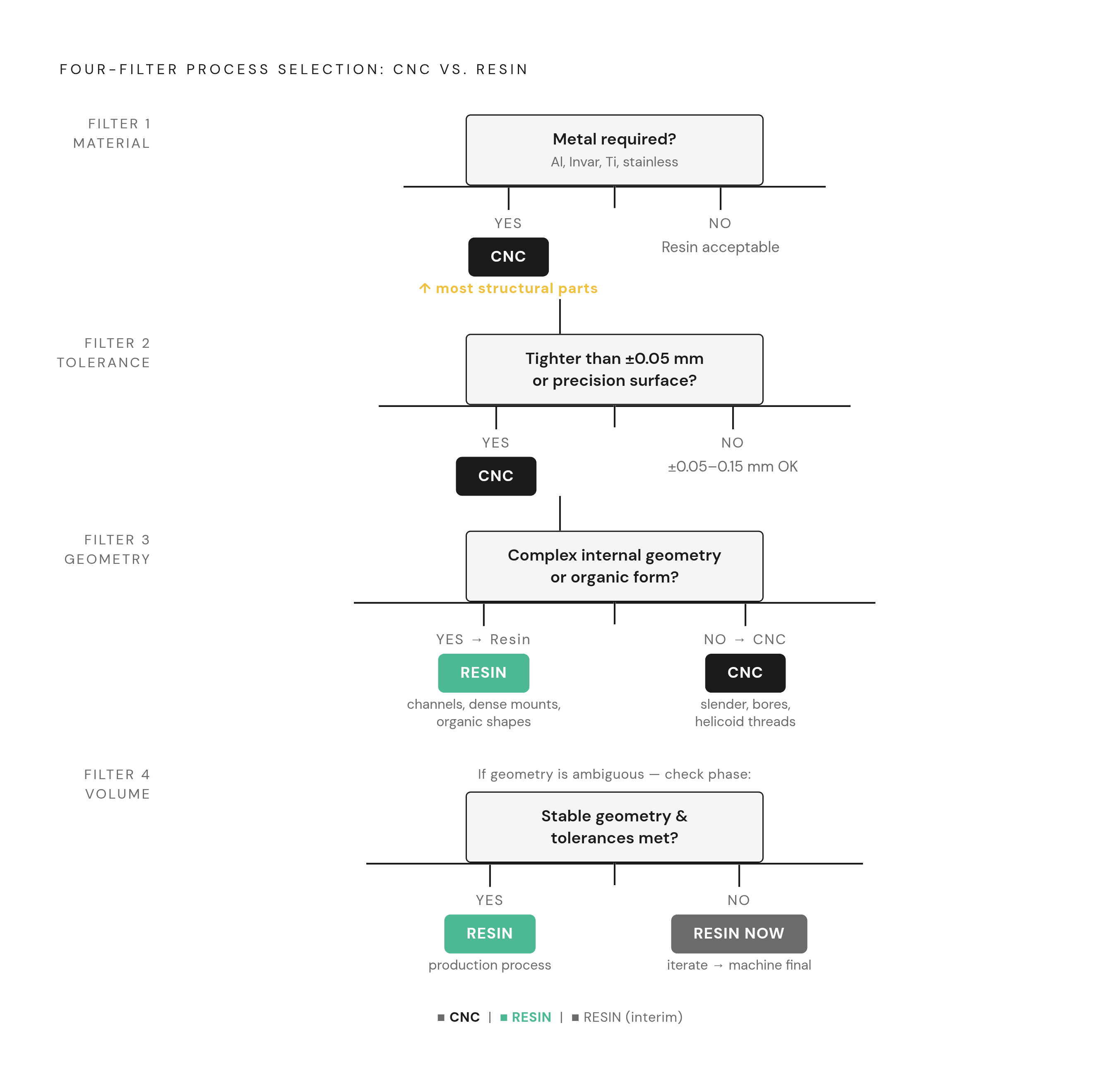
None of this needs a scoring matrix. Run it as a sequence of filter questions, each one either ruling a process out or confirming it, in order.
Filter 1, material. Does the part need to be metal, aluminum, Invar, titanium, or stainless? CNC wins and resin is out of the running, no exceptions. Is engineering resin actually acceptable for the job, whether that's a prototype, a non-load-bearing mount, or a thermal environment resin can handle? Then resin printing stays in the running for the next filter.
Filter 2, tolerance and surface finish. Does the part need tolerances in the range CNC routinely delivers, such as ±0.003 to 0.005 mm or concentricity control down to ±5 μm, or a surface finish that resin cannot reach without significant post-processing? CNC, and don't bother testing resin against that bar. Does the tolerance sit inside ±0.05 to 0.15 mm, with a surface finish that matters for mounting rather than for the actual light path? Resin printing works. Threads split the same way: precision helicoid or adjustment threads go to CNC, light-duty fastening with inserts is fine in resin.
Filter 3, geometry. Internal channels, dense mount arrays, organic shapes that would need an expensive multi-axis CNC setup to reproduce? Resin has the advantage. A tall, slender structure shaped like a periscope? Resin can't be trusted there, even with a broadened base, so the part goes to CNC or a hybrid design. Precision cylindrical bores or multi-start threads? CNC, no real substitute exists.
Filter 4, volume and iteration phase. Still validating layout, still iterating fast, volume low? Resin now, with a plan to re-machine the final version in aluminum once the geometry settles. Low-volume production, under a few dozen units, geometry stable, tolerances within resin's reach? Resin printing can serve as the production process itself, not just a stand-in for one.
Run a part through all four filters and the answer stops being a judgment call. It becomes the plain output of what the part actually needs, whether that verdict is the popular one or not.
Sources
- 3D Printing of Optical Lenses Assisted by Precision Spin Coating - Shan - 2024 - Advanced Functional Materials - Wiley Online Library
- Qubit operations using a modular optical system engineered with PyOpticL: a code-to-CAD optical layout tool
- arxiv.org
- Additive manufacturing wins out over CNC machining in headlight lens case study - Engineering.com
- machining-custom.com