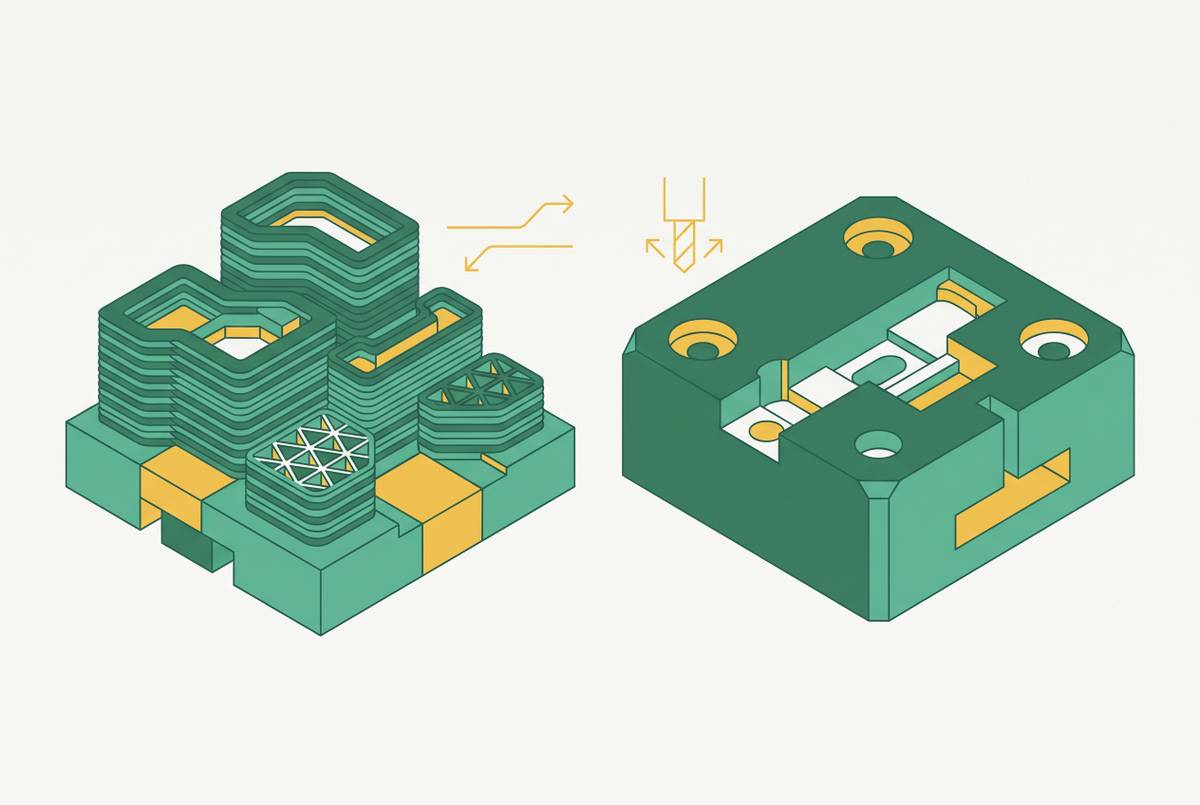
Multi-Axis CNC vs. DMLS for Titanium Aerospace Brackets
DMLS wins for complex geometry; CNC dominates simple, high-volume brackets.

Ti-6Al-4V dominates aerospace bracket work because its strength-to-weight ratio, corrosion resistance, and fracture toughness beat almost anything else in the alloy catalog. That same chemistry makes it miserable to cut or print: low thermal conductivity, a habit of work-hardening under the tool, and a cost per kilogram that punishes waste. Most engineers still default to CNC out of habit, even when the geometry fights them the whole way through the job. That habit is the single most expensive mistake in this decision, and it's worth naming before anything else: for a titanium bracket with any internal geometry, DMLS is typically the stronger process choice, though quantity and geometry complexity still shape the final economics.
Forging, casting, and rolling still cover most aerospace titanium volume, and that's not a knock on either process discussed here. CNC and DMLS own specific niches, brackets with complex geometry or modest production runs, rather than replacing forged parts on high-volume, predictable components.
What multi-axis CNC actually does to a titanium bracket, and where it struggles
Five-axis simultaneous machining is the right call for most aerospace brackets, for one plain reason: one setup lets the tool reach almost any angle, so there's no datum shift from re-clamping the part halfway through the job. Compound-curved surfaces, angled interfaces, deep cavities, anything that outruns a 3-axis or 4-axis machine, is native territory for 5-axis work. Cutting a bracket in one setup instead of three isn't a convenience. It's the difference between holding tolerance and chasing it around the shop floor.
Titanium fights back at every stage, though. Low thermal conductivity means heat pours into the cutting tool instead of dissipating into the workpiece, which chews through tool life and forces slower feed rates. Threading is its own small battle: engagement often gets dialed back well below the usual threshold, with a larger pilot hole just to keep tapping torque and galling under control. None of this is optional gear. Through-spindle coolant, spindle oil cooling, vibration-damped bed construction: these are baseline requirements for cutting titanium, not upgrades bolted on later.
Buy-to-fly is really the economic core of the whole CNC argument. Conventional machined titanium brackets run ratios of 12:1 to 25:1, meaning up to 90% of the billet ends up as chips on the floor, and at roughly $80 per kilogram for Ti-6Al-4V bar stock, that waste decides whether CNC makes sense at all. Topology optimization paired with near-net-shape blanks can pull that ratio down toward 3:1, but only if the design work happens upstream, before anyone touches a toolpath. Wait until the part is drawn the old way, and that savings is gone for good.
Tolerance work adds another squeeze. MIL-SPEC jobs often call for ±0.0001 inch precision, and aerospace machining broadly holds tighter than ±0.025 mm. Add AS9100D, ITAR registration for defense programs, and NADCAP approval for special processes like NDT or coatings, and a supplier without those credentials simply isn't in the running. These aren't differentiators. They're the price of entry.
CNC genuinely breaks down at internal channels, lattice structures, organic topology-optimized shapes. A cutting tool can't turn a corner it can't physically reach, and no amount of 5-axis cleverness changes that. Shops underrate this failure mode because it doesn't show up as a machining problem on the floor. It shows up months later, as a redesign, when the "simple" bracket turns out to need a passage nobody can cut.
What DMLS actually does to a titanium bracket, and where it struggles
Direct metal laser sintering fuses Ti-6Al-4V powder layer by layer with a high-power laser. Unfused powder gets recycled, support structures hold the geometry during the build, and those supports have to come off afterward. Then comes stress-relief heat treatment, wire-EDM removal from the build plate, and CNC post-machining of any tight-tolerance feature. DMLS on its own almost never finishes a flight-critical bracket, and anyone selling it as a one-step process is skipping the part that actually eats the schedule. DMLS plus post-machining is the real workflow. Treat DMLS alone as a finished part and the quote comes in low, then the schedule blows up later.
Surface finish makes the point plainly. As-printed roughness typically runs 8 to 25 micrometers, fine for a surface that doesn't mate with anything, nowhere near acceptable for bearing journals, sealing faces, or interference fits. Post-machining brings those critical surfaces down to Ra 5 to 10 micrometers, on par with CNC, but that step adds real time and cost that has to get budgeted at the start, not discovered when the part comes back from inspection.
Mechanical properties have closed a lot of ground, though not all of it. Optimized DMLS Ti-6Al-4V now clears 950 MPa ultimate tensile strength with 10% elongation, and a 2024 study measured printed Ti-6Al-4V reaching 95% of wrought material properties after optimization. That remaining 5% matters a great deal in fatigue-critical primary structure, and matters far less in secondary brackets where stress is already bounded by analysis. Hot isostatic pressing closes residual porosity and is close to standard now for any flight-critical DMLS titanium part, so it belongs in the cost model from the start, not treated as an optional extra tacked on at the end.
Throughput is where DMLS actually loses the argument, and it loses badly. Machine time runs around $97 an hour, and a 100-part build takes roughly 109 hours, about 65.4 minutes per part. A well-developed CNC job on simple geometry does the same job in around 2.4 minutes per part. That gap is the single biggest reason DMLS falls apart once quantities climb and the geometry gets simple. Powder cost doesn't rescue it either: Ti-6Al-4V powder runs $200 to $400 per kilogram, not dramatically cheaper than billet once the shape is basic. Standard DMLS tolerances land around ±0.1 mm before post-machining, plenty for most bracket envelope features, nowhere near enough for a precision interface without a secondary CNC pass.
The cost crossover in concrete terms: a titanium bracket at quantity 50
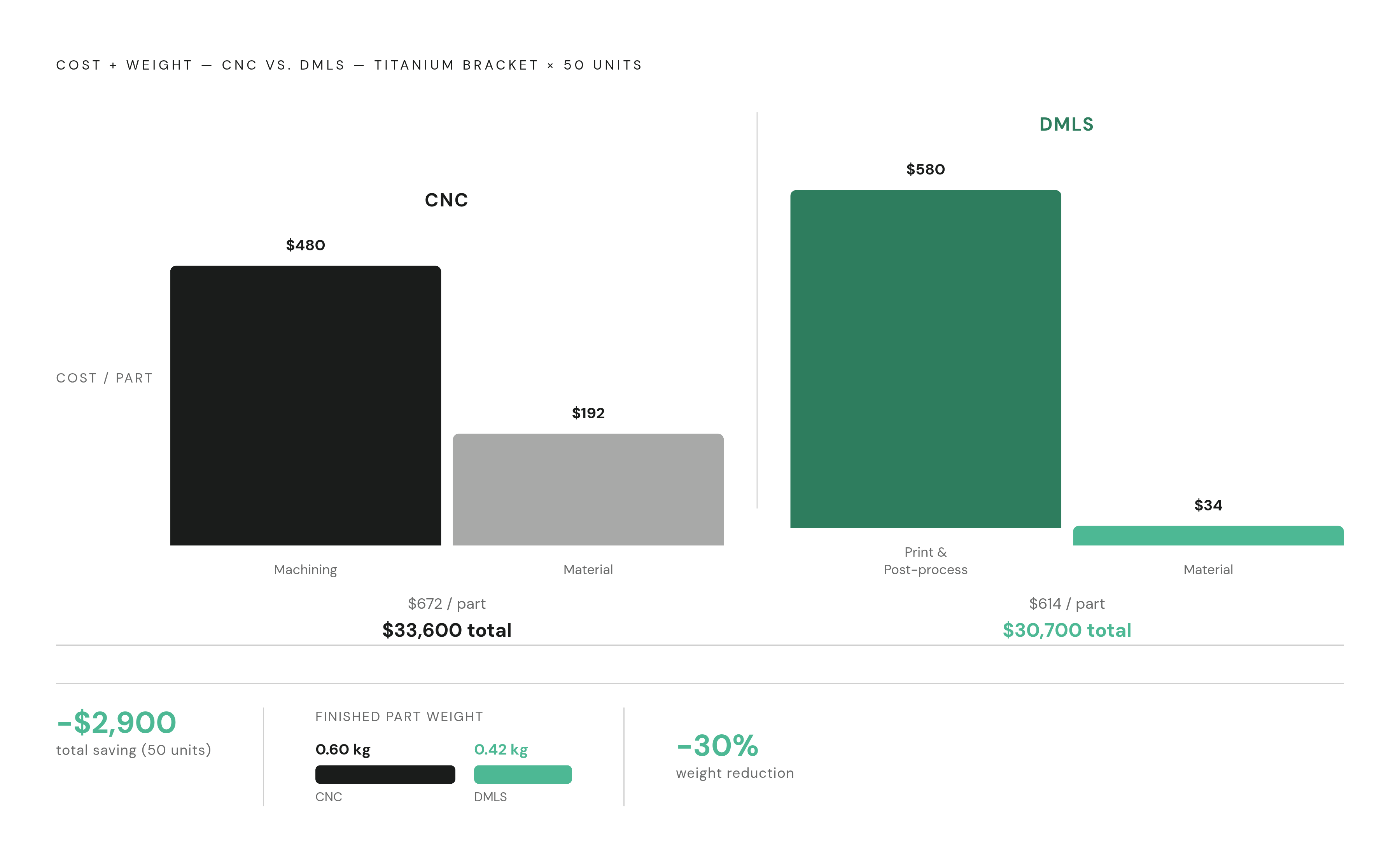
Take a bracket machined from a 2.4 kg billet down to a 0.6 kg finished part. Material runs $192, machining adds $480, for a total of $672 per piece. At 50 units, that's $33,600.
Now print the same part with DMLS and pull another 30% of the weight out through lattice structures, landing at 0.42 kg finished. Material cost drops to $34, print plus post-processing runs $580 per piece, for a total of $614. At 50 units, that's $30,700.
DMLS wins by $2,900 at this quantity, and the bracket comes out 30% lighter besides. Two wins from one process decision, and that's exactly why DMLS deserves better than the "still too expensive" reputation it carries in a lot of engineering shops.
Flip the material, though, and the whole equation reverses. A conventional aluminum bracket in 6061-T6 costs around $35 per piece by CNC, or $7,000 for 50 units. DMLS on the same aluminum part can run 5 to 15 times more. The crossover in the titanium example isn't some universal law of additive manufacturing being cheaper. It's driven specifically by how expensive titanium is to waste as scrap. Take titanium out of the picture and CNC wins outright, no contest, no modeling required.
Early in a program, prototyping tilts further toward DMLS, since validating a complex bracket with no fixtures and no CAM programming is almost always cheaper before anyone commits to toolpaths and hard tooling. The worked example above holds for a geometrically complex bracket with real topology optimization opportunity. A simple drilled-and-pocketed plate bracket never crosses over at all, and modeling it as if it might is wasted effort.
The geometry variables that predict which process wins before you run the math
Internal features are the cleanest signal there is. Cooling channels, lattice infill, conformal passages, none of it is machinable no matter how many axes the mill has. For a titanium or Inconel bracket with internal geometry, DMLS wins regardless of quantity. No modeling required, no exceptions worth arguing over.
External complexity is murkier. Compound-curved surfaces, swept flanges, multi-face precision work: 5-axis CNC handles all of it well and runs faster per part once the program is written. Deep undercuts only start tilting toward DMLS when they need tool access from more than two directions and can't be fixtured efficiently.
Tolerance sets a hard floor. CNC holds ±0.025 mm or tighter as a matter of course; DMLS holds ±0.1 mm before any post-machining touches it. A bracket loaded with tight-tolerance interfaces, bearing journals, pin bores, sealing faces, needs post-CNC no matter which process shapes the envelope, so that cost and lead time belongs in the DMLS model from day one. If most of the surfaces on the part need tight tolerance, machining the whole thing on CNC is usually just faster than printing it and then machining half of it anyway.
Buy-to-fly ratio works as a quick gut check before anyone runs real numbers. Ballpark the machined ratio above roughly 10:1, and the material waste on titanium alone justifies building out a real DMLS cost comparison. If the bracket is basically flat or prismatic with modest stock removal, CNC wins without any modeling required at all.
Weight budgets change the calculus too. When topology optimization is baked into the design intent from the start, DMLS opens up weight savings that CNC can't touch without resorting to exotic multi-step processes. That moves structural mass budgets on an actual flight vehicle, not a line on a spec sheet nobody reads twice.
Organic, non-prismatic envelopes point the same direction. A bracket shaped to conform to a curved fuselage skin, or one that has to integrate into a rib, fights against fixturing on a CNC table by its very shape. DMLS is the natural fit there, and forcing it onto a mill just because that's the familiar process wastes both time and material.
How program stage shifts the right answer even for the same bracket geometry
Early in a program, DMLS carries a real advantage simply because it needs no tooling. No fixture fabrication, no CAM programming for complicated setups, and geometry can change between builds without sunk cost piling up. As-printed tolerances are plenty good enough to check fit, clearance, and assembly interfaces at this stage, so don't waste budget chasing CNC-grade finish on a part that's still going to change shape twice more.
Move into qualification and first-article testing, and DMLS mechanical properties, that UTS exceeding 950 MPa, 95% of wrought after optimization, hold up fine for secondary brackets. Primary structure demands a lot more documentation before anyone signs off. AS9100D and NADCAP approval for DMLS titanium is achievable, but it adds lead time, so plan for it ahead of the qualification build instead of discovering the gap mid-program. If the bracket is eventually moving to CNC for production anyway, qualifying both processes on the same design is wasted effort. Pick the production process, and qualify that one only.
Low-rate initial production is where things get genuinely close. Quantities around 50 units sit right near the crossover point for a complex titanium bracket, which means the cost model has to run against the actual part geometry, not assumptions carried over from a different bracket. DMLS throughput, that 65.4 minutes per part, becomes a real schedule risk here unless build plate space gets used efficiently by nesting several brackets into one build.
Full-rate production tips hard toward CNC. Setup costs are amortized, toolpaths are proven, cycle times are optimized down toward that 2.4 minutes per part for simpler geometries. Conventional processes' dominant share of aerospace titanium volume reflects exactly this pattern: volume pulls production back toward subtractive methods for most bracket families. The exception is brackets with internal features or extreme weight targets that genuinely can't be made any other way. Those stay in DMLS even at high volume, because there's no alternative, not because DMLS got cheaper at scale.
When the right answer is neither process alone: the hybrid CNC + DMLS workflow
Sometimes the honest answer is to stop treating this as an either-or choice. DMLS builds the complex envelope and any internal geometry, then CNC finishes whatever surfaces need tight tolerance and a smooth finish. Standard practice adds 1.0 mm of machining stock to DMLS-printed features, bearing journals, pin bores, mating flanges, so those spots get finish-bored on a 5-axis mill after the print comes off the build plate.
That workflow captures DMLS's buy-to-fly advantage and its geometric freedom, while still meeting CNC-grade tolerance on the interfaces that actually need it. Neither process delivers both on its own, and pretending one will is how programs end up with a bracket that's either overweight or out of tolerance. Hybrid approaches that combine additive and subtractive steps take this further, building near-net shapes and finishing critical surfaces without reintroducing fixturing error, a direction worth tracking as the technology matures.
The catch sits upstream, at the drawing stage. Design has to flag early which surfaces get post-machined, and the datums for that CNC operation need to stay accessible and stable after the DMLS build finishes. Skip that step, and the consequences show up later as rework, not as a line item anyone budgeted for. The DFM decisions made early are the ones that actually hold the budget together, and no amount of clever machining downstream fixes a datum nobody protected at the drawing board.