Progressive Die Stamping Versus Laser Cutting for High-Volume Brackets
Know your break-even volume or overpay for brackets every single month.
Progressive die stamping and laser cutting split brackets into two different cost curves, and picking wrong costs real money. Get the break-even volume wrong and you either sink cash into a die that never earns it back, or you keep paying a per-part laser premium on parts that should've been tooled a year ago. Most teams get this backwards: they tool too early out of fear of laser costs, or they stay on laser too long out of fear of commitment. The second mistake is the more common one and the more expensive one, because every month spent on laser past break-even is money a $30,000 die would've already earned back.
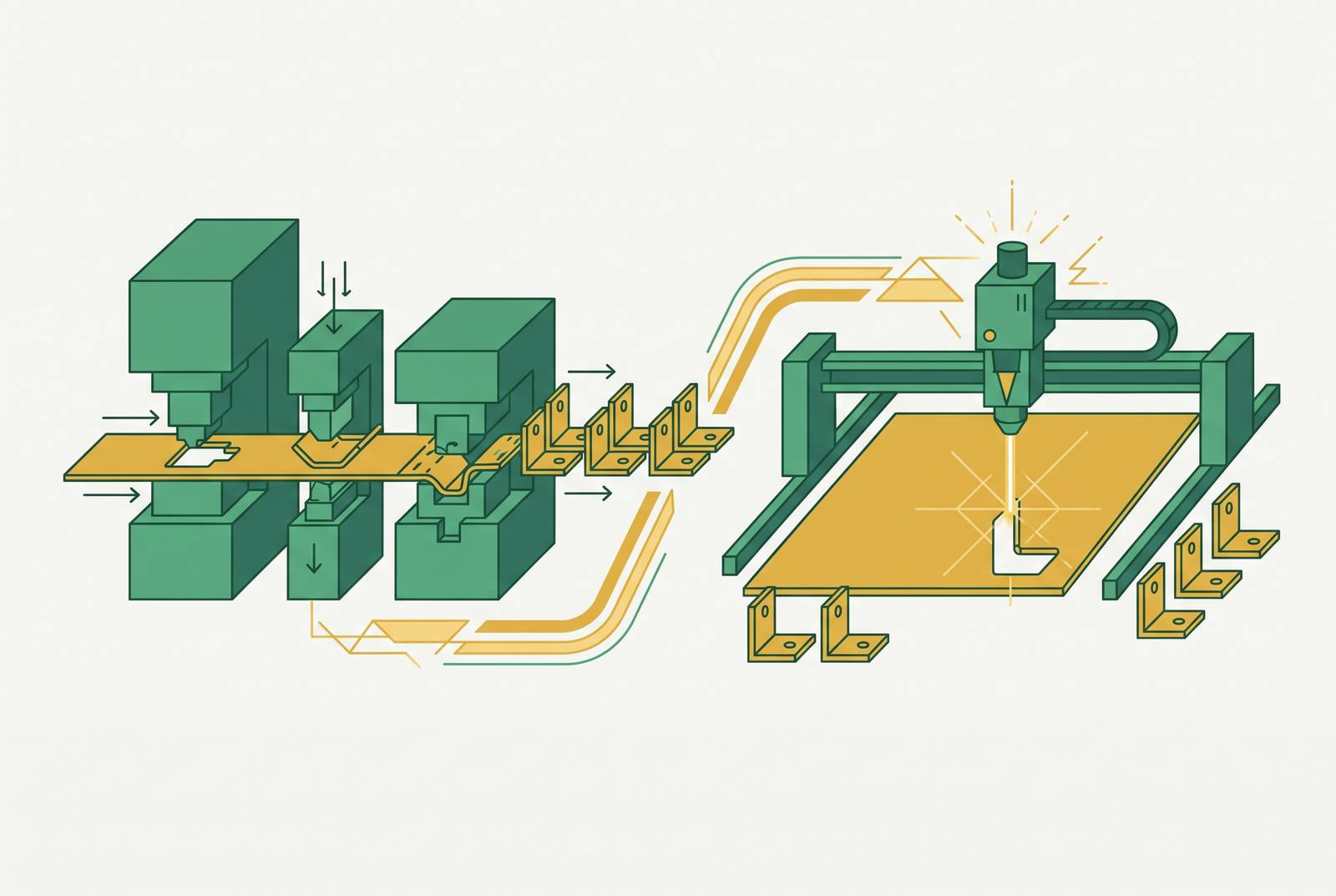
Progressive die stamping feeds coiled metal strip through a series of stations built into a single tool. Each press stroke fires every station at once, piercing, forming, bending, blanking, and the part comes out finished at the far end of the strip. The geometry has to be locked into the die before the first stroke ever happens; adjusting mid-run means pulling the tool apart and reworking it.
Laser cutting runs on a different logic. A focused beam melts or burns through metal along a path set in a CAD file, so the geometry lives in software. Change the design, and you update the file, no new hardware, no waiting on a toolmaker. Both processes start from flat sheet or strip, which is why brackets end up as candidates for either one. Laser cutting stays flat, producing 2D profiles that still need a separate press brake pass for any bend, while stamping folds forming and blanking into the same stroke. Thickness ranges split too: progressive dies run 0.1 mm to 6 mm, while fiber lasers reach up to 25 mm in stainless on high-output systems. Volume, geometry, and how much runway you have before parts ship decide which process wins.
Where tooling cost meets per-part cost: how the break-even works
Laser cutting carries almost no setup cost, but the per-part price stays high, driven by machine time and consumables. Stamping flips that arrangement: heavy money up front, then a piece price that drops close to the cost of the raw metal itself.
Progressive die tooling runs $30,000 to $250,000 depending on station count, material, and part complexity. A simple two-station pierce-and-blank die for a 1.5 mm stainless washer costs closer to $8,000 to $12,000. Run the math on a $30,000 die that drops per-part cost from $5.00 on laser to $0.50 stamped: that die pays for itself at 20,000 parts, and every part after that saves $4.50. That's the number that should drive the decision, ahead of any gut feel about which process sounds cheaper.
Laser pricing does fall as volume climbs and suppliers offer breaks, but it hits a floor tied to cycle time and consumable burn. Past a certain annual volume, squeezing the laser shop for a better rate stops moving the needle, because the process itself, not the supplier's margin, sets the ceiling on how cheap a part can get. Teams that keep shopping for a better laser quote instead of running the break-even math are solving the wrong problem.
Break-even isn't fixed. More stations mean a pricier die, which pushes the crossover volume up. Stainless needs costlier die steels than mild steel, so that raises the threshold too, and bigger parts shift it further still. The actual calculation: take the laser unit cost, subtract the stamped unit cost, multiply by projected annual volume, then compare that number to tooling cost spread over the product's expected life.
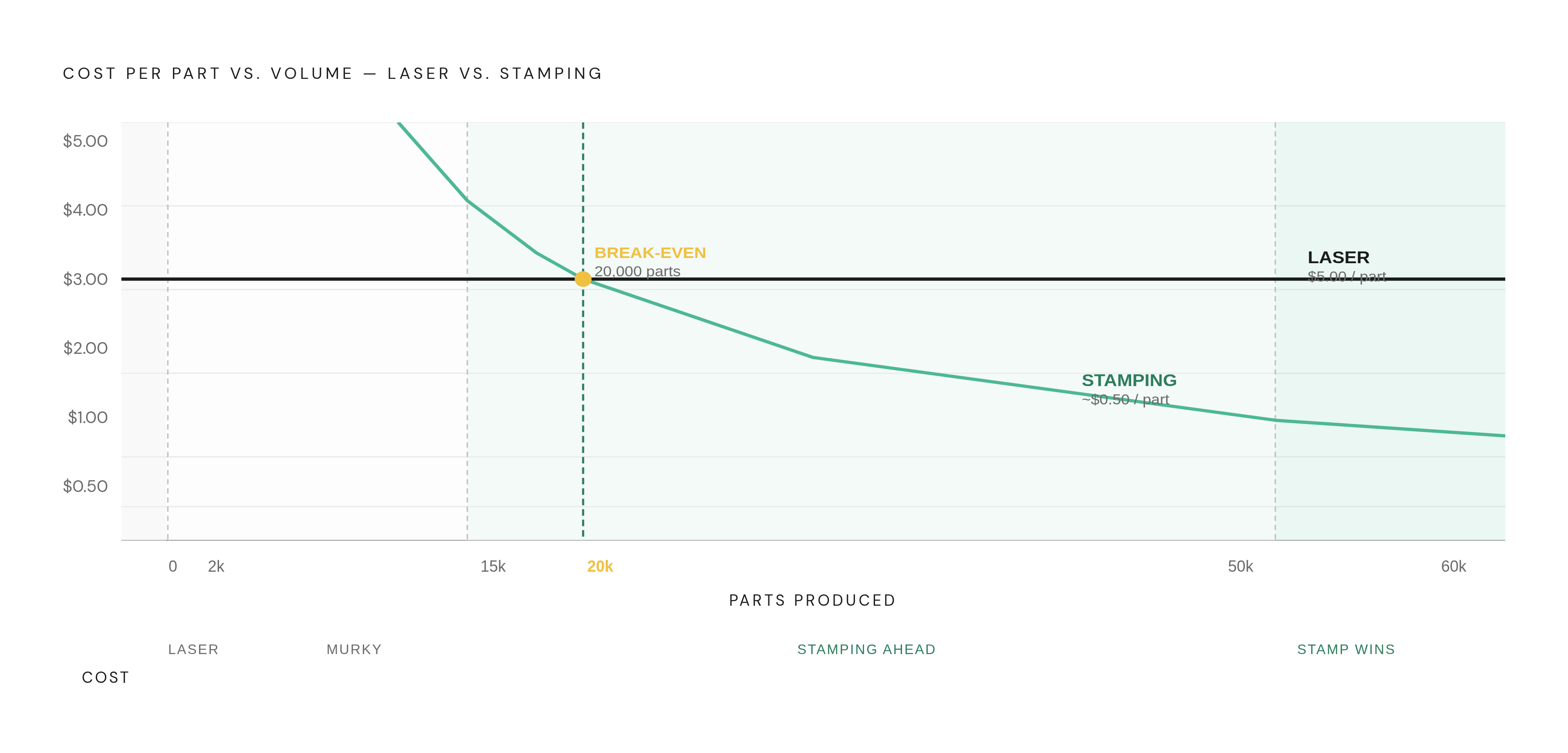
The volume bands where each process wins
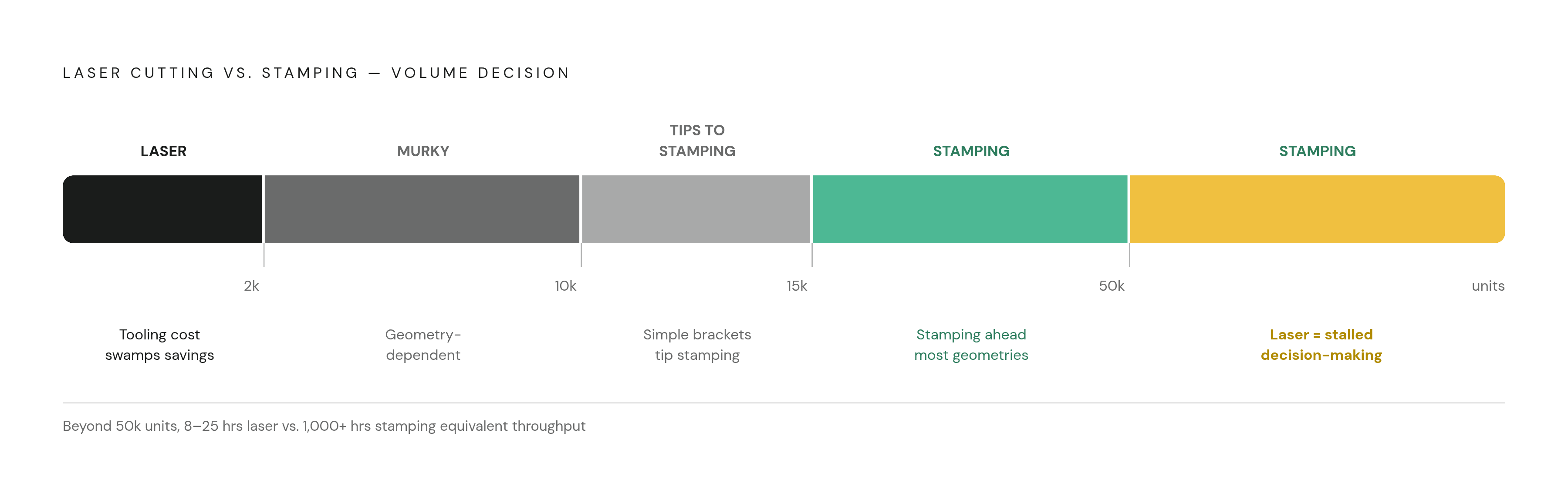
Below roughly 2,000 units, stamping almost never makes sense. Tooling amortization swamps any per-part savings, so laser or press brake forming wins by default, no real contest.
From 2,000 up to somewhere between 10,000 and 20,000 units, the answer gets genuinely murky. Simple geometries might justify a basic die, while complex ones probably don't. Somewhere around 5,000 to 15,000 parts, simpler bracket shapes can tip toward stamping, though where exactly depends on die cost and how wide the gap is between laser and stamped unit prices.
Past 15,000 parts, die cost per unit falls fast, and stamping starts pulling ahead for most bracket geometries. Beyond 50,000 units, stamping wins on cost almost every time, and by then the tooling has usually already paid for itself. Running laser at that volume tends to reflect stalled decision-making more than a deliberate cost choice.
Cycle time is why. Cutting 50,000 parts on a laser eats hundreds to over a thousand hours, plus separate press brake hours for bending on top of that. A progressive die running 60 to 100-plus strokes a minute knocks out the same volume in 8 to 25 hours of press time, and that gap widens as volume climbs, it doesn't narrow.
Annual volume, not total volume, is the number that matters here. A product running three years at 20,000 units a year adds up to 60,000 lifetime parts, and that reshapes the tooling ROI picture compared to judging it off a single production run. Forecast volume also carries risk that firm orders don't: tooling money spent against a demand projection that doesn't hold is real exposure that laser cutting avoids.
Geometric and material constraints that can override the volume math
Volume math only matters once the part actually fits the process. Progressive dies work with strip widths between 5 mm and 500 mm, so large structural brackets that blow past that range can't run on progressive tooling at all without switching to dedicated heavy stamping presses.
Thickness sets another hard ceiling. Progressive dies max out around 6 mm; anything past that needs heavy stamping equipment running at just 7 to 50 parts a minute, which wrecks the economics that made stamping attractive in the first place. Laser, meanwhile, cuts stainless up to 25 mm on a high-powered system, so for thick-section brackets, laser, waterjet, or plasma might be the only sheet-cutting option on the table at all.
Geometry matters as much as thickness does. Stamping builds bending and forming into the die itself, but it's still boxed in by what's achievable from flat strip. Laser stays strictly 2D, and any bend means a separate press brake step, no way around it. Complexity drives cost too: every added feature needs at least one more station, and a complex bracket can demand 20 or more stations, pushing tooling toward the $250,000 end and dragging the break-even volume up with it. Material choice compounds this further, since stainless needs vanadium steel or carbide dies, which cost more to build and maintain than mild-steel dies, so the crossover point climbs again.
Tolerances tell a similar story on the laser side. Standard tolerance sits around ±0.1 mm to ±0.2 mm for dimensions under 100 mm, tightening to about ±0.05 mm under optimized conditions on high-end fiber systems, which covers most bracket work without issue. Stamping holds consistency through the die itself: the geometry gets machined to spec once, and every stroke after that turns out an identical part by design.
Edge quality is where the two processes actually diverge, and it matters most on fatigue-critical brackets. Laser cutting leaves a heat-affected zone of 0.005" to 0.020" from the cut edge, and gas choice shifts this further: nitrogen leaves a clean, oxide-free edge, while oxygen leaves a slightly wider, rougher cut on carbon steel. That distinction matters directly when the bracket gets welded or coated downstream.
Design decisions that lock in cost before a single part is made
Roughly 70% to 80% of total product cost gets locked in at the design phase, before a single part exists. For progressive die stamping specifically, decisions made during die design determine up to 80% of total production cost, and that's not a margin for error most programs can afford to waste. Skip the DFM pass here and the mistake doesn't show up until the die's already cut.
Stamping DFM comes with its own non-negotiables. Bend radius and springback have to get handled at the design stage; there's no fixing them after the die is cut without reworking the tool itself, and wall thickness has to stay uniform throughout, since the part comes from a single strip with no room for variation. Holes need sizing relative to material thickness, or undersized holes in thin stock crack or deform the punch. Grain direction matters too: aligning bend lines perpendicular to the grain cuts cracking risk. Switching to HSLA materials gets thinner, lighter parts at the same strength, though it sometimes calls for TiN tool coatings, which adds a bit of lead time to the die build. Flagging high-friction zones early lets engineers spec carbide inserts at build time, stretching tool life well past a million strokes.
Laser DFM runs on a different set of rules. Hole diameter should equal or exceed material thickness, since smaller holes distort or fail to cut clean, and sharp inside corners need a minimum 0.5 mm internal radius to dodge heat buildup and micro-cracking. Kerf width matters for tight assemblies too: fiber lasers remove 0.006" to 0.012" of material along the cut path, and that has to get built into hole spacing and edge clearance from the start. Slapping tight tolerances across every feature also drives up cost for no real reason, since critical holes deserve ±0.05 mm while everything else usually lives fine with ±0.1 mm to ±0.2 mm.
FEA simulation catches stress problems before a die ever gets built, and that matters most on high-station-count tools where one design flaw compounds across the entire run. Skipping a DFM review before committing to tooling isn't a shortcut worth taking. On a six-figure-plus die, catching a flaw after the build means an expensive fix, or worse, starting the tool over from zero.
Lead time realities: die build versus production speed
Progressive die fabrication requires a meaningful lead time from design sign-off to the first production part, depending on station count and complexity, and that timeline holds no matter the order size, since the die has to exist before a single bracket comes off it.
Laser cutting works differently. Setup is minimal, and a revised DXF file and a sheet of stock are all it takes to start a fresh run. Once the die exists, though, the equation reverses hard: stamping turns out 50,000 parts in 8 to 25 hours of press time, while the equivalent laser run burns hundreds to over a thousand hours of cutting, plus separate bending operations on top.
That has real consequences for timing. Committing to a progressive die while a bracket design is still moving locks in the geometry for months, and a change after tooling starts can add weeks and real cost to the program. Some teams handle this by running laser-cut brackets through development and early production on purpose, staying below break-even volume on purpose, then shifting to stamping once the design freezes and volume justifies the spend. That's a deliberate sequencing call, not a failure to commit to a process.
For programs with a hard ship date, the 8 to 20-week die build window has to get planned against the launch schedule from day one. Late tooling decisions are one of the more common causes of bracket supply delays on new product programs, and nearly all of them are avoidable with earlier planning.
Applying the decision framework to a bracket sourcing situation
Start with volume. Is annual demand solidly above 10,000 to 20,000 units, and likely to hold there across the product's life? If not, laser cutting is the sensible default, full stop.
Next, check geometry. Does the bracket fit inside a 500 mm strip width and stay under 6 mm thick, using only shapes flat strip can actually produce? Blow past those limits, and stamping either needs heavy tooling or isn't viable at all.
Then look at material. Stainless raises die cost and maintenance burden, while mild steel and aluminum stay the cheapest choices for stamping, and laser handles either with barely a change in setup.
Check design stability too. If the geometry is still moving, keep it on laser until the shape locks down, then run the actual break-even: take the laser unit cost, subtract the stamped unit cost, multiply by projected lifetime volume, and weigh that number against tooling cost. If the savings clear the tooling investment inside a reasonable payback window, stamping is the right call. Waiting past that point just burns cash on laser premiums for no reason.
Finally, check the calendar. Does the program have room for 8 to 20 weeks of die build before the first shipment needs to go out? If not, a laser bridge with a planned transition to tooling later is the practical move.
For teams sourcing full mechanical assemblies, brackets alongside machined parts, hardware, and other formed components, juggling stamping suppliers, laser shops, and secondary vendors as separate relationships multiplies coordination work fast. Putting that bill of materials under one manufacturing partner that runs multiple processes in-house cuts down both lead time and sourcing risk, and services like OneWeekParts, a single-source custom parts and assembly supplier that handles CNC, sheet metal, stamping-adjacent forming, and a dozen other processes under one quote and one purchase order, exist precisely for that consolidation. And at the quoting stage, before any tooling money moves, a quote that comes back with process-specific DFM notes attached is worth reading closely; that's usually where the cheapest design fixes get caught, long before any steel gets cut.