Hydroforming vs. Stamping for Complex Curved Sheet Metal Parts
Tooling cost and cycle time determine which process wins for your part geometry.
Choosing between hydroforming and stamping for a complex curved part comes down to three hard tradeoffs: what the tooling costs upfront, how many parts the program actually needs, and what surface finish the customer expects to see. Get those three wrong and the mistake doesn't appear as a rounding error on a spreadsheet. The mistake becomes visible eighteen months later as a re-tool, after the die's already cut and the first production run has already shipped short of spec.
What each process does to the metal
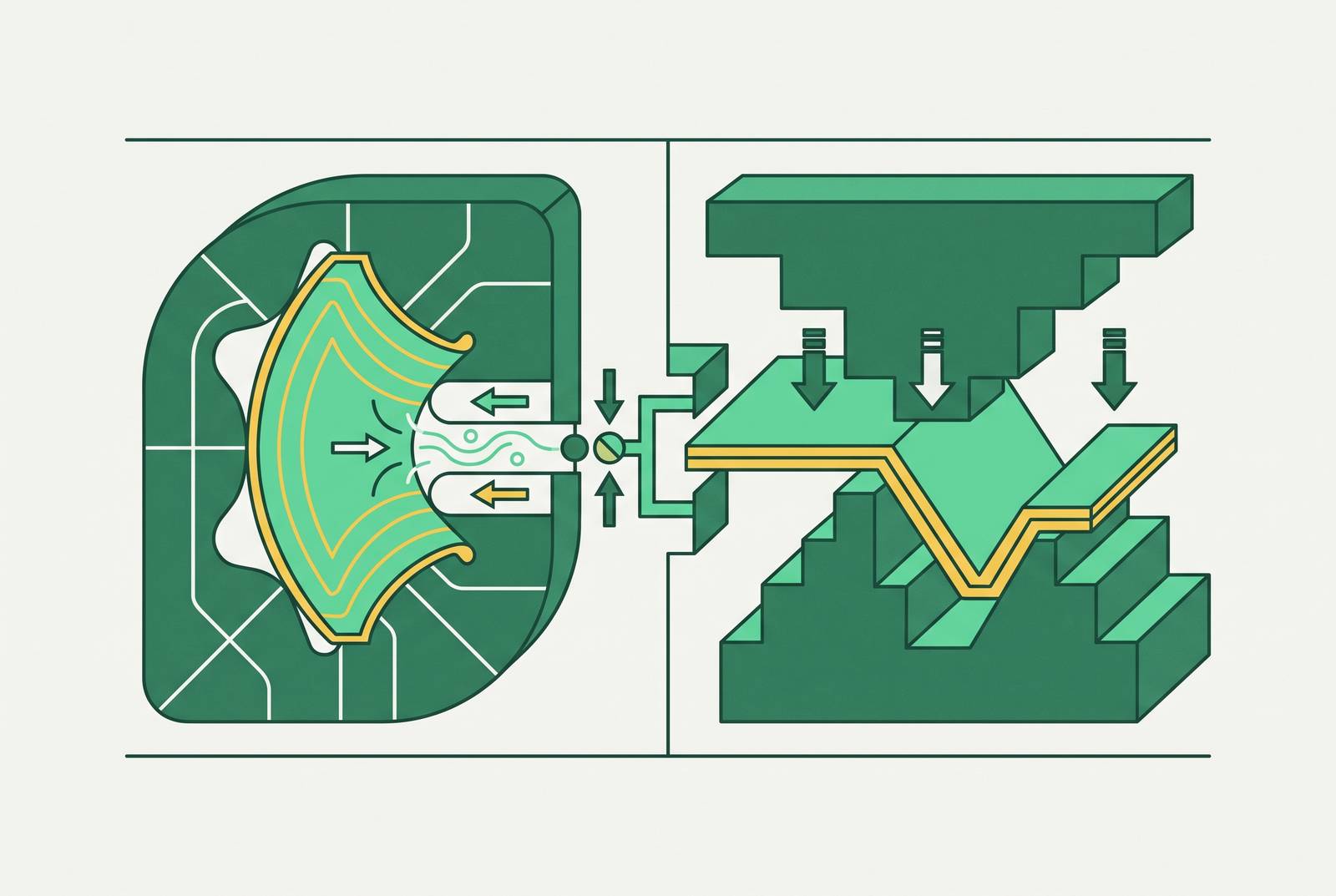
Stamping squeezes metal between two matched rigid dies. Cold-forming, tonnage typically somewhere between 10 and 350 tons, one stroke of the press can punch a hole and set a bend at the same time. It's fast and mechanical in the most literal sense: two hard surfaces close on the blank, and the metal goes wherever the dies push it.
Hydroforming swaps out one of those dies for fluid. Instead of a second rigid tool, high-pressure hydraulic fluid, pushing up to 100 MPa, presses against the back of the blank while a single rigid die shapes the front. That's the whole mechanical difference in one sentence, but the downstream effects run deep.
A solid punch touches the blank at specific contact points and pushes hardest right there, which is exactly where trouble starts. Fluid has no contact points. It pushes on the entire surface evenly, letting metal flow into the die gradually instead of getting yanked into shape in one violent stroke. That's why deep-drawn stamped sections regularly see wall thinning past 25%, especially in corners where the punch bites hardest. Hydroforming avoids most of that thinning for a plain reason: nothing is biting.
What each process can and cannot form geometrically
Tube hydroforming produces a hollow part whose cross-section changes continuously along its length. No stamping setup handles that without cutting the part into pieces and welding them back together. Sheet hydroforming does something similar for flat stock: complex 3D curvature, undercuts, concave sections, all in one hit, where stamping needs multiple operations to land the same shape.
Stamping still wins plenty of jobs, just not this one. Deep drawing handles hollow shapes well, embossing and piercing happen in the same stroke as forming, and for any 2D-to-3D geometry that fits inside stamping's formability window, repeatability is excellent run after run.
The real dividing line is complexity of curvature, not curvature by itself. A gentle dome stamps fine, no argument there. A part with reversing curves, a variable cross-section, and an undercut in the same footprint is a hydroforming problem, full stop, and pretending otherwise just delays the redesign by however many months it takes to admit the first die didn't work.
Tooling cost and lead time: where the upfront economics diverge sharply
Hydroforming needs one rigid die and a blank-holding ring. The hydraulic press itself acts as the second die element, and that single fact is the entire source of the cost gap between the two processes.
The numbers back it up. Hydroforming tooling runs up to 50% less than the equivalent stamping tooling, and once development, tooling, and setup get totaled together, hydroforming can land as low as 70% of what the stamping route costs for the same part. Part of the savings comes straight from material choice: hydroforming punches are commonly made from 4140 steel, softer and cheaper than the hardened tool steel a stamping die needs to survive repeated impact.
A hydroforming tool adapts to a new material thickness because the hydraulic pressure just gets dialed up or down. A stamping die doesn't get that option. Changing the gauge usually means cutting an entirely new die set, and for a design that's still moving during development, that gap in flexibility can swing total program cost by a lot more than the base tooling quote suggests.
Production volume as the dominant switching variable
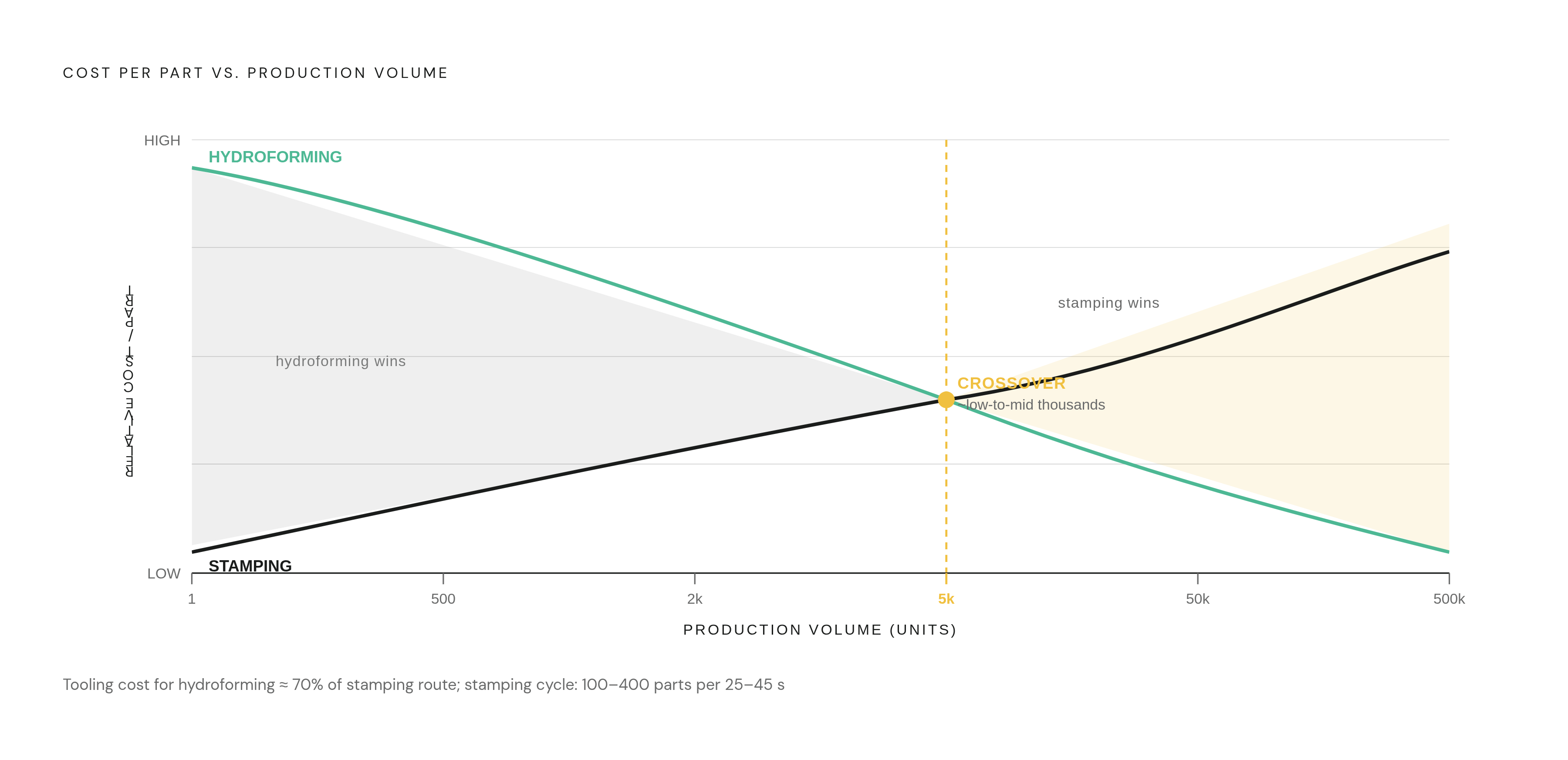
Volume settles this decision more often than any other factor on the list, and engineers who jump straight to surface finish or material grade are answering the wrong question first. Check the unit count before anything else gets discussed.
Hydroforming pencils out for runs as low as 250 parts, and it works fine for a single prototype too. But hydroforming's cycle time runs 25 to 45 seconds per part at best, while stamping cycles through 100 to 400 parts in that same window. At low volume, tooling savings win. At high volume, that throughput gap compounds fast, and stamping wins by a wide margin, not a close one.
This crossover occurs constantly on the shop floor, not just on paper. An automotive bracket that gets hydroformed for development and early builds can turn dramatically cheaper as a stamped part once volume climbs into the hundreds of thousands. Nobody hydroforms brake brackets at automotive scale, and nobody should try. But almost everybody hydroforms them during the prototype phase, because paying for a stamping die before the design freezes is money set on fire.
Surface quality and dimensional accuracy, and their downstream costs
Hydroforming has no metal-to-metal contact between the punch face and the blank's outer surface. Fluid does the pushing, so there's no tool mark to transfer, and the part can hold tolerance to ±0.005 inches or tighter, a direct payoff of pressure that stays even across the whole surface.
Stamping leaves its fingerprints, literally. Punch contact marks come standard with the process, and deep-draw stamping in particular tends to leave scratches that can require additional finishing work.
That finishing pass is the single biggest hidden cost in a stamping quote, and it's the one line item engineers consistently leave out of the first estimate. Aerospace skins and medical enclosures often specify a surface standard a stamped part can't hit without extra labor added downstream, labor that has to get budgeted somewhere, usually after the tooling quote already looked cheap. Hydroforming's slower cycle time looks worse on paper right up until that finishing cost gets subtracted from the stamped part's real total. Then the math flips, sometimes hard.
Material compatibility and the formability illusion engineers must avoid
Both processes work across a similar range of metals: aluminum, brass, copper, carbon steel, stainless, high-strength alloys. Hydroforming has a particular edge with aluminum alloys and high-strength steels, materials that don't give much under a rigid punch but respond well to gradual, evenly distributed pressure. Automotive and aerospace programs reach for hydroforming specifically when the material itself is the constraint, not just the shape.
Watch out for this trap: hydroforming's pressure regime makes a material look more formable than it actually is. A part that comes off a hydroforming prototype run clean, no tears, no wrinkles, no thinning past spec, can fail outright the moment someone tries to stamp that exact geometry at production volume. The metal didn't get more cooperative. It got a favor from fluid pressure that stamping simply can't replicate.
So if the plan runs prototype-by-hydroforming into production-by-stamping, the geometry has to get validated under stamping conditions specifically, not carried over on faith. Assuming hydroforming success predicts stamping success is a guess dressed up as a conclusion, and it's the single most common way programs end up back at the drawing board. The material grade matters less at that stage than the process itself: the shape got designed around a pressure distribution that only one of the two processes can actually deliver.
DFM rules that apply inside each process once you've chosen one
Process selection is stage one of design-for-manufacturing. Stage two checks that the design actually survives inside the constraints of whichever process got picked, and that stage runs on its own rulebook.
Stamping trips up on the same three mistakes, over and over. Tolerances get called out tighter than the part needs across the entire drawing, when a generous default should be standard and anything tighter should get reserved for features that truly demand it. Sharp inside corners on formed features cause the second recurring headache, since a modest minimum bend radius should be the default unless a zero radius is functionally necessary. Hole diameters smaller than the sheet thickness cause the third: burring or outright punch failure. Hole diameter needs to be at or above sheet thickness, sometimes double that for harder alloys, and the rule of thumb holds firm regardless of material.
DFM doesn't stop at the single part either. Blank nesting and grain alignment, done well, save around 15% in material while keeping structural performance intact. Tab-and-slot features built into the design cut assembly time by 30% by removing the need for external fixtures. Shops running a systematic DFM review before production see cost reductions in the 15 to 30% range against designs that skip the review and go straight to tooling.
Prototyping and low-volume strategies when tooling commitment is premature
Sheet hydroforming earns its keep in prototyping precisely because the tooling investment runs so much smaller, sometimes 50 to 90% less than a comparable conventional forming setup. That makes it a real production option even at low volume, before the real tooling is built.
A no-tooling path deserves a look too, before committing to either hydroforming or stamping dies. Laser cutting combined with CNC bending needs no hard tooling at all, so design changes cost little and move fast, and the same setup carries forward reasonably well into mid-volume production for parts that are flat-developed or only need simple bends.
Lead time backs this up. Functional prototypes can ship quickly enough to run thermal or structural validation before anyone commits to production tooling. When a design goes through several rounds of revision, fast turnaround on updated prototypes lets a team iterate on geometry without burning weeks per revision.
Prototype unit costs run higher than production unit costs, plain and simple, because setup, programming, and fixturing haven't amortized across a large run yet. That gap belongs in the total program cost math rather than getting waved off as a rounding error, and managing the transition well keeps it from ballooning into something bigger than it needs to be.
A practical decision framework for choosing between the two processes
Five questions, asked in order, get most engineers to the right answer faster than any spreadsheet comparison will.
Geometry comes first. Can two matched rigid dies capture the shape without driving the wall thinning that conventional stamping is known to produce in deep-drawn sections, and without needing multiple pieces joined afterward? A no here makes hydroforming the lead candidate immediately, no further debate needed.
Volume comes second. Is the run under a few thousand units, or is it confidently headed into the hundreds of thousands? Low-to-medium volume favors hydroforming's lighter tooling investment. High volume favors stamping's per-part economics, and at true scale, stamping isn't close.
Surface finish comes third. Does the application demand a mark-free or near-original surface, the kind aerospace skins, medical housings, and visible automotive panels tend to require? Hydroforming's contact-free forming carries a real cost advantage here once finishing labor gets counted honestly.
Material and formability come fourth. Is the metal a low-formability alloy, an aluminum grade or high-strength steel that fights a rigid punch? Hydroforming's gradual pressure handles those more reliably. If a prototype-to-production transition across processes sits in the plan, the geometry needs enough margin to survive both regimes.
Tooling flexibility comes last. Is wall thickness or material likely to change before the design locks? Hydroforming's single-die setup absorbs that change without new tooling. Stamping generally can't, and pretending it can is how programs end up cutting a second die set six months in.
Running those five questions in order makes the answer obvious well before the first die gets cut. Tooling money spent on the wrong process doesn't come back, and that's the whole reason to ask them early instead of after the quote's already signed.