SLS Nylon vs. CNC Delrin for Sliding Mechanism Components
CNC Delrin outperforms SLS nylon on precision and moisture stability.
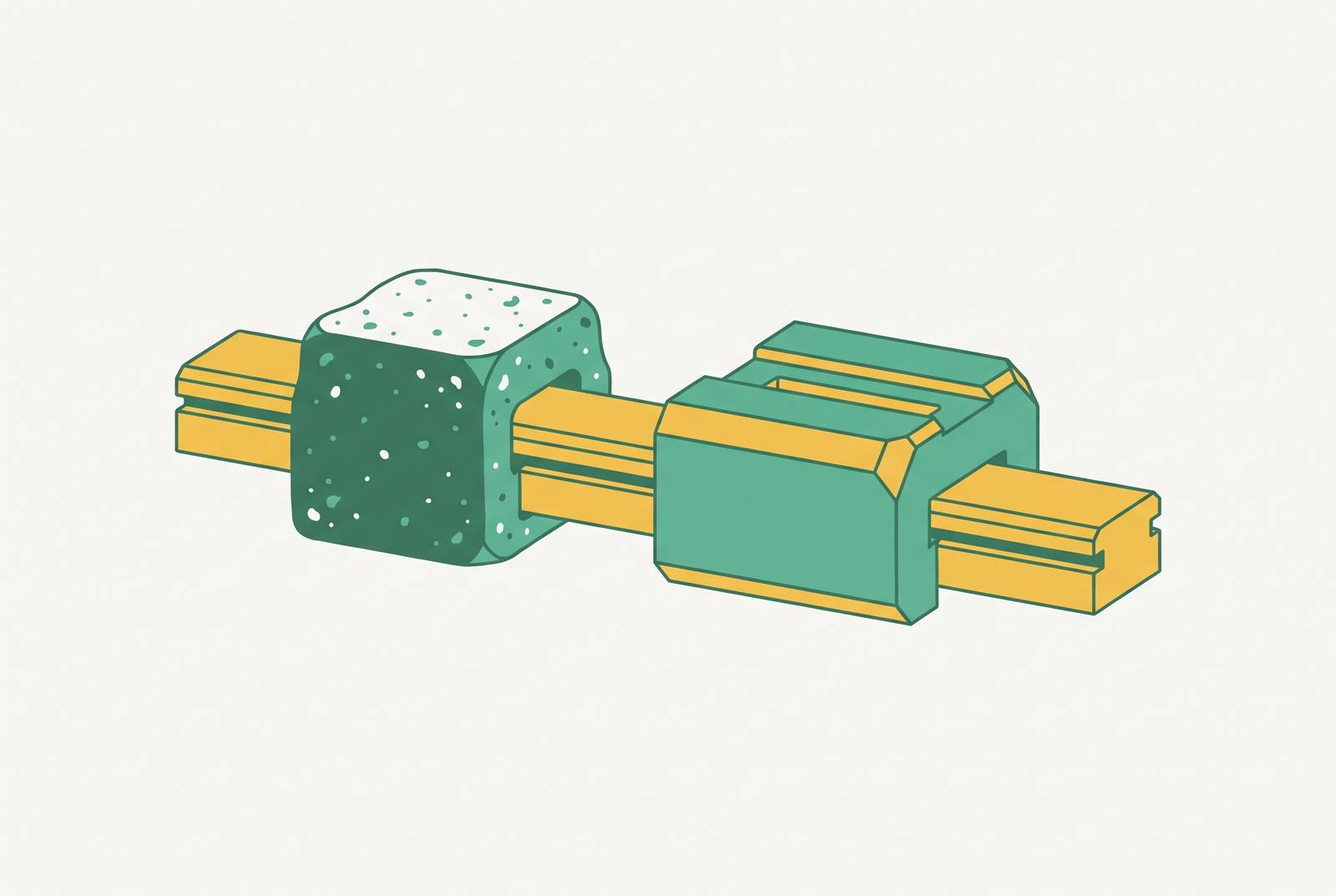
Choosing between SLS nylon and CNC Delrin for a sliding mechanism comes down to one question: can the process actually hold the tolerance, surface finish, and moisture stability a moving interface demands? Most people treat this as a material pick, nylon versus Delrin, like choosing a color swatch. That framing skips the step that actually decides the outcome, and getting the process wrong makes the mechanism bind, seize, or wear out early no matter which plastic you specified. For most sliding parts, CNC Delrin should be the default; SLS earns its way in only when geometry forces the issue, and that's a narrower set of cases than most teams assume going in.
For most sliding mechanism components, CNC Delrin is the right process and material. CNC-machined Delrin holds tolerances of ±0.01 mm and achieves surface finishes below Ra 0.4 μm, while SLS nylon PA12 delivers Ra 8 to 12 μm off the machine and plans realistically for ±0.3 to ±0.5 mm across general geometry. That 20 to 30 times finish gap and order-of-magnitude tolerance gap are not vendor-to-vendor variation; they are built into how sintering works. Moisture absorption compounds the problem further: at 50% relative humidity, nylon can grow a 4-inch part by up to 0.048 inches, enough to convert a slip fit into a press fit and seize the mechanism, while Delrin absorbs roughly 0.2% and stays inside running-fit clearance bands. SLS earns its place when geometry demands internal complexity that CNC toolpaths cannot reach, and in those cases the standard resolution is a hybrid build that prints the housing body in SLS and CNC-machines every bore, rail surface, and sliding face to ±0.001 inch afterward.
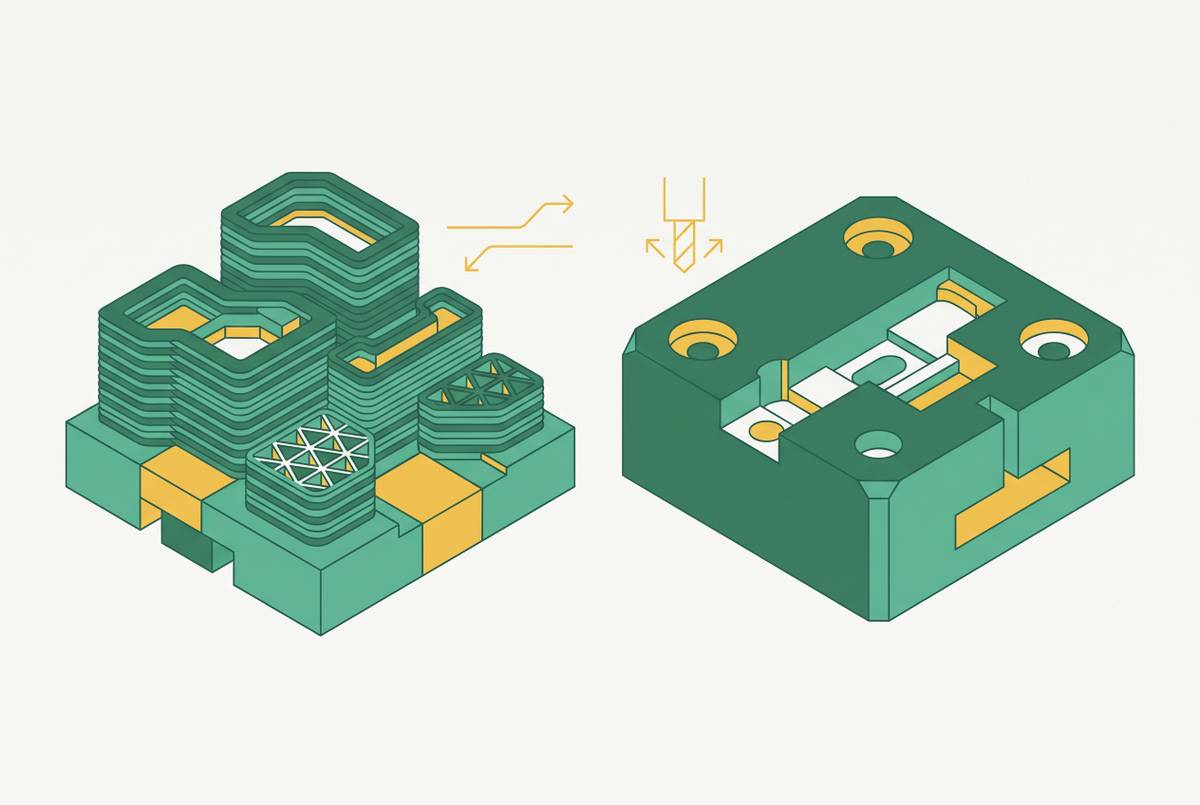
SLS and Delrin come out of fundamentally different processes, and that limits how freely they swap in and out of a design. SLS builds parts by sintering powder layer by layer, fusing cross-sections one at a time until a shape rises out of a bed of loose material, while CNC cuts material away from solid stock until nothing's left but the part. That difference sets a hard ceiling on tolerance, finish, and geometry before either material's mechanical properties even enter the conversation.
A static bracket rarely cares about this distinction, but a sliding interface is a different animal. A bore running against a shaft, a rail carrying a wear plate, a gear meshing under load: these features live or die on surface roughness, dimensional drift, and moisture-driven swelling in a way a mounting flange never has to worry about. Two decisions sit inside this choice: what material fits the mechanism's duty cycle, and which process can put that material where it needs to be, at the precision the mechanism demands. What follows walks through friction, moisture, process limits, design rules, and how to commit to a path before parts get ordered.
What Delrin and SLS nylon actually are, and where each material sits mechanically
Delrin is DuPont's trade name for acetal homopolymer, POM-H, and that word "homopolymer" carries more weight than most spec sheets let on. It's a different grade from acetal copolymer, and the homopolymer version holds meaningfully better mechanical properties and impact resistance. When someone says Delrin, they mean this specific grade, not generic acetal off some catalog page.
On the nylon side, sliding components almost always mean PA12 when SLS is the process, since PA12 beats PA11 on stiffness and cost. It's become the default SLS choice for functional mechanism parts.
Line the numbers up and the picture forms fast. Delrin's tensile strength runs 75 to 85 MPa, while SLS-processed PA12 lands around 45 to 50 MPa, roughly a third to a quarter of what injection-molded PA12 delivers, because sintering never reaches the crystallinity that molten injection molding does. The powder fuses, but not the way plastic does when it's fully melted and packed under pressure.
Delrin's flexural modulus, around 3,000 MPa, tells the stiffness story, and that number is why Delrin holds its shape under load, which matters directly for a bushing or rail guide whose bore has to stay round after the axle's been shoved through it ten thousand times.
The trade-off, stated plainly: Delrin is stiffer and holds its dimensions more predictably, while nylon absorbs impact energy better and forgives overload conditions that would crack a stiffer part. When deflection is the failure mode to worry about, meaning the part needs to hold a precise shape under load, Delrin wins. When fracture is the concern, meaning something's getting whacked or shock-loaded, nylon's toughness buys margin. Pick based on which failure mode actually threatens the part, not habit. When you're not sure which one threatens it, that uncertainty is itself a reason to lean Delrin, since it fails more predictably.
How friction and wear behavior actually differ at a sliding interface
Dry, unlubricated, running against steel: Delrin sits at a coefficient of friction between 0.20 and 0.35, while unfilled nylon runs 0.30 to 0.45. Delrin is the lower-friction material in the conditions most sliding mechanisms actually see day to day.
Step up to Delrin AF, the PTFE-filled grade at 13 to 20% by weight, and that coefficient drops further, down to 0.10 to 0.20 against steel, worth knowing if the design calls for a zero-lubrication mechanism running high cycle counts. That lower dynamic friction isn't just a number on a data sheet: it shows up as roughly 20 to 30% longer service life for acetal over nylon in dry-sliding conditions, and that's a real gap, not a rounding error.
Wear resistance flips the story entirely, though. Nylon's wear factor beats acetal's by a factor of two to five under abrasion testing, and in gritty, dusty, or contaminated environments, where abrasive particles do the damage instead of clean metal-on-plastic contact, nylon holds up noticeably better.
So the split comes down to environment, not preference. Delrin wins on stick-slip smoothness and low-load, dry-sliding guide rails, while nylon wins where grit is in play, or where contact pressure runs high enough that toughness against gouging matters more than raw friction numbers.
Wet conditions complicate things, and not in nylon's favor. Delrin holds its low friction coefficient in humid or submerged environments, while nylon's friction and its dimensions both shift as it takes on water. That's the exact failure mode the next section walks through.
The short version for a designer: light-to-medium load, dry-running, low-stick-slip, pick Delrin without hesitation. Gritty, abrasive, or heavily loaded, let nylon's toughness offset its friction disadvantage.
Moisture absorption and why it is the most common cause of sliding mechanism failure with nylon
Start with the numbers, because they explain nearly every nylon sliding-mechanism failure that ever shows up in the field. Delrin absorbs about 0.2% moisture at saturation, while standard nylon, PA6 or PA66, absorbs 1 to 3%, which drives dimensional swelling up to 1%. PA12 does better, staying under 2% at saturation, but that's still far above what acetal does.
At 50% relative humidity, roughly what a typical shop floor or warehouse sits at, nylon settles around 2% moisture content, which works out to a size increase of 0.5 to 0.6%. Acetal, same conditions, absorbs about 0.2% and grows about 0.2%. Same room, same air, wildly different outcome.
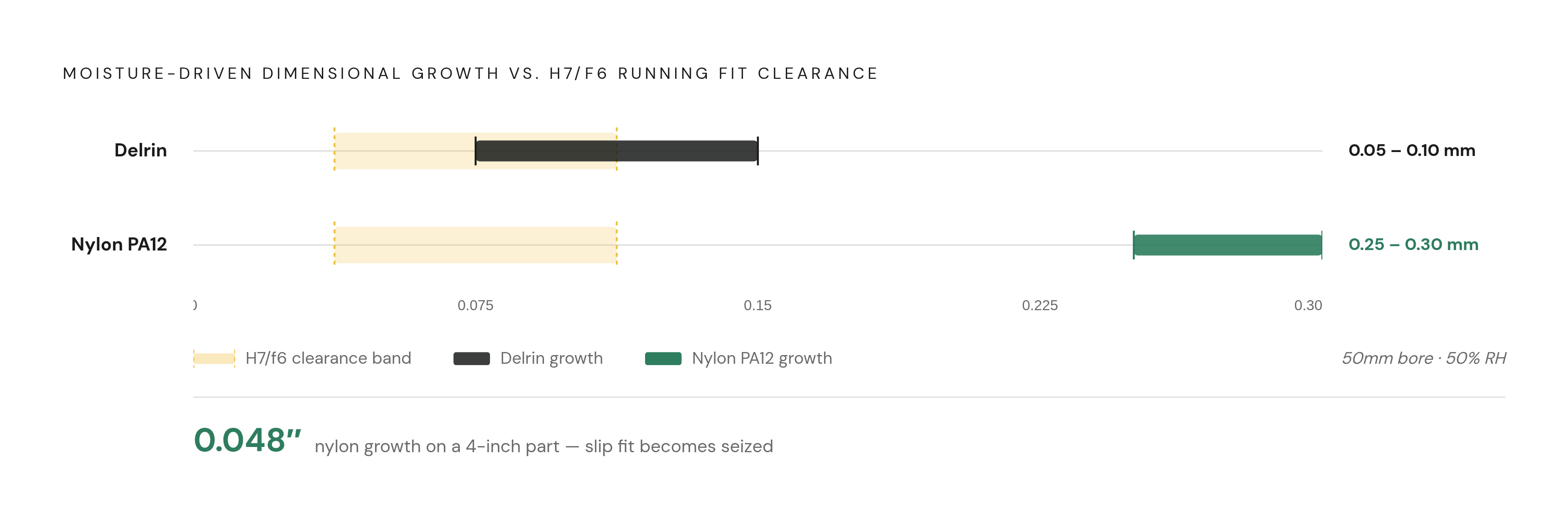
Put a number on an actual part: a 4-inch nylon component can grow up to 0.048 inches from moisture absorption alone, enough to turn a slip fit into a press fit and seize a sliding mechanism solid.
Set that against real fit tolerances. A standard H7/f6 running fit, the kind used constantly on shafts and bushings, has a clearance band of only 0.025 to 0.075 mm, and nylon's moisture growth swallows that gap whole. Run the same 50 mm bore in acetal and the growth comes out to roughly 0.05 to 0.10 mm, which stays inside the fit tolerance. That's the entire moisture argument in one paragraph.
Here's where it bites people who didn't see it coming: nylon parts get machined and measured in a dry, climate-controlled shop, checked good to print, boxed, and shipped, and then they grow after they land in the field. The failure never shows up on the inspection report, since it passed inspection clean. It shows up three weeks later, when the mechanism won't move and nobody can figure out why.
If nylon gets picked for other reasons, PA12 is the right grade, since it absorbs less than PA6 or PA66. Even so, it still doesn't close the gap with Delrin for tight-tolerance running fits in environments where humidity swings.
Temperature deserves a mention too. Delrin runs continuously from -40°C to 120°C, while PA12 SLS stays dimensionally stable near 182°C in thick sections but softens above 100°C in thin ones. Nylon 6/6 actually holds a 20 to 30°F continuous-use edge over acetal. Temperature rarely decides the material choice on its own, but it belongs in the math.
What tolerances and surface finish can CNC Delrin and SLS nylon actually deliver at a sliding interface?
Surface finish is where the two processes reveal themselves as different categories of manufacturing entirely. CNC-machined Delrin hits Ra below 0.4 μm, while SLS nylon straight off the machine sits at Ra 8 to 12 μm. That's a 20 to 30 times gap, and it's the single biggest practical factor separating these processes on a sliding interface.
That roughness isn't a quality-control problem an SLS vendor can fix with a better machine. It's baked into how sintering works: powder particles fuse layer by layer, and the surface carries the texture of that process. The only way around it is post-processing: tumbling, bead blasting, or machining specific faces after the print comes out of the bed.
Tolerances follow the same script. CNC Delrin holds ±0.01 mm reliably, while SLS PA12 plans realistically for ±0.3 to ±0.5 mm across general geometry, tightening to ±0.2 mm on features under 100 mm in the best case. That's the difference between a running fit that works and one that needs a redesign after the first prototype seizes.
Give SLS its due, though. No tooling, no support structures for most geometries, and the ability to print complex internal features, lattices, conformal channels, integrated snap fits, in a single build with no distortion from support removal. That's a genuine advantage, and it's why SLS keeps showing up in mechanism housings even when its sliding-surface numbers look weak on paper.
The answer most engineering teams land on is a hybrid build: print the housing body in SLS to grab the geometric freedom, then CNC-machine the mounting faces, bearing bores, and sliding surfaces to ±0.001 inch. That combination takes what each process does well and skips what it does poorly. Post-machining those specific features can close much of the tolerance gap. This adds cost and lead time, though, and that added cost has to get weighed honestly against just machining the whole part in Delrin from the start, especially on small runs.
Machining economics tip the scale further toward Delrin. It cuts clean, with no burrs and higher allowable cutting speeds, which typically cuts cycle time 15 to 30% compared to machining nylon. On small-batch production, that difference lands directly on the invoice.
DFM rules that differ between SLS nylon and CNC Delrin for mechanism parts
SLS nylon runs its own wall-thickness rules, and they're not intuitive coming from a CNC background. Very thin walls risk print failure or fragility, while overly thick solid sections trap heat during sintering and warp as they cool, so hollowing out heavy masses is standard practice.
Small holes are a known weak point in SLS. Very small diameter holes are unreliable, because unsintered powder gets trapped inside and is hard to clear. Any precision bore meant to serve as a sliding interface should print undersized and get finished with a CNC drill or reamer afterward, since the print alone won't deliver that bore.
Clearance fits need SLS's 0.3 to 0.5 mm process tolerance baked in from the start. A clearance that looks fine on the CAD screen can vanish entirely at the high end of SLS's dimensional scatter if no deliberate offset gets built in ahead of time.
Build orientation matters too. The angle a part sits at in the machine affects surface quality on specific faces, so placing the primary sliding surface at an angle that minimizes stair-stepping cuts down on the post-processing work waiting on the other end.
CNC Delrin plays by a different rulebook entirely. It's one of the easiest engineering plastics to machine: cuts clean, rarely burrs, holds tight tolerances without secondary deburring passes, and that reliability is part of why it's the default for precision sliding features.
Thin walls are the main CNC risk, since they deflect under cutting forces and throw off the tolerance, so fixturing and toolpath sequencing need real attention on slender features. Undercuts and internal channels are the other constraint: tool access governs what geometry is even possible, and features that are trivial in SLS, internal lattices, side-entry channels, need creative fixturing or multiple setups in CNC. When the design lives or dies on that kind of internal complexity, SLS has a real structural edge worth taking seriously.
Threads split the two processes cleanly. Delrin machines clean, reliable threads directly, but SLS nylon threads are generally less reliable than machined ones, so high-cycle or precision thread applications typically warrant a heat-set or ultrasonic insert installed afterward, regardless of which process made the part.
A decision framework for committing to one path before parts are ordered
Pick CNC Delrin when dry-running friction needs to stay low, when the environment swings in humidity and moisture stability actually matters, when the sliding interface needs a fine surface finish with no exceptions, and when the geometry is simple enough for CNC toolpaths to reach every feature without a fight. If nothing on this list clearly points the other way, this is where the part should land. Default to Delrin, and make SLS prove its case.
Pick SLS nylon PA12 when the geometry is complex enough that CNC setup costs stop making sense, when the load favors toughness over low friction, when the application runs lightly loaded and lubricated, or when speed and skipping tooling matter more than nailing precision on the first article.
Use the hybrid build when both conditions show up at once: a housing complex enough that only SLS makes it affordable, paired with sliding bores or guide faces that need CNC-level finish and tolerance. That combination is the most common resolution for production-ready sliding assemblies with real geometric complexity, and it's usually the right default when in doubt.
Before ordering anything, run the mechanism through four questions. What's the nominal clearance on the running fit, and can it tolerate the dimensional growth nylon exhibits if humidity swings? Is the sliding environment dry, lubricated, or abrasive, and does friction or wear resistance decide how this part actually fails? Does the geometry demand internal features, conformal paths, or thin walls that are genuinely easier to produce with an additive process? And what's the production volume, a one-off prototype versus a small production run, since that alone can decide whether CNC or SLS makes financial sense?
When question three points toward SLS but question one demands tight precision, plan for CNC post-machining on the sliding features from the start of the design, not as a fix bolted on after the first prototype seizes. Design for it the same way a designer plans for a drilled bore rather than hoping the print delivers one on its own.
Finally, when a bill of materials has Delrin bushings sitting next to SLS housings and other fabricated parts, getting DFM feedback at the CAD stage, before any tooling gets cut, catches the material-process mismatches that otherwise only surface after the first assembly attempt fails.