Sourcing Machined Welded and Finished Mechanical Assemblies Under One Purchase Order
One partner owning the complete assembly eliminates costly handoffs and quality gaps.
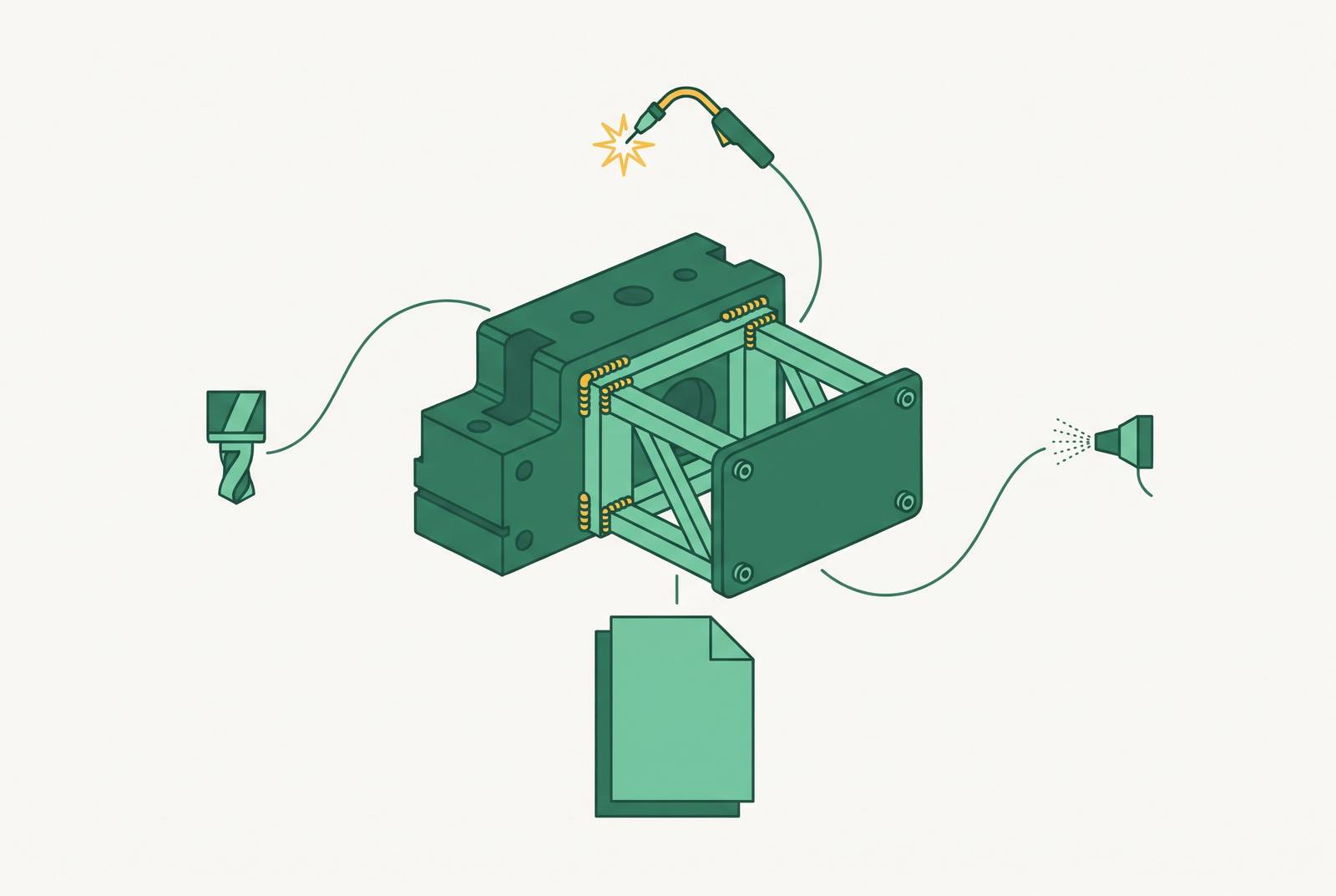
Sourcing machined, welded, and finished mechanical assemblies under one purchase order works when one partner owns the finished result. A multi-process mechanical assembly sourcing platform should cover the processes needed, review the design across those processes, and inspect the assembly as a whole. The benefit is fewer handoff costs and one accountable partner delivering an assembly ready to use.
Why a finished assembly touching four vendors costs more than its purchase orders show
A buyer receives passing dimensional inspection reports from two vendors, yet the part will not assemble. The fab shop points to its inspection results. The assembly house points to its own. Both are telling the truth because each checked its own work, but nobody was responsible for how the parts fit together. The failure sits between the purchase orders.
SP Manufacturing’s analysis identifies the costly gap as parts passing at one shop and failing at the next because nobody with visibility across both sides validated the tolerance stack against the real assembly. That makes fragmentation a problem for mechanical engineering as well as a problem of how many vendors are involved. Individual dimensions can pass without proving that the finished assembly works.
Freight between shops, duplicated inspection, revision mismatches, coordination, and rework add costs that no individual supplier’s quote captures. Component Solutions Group’s consolidation guide illustrates the exposure with a single missing fastener from a minor supplier that can halt a multi-million-dollar assembly line. A small purchase can interrupt a much larger build. Consolidation addresses that imbalance only when responsibility extends through the finished assembly.
How lead times stack rather than overlap across a fragmented chain
SP Manufacturing’s sourcing comparison sets out the schedule arithmetic. A four-week fabrication lead time, a one-week coating window, and a three-week assembly lead time, plus inter-facility freight, mean eight or nine weeks compared with four. Each supplier’s private schedule buffer adds further time. Those operations depend on the preceding work being complete.
A delay can also exceed its original length. A one-week slip at the fab shop can lose the assembly house’s scheduled production window, leaving the program waiting for another opening. The queue becomes a second source of delay. Raw material deliveries, custom springs needing new tooling and specialty wire, and custom metal gasket specifications add dependencies that must be planned before fabrication begins.
Consolidation changes this mechanism when fabrication, finishing, and assembly share a floor and a scheduler. Handoffs become internal queue moves, and a slipped operation can be addressed in hours. Dynamics Group’s supplier consolidation guide illustrates the development case with a validation part printed and tested, then its production version machined within the same week. A loop taking weeks across three vendors can close in days under one roof.
The three consolidation models and which program profile each fits
Single-source fits a mature program with a stable BOM, mid-volume demand, tight tolerances, and traceability requirements. One partner owns fabrication, finishing, machining, and light assembly under one quality system. It also fits teams without the bandwidth to manage another coordination layer. For high-mix, mid-volume programs with multiple finishing requirements, a partner holding finishing and assembly in-house can offer the cleanest scope match.
Lead-vendor fits when one or two specialized processes fall outside any single partner’s capabilities. One partner manages a few subcontracted processes, so the buyer gets more processes covered but still has a coordinator layer. The trade-off should be explicit. Wootz’s supplier consolidation guide describes the coordinating engineering partner variant, in which one partner controls drawings, coordinates factories, and answers for the finished assembly.
Phased multi-source fits high-mix portfolios with divergent tolerance bands, early-stage programs, or buyers preserving competition by category. It reduces a large vendor base to a small qualified set organized by product family. Single-source is a deliberate choice from a qualified field that can be re-competed, while sole-source is a constraint created by tooling, process, or specification lock-in.
Where can a buyer source machining, welding, and finishing under one purchase order?
The practical test is whether a potential partner can quote and own the complete scope. Can it combine CNC machining and turning, sheet metal fabrication, qualified weldments, surface finishing, and hardware insertion on one document? Where needed, does that scope include tube bending, custom springs, gaskets, and wire EDM? A capability list alone is not enough. The buyer should establish which operations happen in-house and which depend on subcontractors, because outsourced steps retain external coordination work.
Does one quality system apply to the whole assembly? The answer should cover one datum scheme, one drawing revision gate, one inspection format, and one corrective-action loop. These controls address the gaps that separate passing reports can conceal. Multiple certifications alone do not resolve those gaps. Each operation needs to work from the same requirements, and assembly-level failures need to go through the same correction process.
When does the partner write the inspection plan? Dynamics Group notes that a consolidated supplier does this during quoting, identifying critical dimensions early and shipping the first-article report with the parts. How quickly can engineering respond during that same stage? Same-day support and instant DFM feedback signal that engineering is integrated with production. Finally, does a remake-or-refund guarantee cover the finished assembly? That commitment puts financial accountability behind the promise, rather than limiting responsibility to an individual operation.
DFM across a multi-process assembly and why it has to happen before the RFQ, not after
Design for manufacturability must begin before the RFQ package is fixed and continue through quoting. Otherwise, the partner may accept responsibility for an assembly whose process conflicts have already been locked into the drawings. These conflicts cross shop boundaries. A choice that reduces CNC cycle time can conflict with weld-distortion control, while neither review alone establishes how finishing affects final fit. The review must cover the full scope before drawings are released and production is scheduled.
For machining, generous internal radii avoid tiny tools, while deep narrow pockets and awkward setups demand slower feeds, longer tools, and extra fixtures. Those choices affect every production run. Holes near sheet metal bend lines can deform during forming, and flanges below minimum thickness can fail during bending and keep the assembly from fitting together.
Weld joints also need equipment access and allowance for shrinkage, typically 1–2% of length. Ignoring that interaction can force post-weld machining that erases the cost benefit of welded construction. Assembly design belongs in the same review. Clinch nuts, folded solutions, and designed-in self-location features can cut the number of parts and the work needed for manual assembly by reducing the burden of many fasteners. A partner reviewing the full scope during quoting can address these conflicts before they become rework or disputes over which shop caused the mismatch.
How to prepare and package an RFQ that a consolidated partner can actually quote
An incomplete RFQ forces a consolidated partner back into serial clarification. Industrial suppliers and custom contract manufacturers can lose up to 40% of engineering capacity evaluating incomplete packages. Missing information also invites safety pricing or no quote at all. The minimum package is a dimensioned CAD file, a 2D drawing with tolerance callouts, a material specification, and a target quantity. STEP is the standard format for quoting, DFM review, and CAM programming because it reduces import problems and supports interoperability.
The PDF must match the STEP revision exactly, and both must stay synchronized through quoting and production. A shop cutting Rev C while the partner works from Rev B recreates the fragmented build’s failure inside the consolidated arrangement. Include a BOM with quantities for every component. Reference images or annotated drawings should make unclear geometry clear, while end-use conditions should explain requirements that affect the choice of material or process.
Tight tolerances applied to every face add costs that are not needed, so the quoting review should flag them before manufacturing begins. Specialty requirements also need clear specifications at submission. Complete information for tube bending, custom springs, gaskets, and wire EDM can reduce quoting time from days to hours and prevent scheduling bottlenecks. Platforms offering an automatic manufacturability review on CAD upload can catch file and DFM problems before manual engineering review, rather than after a quoting cycle has already elapsed.
Managing concentration risk without reintroducing fragmentation
Concentrating volume on one partner creates a legitimate risk. Removing suppliers without distinguishing critical parts from easily replaced ones leaves the program exposed. The approach is to classify parts by failure impact and qualify backups where interruption would stop assembly.
Wootz’s guide recommends classifying each part as A, B, or C before removing any supplier. Tier A parts are those whose delay or failure halts assembly, and they warrant a qualified backup. Parts with multiple capable sources and short lead times can consolidate without one. The operational distinction puts the work of backup qualification into parts that would stop production if they were missing, rather than giving every part in the BOM the same effort.
For critical parts, the practical safeguard is a second qualified supplier with capacity covered in the contract. The primary partner retains production responsibility, while the backup stays dormant unless needed. This does not require splitting routine accountability. Independent qualification of a new overseas supplier may take many months, so backup planning cannot sensibly begin only after a failure. A partner with an established network of pre-qualified factories can shorten that timeline while retaining control of drawings and responsibility for the finished assembly.
What to look for in the finished assembly before it leaves the partner’s dock
First Article Inspection is the quality gate for a new assembly. It formally documents whether the first production part conforms to all engineering documentation requirements, with records maintained for customer and regulatory audits. The partner should complete the report and ship it with the first article. It should not require a follow-up request. This is where the inspection plan developed during quoting becomes evidence that the finished result meets the agreed requirements.
The outgoing standard should extend beyond the first article. Every part should be inspected before it leaves the facility, which requires more than sampling alone. Dimensional conformance, surface finish, hardware installation, and process-specific requirements should be verified against the drawing before packaging. Individual-operation reports are not a substitute for that check. AS9100 Rev D covers configuration management, key characteristics, and counterfeit parts prevention, which are additions for aerospace that also apply directly to high-stakes multi-process assemblies.
Shared production and quality control make failures easier to resolve before shipment. When fabrication and assembly share a floor, an assembly fit problem is also the fab department’s problem, and both work through the same quality system. A correction loop that takes weeks when vendors are separate can close in hours. The buyer receives a finished assembly ready to bolt in.